


Al-Qaeda's wing in Yemen claimed responsibility for Sept. 15 attacks on oil facilities in the Arab state and vowed more strikes against the US and its allies.
"Let the Americans and their allies among the worshippers of the cross and their apostate aides ... know that these operations are only the first spark and that what is coming is more severe and bitter," the group said in a statement posted on the Internet.
The authenticity of the statement posted on a Web site used by Islamist militant groups could not be verified. The statement, believed to be the first posting by Yemen's branch of al-Qaeda, was dated Ramadan 20, which corresponds to Oct. 13.
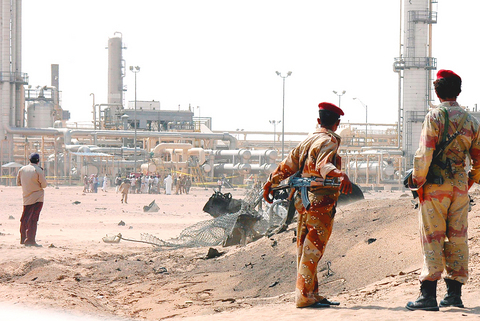
PHOTO: EPA
A US intelligence official, speaking on condition of anonymity, said analysts were working to try to verify the authenticity of the posting.
"We know there is now some sort of organization that calls itself al-Qaeda Yemen," the US official said. "We think they've been trying to get this up on a Web site for a while."
Yemen had said that four bombers were killed on Sept. 15, when security forces blew up four rigged cars before they reached oil and gas facilities in the eastern provinces of Marib and Hadarmout. A worker with Canadian oil company Nexen Inc was also killed.
The attempts came days after al-Qaida's No. 2, Ayman al-Zawahri, issued a videotaped threat of attacks on the Persian Gulf and on facilities he blamed for stealing Muslim oil.
Commenting on the foiled attacks, the group said: "These operations came in response to directives from our emir [leader] Sheikh Osama bin Laden, may God preserve him, in which he ordered Muslims to hit the Western economy and stop the robbing of Muslims' wealth."
The group also said Yemeni President Ali Abdullah Saleh should "repent, return to his faith, apply Islamic law, renounce democracy, the religion of America and abandon [his] alliance with the infidels."
"Let him [Saleh] know that his rule will not last [forever] and that God bestows his victory upon his soldiers ..."
Saleh, who has ruled Yemen since 1990, has cracked down on al-Qaeda after the Sept. 11, 2001, attacks on the US and bombings in the Arab state.
"Let them know that our blood is not cheap. The killing of Sheikh Abu Musab al-Zarqawi will not pass without revenge ... let the tyrant of Yemen know that the killing of Sheikh Ali al-Harthi by US missiles will not pass without revenge," the statement continued.
Harthi, al-Qaeda leader in Yemen, was killed by a missile fired by an unmanned CIA plane in Yemen in 2002 and Iraq's al-Qaeda branch chief Zarqawi was killed in a US air strike in June. It said the operations were named after the two men.
Yemeni officials were not immediately available for comment, but the US intelligence official said the group appears to be trying to emerge as an organization.
"They clearly have tried to be organized. They carried out attacks in September that showed some semblance of an organization. But whether this is from them or bears that mark, I don't know," he said.

Kouri Richins, a Utah mother who published a children’s book about grief after the death of her husband is to serve a life sentence for his murder without the possibility of parole, a judge ruled on Wednesday. Richins was convicted in March of aggravated murder for lacing a cocktail given to her husband, Eric Richins, with five times the lethal dose of fentanyl at their home near Park City in 2022. A jury also found her guilty of four other felonies, including insurance fraud, forgery and attempted murder for trying to poison her husband weeks earlier on Feb. 14, 2022, with a

DELA ROSA CASE: The whereabouts of the senator, who is wanted by the ICC, was unclear, while President Marcos faces a political test over the senate situation Philippine authorities yesterday were seeking confirmation of reports that a top politician wanted by the International Criminal Court (ICC) had fled, a day after gunfire rang out at the Philippine Senate where he had taken refuge fearing his arrest. Senator Ronald “Bato” dela Rosa, the former national police chief and top enforcer of former Philippine president Rodrigo Duterte’s “war on drugs,” has been under Senate protection and is wanted for crimes against humanity, the same charges Duterte is accused of. “Several sources confirmed that the senator, Senator Bato, is no longer in the Senate premises, but we are still getting confirmation,” Presidential
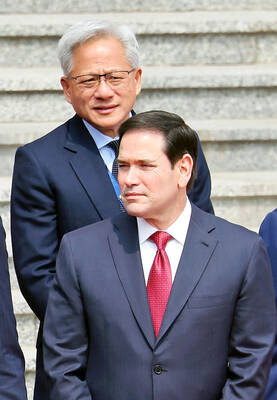
HELP DENIED? The US Department of State said that the Cuban leadership refuses to allow the US to provide aid to Cubans, ‘who are in desperate need of assistance’ US Secretary of State Marco Rubio on Wednesday said that Cuba’s leadership must change, as Washington renewed an offer of US$100 million in aid if the communist nation agrees to cooperate. Cuba has been suffering severe economic tumult led by an energy shortage that plunged 65 percent of the country into darkness on Tuesday. Cuba’s leaders have blamed US sanctions, but Rubio, a Cuban American and critic of the government established by Fidel Castro, said the system was to blame, including corruption by the military. “It’s a broken, nonfunctional economy, and it’s impossible to change it. I wish it were different,” he told

Myanmar yesterday published a parliamentary bill proposing the death sentence for those who detain or violently coerce people into working in online scam centers. Internet fraud factories have flourished in Myanmar, part of Southeast Asia’s scam economy, targeting Internet users worldwide with romance and cryptocurrency investment cons. The multibillion-dollar black market attracts many willing employees, but repatriated foreigners have also reported being trafficked to sites in Myanmar and tortured by scam center operators. The draft legislation would allow capital punishment for “violence, torture, unlawful arrest and detention, or cruel treatment against another person for the purpose of forcing them to commit online scams.” The


 RSS
RSS