


Five foreigners working for US oil company Exxon Mobil have been kidnapped and two Nigerians killed in an attack in the volatile Niger Delta region, an industry source said yesterday.
The five, whose nationalities were unknown, were seized late on Tuesday by armed men who attacked an oil installation at Eket, in the southern state of Akwa Ibom.
The source also said two Nigerian employees of Exxon were killed.
The assailants were not immediately identified and there was no immediate claim of responsibility.
But the Niger Delta has seen a resurgence of violence by separatist militants seeking local control of the country's oil resources.
On Monday, approximately 70 men attacked a site belonging to the Royal Dutch Shell company in neighboring Rivers State. Military and company sources said 14 soldiers were killed and 25 workers were kidnapped.
Nine of the workers were freed on Tuesday, and authorities in the state were negotiating with the kidnappers to obtain the release of the 16 others.
Responsibility for that attack was claimed by the Joint Revolutionary Council (JRC), a group of several separatist movements.
The JRC said in a statement published by several dailies that the attack was aimed at obtaining the immediate release of Alhaji Mujahid Dokubo Asari, the imprisoned leader of the Niger Delta People's Volunteer Force (NDPVF).
In October last year Asari was charged in an Abuja Federal High Court with treason, illegal assembly and conspiracy.
The Niger Delta is home to Nigeria's multi-billion-dollar oil and gas industry, but each of its inhabitants live on less than US$1 a day.
Nigeria, a country of 130 million people, is Africa's leading oil producer and the world's sixth biggest crude exporter with a normal daily output of 2.6 million barrels.
But attacks on oil installations in the Niger Delta region have cut about a quarter of oil production since the start of the year and at least five Nigerian staff employed in the oil sector have been killed by unknown attackers.
Following an increase in the number of abductions in August, the Nigerian army launched a widespread manhunt for the kidnap gangs on the orders of President Olusegun Obasanjo.

Crowds in Bangladesh are flocking to snap photographs with an unlikely social media star — an albino buffalo with flowing blond hair nicknamed “Donald Trump” that is due to be sacrificed within days. Owner Zia Uddin Mridha, 38, said his brother named the 700kg bull over its flowing helmet of hair resembling the signature look of the US president. “My younger brother picked this name because of the buffalo’s extraordinary hair,” he said at his farm in Narayanganj, just outside the capital, Dhaka. Mridha said that a constant stream of curious visitors — social media fans, onlookers and children — have come throughout

It began as a satirical online project. Now millions of young people in India are flocking to it as an outlet for their frustration. A parody political party called the Cockroach Janta Party, with the insect as its symbol, has exploded across India’s social media by turning absurdist humor into protest. Memes and short videos mocking corruption, joblessness and political dysfunction have flooded social media sites, where millions of users are embracing the cockroach — known for its ability to survive harsh conditions — as a tongue-in-cheek symbol of endurance. The online movement’s rise has been unusually rapid. The Cockroach Janta Party (CJP)
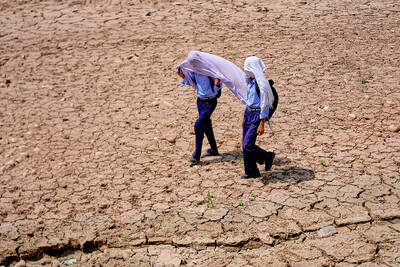
HOTTER: While Indians are accustomed to summer heat, climate change has caused northwestern India to warm faster than other parts of the country, an academic said Roads and markets have emptied during afternoons and some farmers have switched to nighttime work to avoid scorching temperatures as a heat wave grips large parts of India. The India Meteorological Department forecast maximum temperatures for yesterday of about 45°C in the capital, New Delhi, where authorities have opened temporary “cooling zones” to help people cope. The weather department warned that conditions would likely persist across several northern regions in the coming days, with temperatures staying well above seasonal averages. Authorities urged people to stay indoors during the hottest hours and take precautions against heat-related illnesses. India declares a heat wave whenever maximum temperatures

A Hong Kong astronaut is to join a Chinese space mission for the first time as part of a three-person crew launching today, as Beijing edges closer to its goal of landing people on the moon. The Tiangong space station — crewed by teams of three astronauts that are typically rotated every six months — is the crown jewel of China’s space program, boosted by billions in state investment in a bid to catch up with the US and Russia. The Shenzhou-23 mission is to blast off at 11:08pm from the Jiuquan Satellite Launch Center in northwestern China, carrying three astronauts to


 RSS
RSS