


At a news conference after his spirited address to the UN on Wednesday, President Hugo Chavez of Venezuela expressed one regret: not having met that icon of the American left, the linguist Noam Chomsky, before his death.
On Thursday, a call to Chomsky's house found him very much alive. In fact, he was struggling through "10,000 e-mails" he had received since the remarks by Chavez, who urged Americans to read one of Chomsky's books instead of watching Superman and Batman movies, which he said "make people stupid."
At 77, Chomsky has joined the exclusive club of luminaries, like the actor Abe Vigoda and Mark Twain, who were reported dead before their time, only to contradict the reports by continuing to breathe.
"I continue to work and write," he said, speaking from his house in Lexington, Massachusetts.
Chavez, while addressing world leaders at the UN, flagged Hegemony or Survival: America's Quest for Global Dominance, which Chomsky published in 2003, as a must-read. Chomsky said he was glad that Chavez liked his book, but he would not describe himself as flattered.
"We should look at ourselves through our own eyes and not other people's eyes," he said.
Chomsky said he had taken no offense at Chavez's remarks about his being dead. In fact, Chavez's promotion of the book propelled it on Thursday into Amazon's top 10 best sellers.
While retired from teaching full time, Chomsky still goes to his office at the Massachusetts Institute of Technology, occasionally lecturing and also working on a new book.
At the UN, the remarks by Chavez on Wednesday set off a firestorm that nearly overshadowed the visit by Iranian President Mahmoud Ahmadinejad, whose country has been under intense global scrutiny for its nuclear ambitions. From the podium of the General Assembly, the Venezuelan leader said he smelled lingering sulfur, left by US President George W. Bush, who had spoken there the day before and whom he branded "the devil."
Chomsky said that he would not choose to use the same harsh oratory, but added that the Ven-ezuelan leader was simply expressing the views of many in the world. And he said Chavez's anger was understandable.
"The Bush administration backed a coup to overthrow his government," he said. "Suppose Venezuela supported a military coup that overthrew the government of the United States? Would we think it was a joke?"
Proving that he was still up for a lively debate, Chomsky then went on to talk about income inequality in Latin America, the history of the UN, Iraq, Iran, Fidel Castro and, finally, the man who so fervently admires him, Chavez.
"I have been quite interested in his policies," Chomsky said. "Personally, I think many of them are quite constructive."
So would Chomsky oblige Chavez's wish for a meeting, helping ensure that the South American leader will not have that regret to live with anymore?
"I would be happy to meet him," Chomsky said.
Chavez was due to return to Venezuela today.
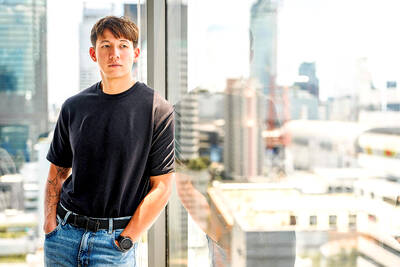
SPEAKING OUT: After Siranudh Scott’s allegations surfaced, celebrities and public figures took to social media to share their own experiences of sexual misconduct and abuse A high-profile alleged sexual abuse case within a wealthy Thai beer brewing family has prompted a wave of painful accounts from survivors of unconnected abuse in the conservative nation. Siranudh Scott, a member of the billionaire Thai family that founded the ubiquitous Singha beer brand, posted an emotional video this month accusing his elder brother Sunit of repeatedly abusing him when he was a teenager. Sunit, who is in his 30s, later denied the allegations in a video posted online, but Singha parent Boonrawd dismissed him from his executive role with the company on Tuesday last week. “I felt I needed to speak

SEEKING ORDER: Rodrigo Paz said that ‘anyone who wants to destroy the nation will have to deal with this president and the full force of the constitution’ Bolivian President Rodrigo Paz on Wednesday said that the nation was at a “breaking point” after nearly a month of protests that have caused shortages of food, fuel and medicine. Paz, who took office six months ago amid the worst economic crisis there in four decades, is battling a groundswell of fury over his policies. The political capital, La Paz, has been besieged by low-income workers and members of the indigenous majority calling for his resignation. “The country needs order and is reaching breaking point,” the 58-year-old said at a public event in La Paz, renewing his appeal for dialogue. On Tuesday, the Bolivian
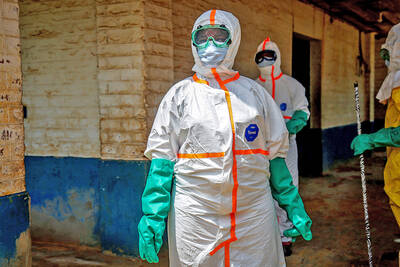
COMMUNITY CONFLICT: Concerns about disease spread from corpses has run up against friends and families’ desire to bury their dead as infection spreads in the area Angry residents of a town at the epicenter of the Ebola outbreak in the Democratic Republic of the Congo (DR Congo) attacked and burned a tent that was part of a health center where people are being treated for the virus, the staff there said Saturday. It was the second such attack in the region in a week. No one was hurt in the attack, according to reports but as patients ran out to escape the fire, 18 people with suspected Ebola infections fled the facility and are unaccounted for, a hospital director said. Angry residents arrived at the clinic in the
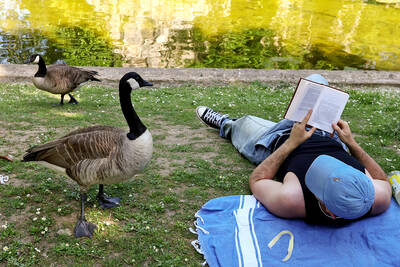
Forecasters in Europe yesterday warned of exceptional heat as record temperatures driven by a “heat dome” push temperatures well above seasonal norms across the continent. The surge follows a record-breaking Monday, with France logging its hottest day in the month of May on record, its weather agency said, and the UK also posting unprecedented highs. A so-called “heat dome” of warm air from northern Africa trapped under a high-pressure system over western Europe is behind the high temperatures not usually seen until high summer. Restrictions on outdoor work were imposed in parts of Italy, beaches in southwest France filled earlier than usual and


 RSS
RSS