


Pope Benedict XVI rode through a cheering crowd that gathered to hear him celebrate open-air Mass yesterday on the outskirts of Munich, part of his six-day homecoming visit to his native Bavaria.
The pope, who says his heart "beats Bavarian," smiled and waved to the crowd from his popemobile on his way to the raised altar platform. People along his route flew yellow-and-white Vatican flags, Bavaria's blue-and-white flag and flags from Germany, Mexico, Croatia, Slovakia and Poland.
In the crowd, Johann Habla, 76, praised Benedict's touch with the young: "He reaches young people ... If they all go to church is another matter, but perhaps something will remain."
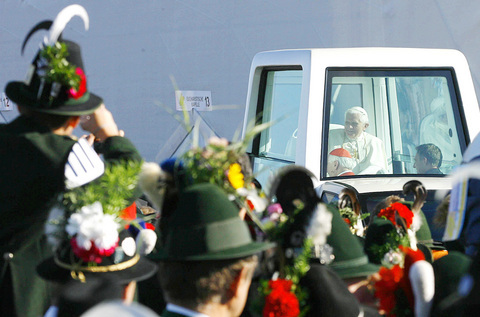
PHOTO: AP
Gerda Holzinger, 57, said that since Benedict became pope last year she was seeing a new side of the conservative former theology professor, who served as the city's archbishop from 1977 to 1982.
"Cardinal Ratzinger was for us a stubborn theologian; now he is opening up, and a different person is coming out," she said.
"I find him good. He sticks to the old values, which have been good for 2,000 years," she said.
Benedict arrived on Saturday on a six-day trip in Munich, which he left in 1982 when he moved to Rome as the Vatican's chief doctrinal watchdog.
The pope is expected to appeal to his homeland -- now largely secular, with a shrinking and more liberal Catholic Church -- to return to its Christian faith.
He also planned to make a brief visit to Marktl am Inn, the small town where he was born, and to Freising, where he was ordained a priest. He taught theology at the University of Regensburg in the region before being named bishop, he still has a house in the city and his brother Georg, a retired priest and choir director, lives there.
Police said that vandals tossed balloons filled with blue paint at the home of Benedict's birth in Marktl am Inn early yesterday. The damage was not serious and Vatican spokesman Frederico Lombardi dismissed the incident as "really secondary."
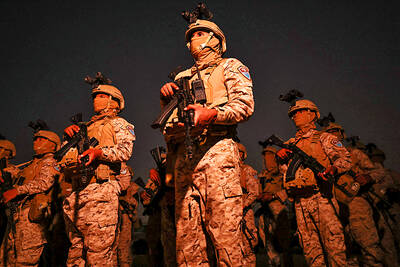
PRECARIOUS RELATIONS: Commentators in Saudi Arabia accuse the UAE of growing too bold, backing forces at odds with Saudi interests in various conflicts A Saudi Arabian media campaign targeting the United Arab Emirates (UAE) has deepened the Gulf’s worst row in years, stoking fears of a damaging fall-out in the financial heart of the Middle East. Fiery accusations of rights abuses and betrayal have circulated for weeks in state-run and social media after a brief conflict in Yemen, where Saudi airstrikes quelled an offensive by UAE-backed separatists. The United Arab Emirates is “investing in chaos and supporting secessionists” from Libya to Yemen and the Horn of Africa, Saudi Arabia’s al-Ekhbariya TV charged in a report this week. Such invective has been unheard of
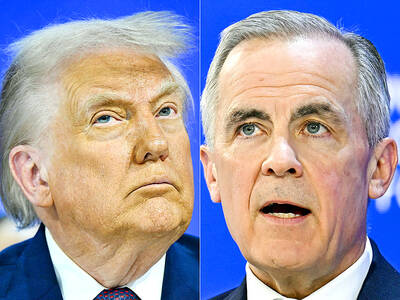
US President Donald Trump on Saturday warned Canada that if it concludes a trade deal with China, he would impose a 100 percent tariff on all goods coming over the border. Relations between the US and its northern neighbor have been rocky since Trump returned to the White House a year ago, with spats over trade and Canadian Prime Minister Mark Carney decrying a “rupture” in the US-led global order. During a visit to Beijing earlier this month, Carney hailed a “new strategic partnership” with China that resulted in a “preliminary, but landmark trade agreement” to reduce tariffs — but
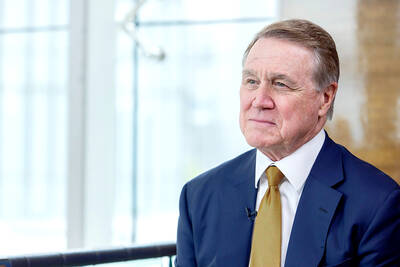
Chinese President Xi Jinping’s (習近平) purge of his most senior general is driven by his effort to both secure “total control” of his military and root out corruption, US Ambassador to China David Perdue said told Bloomberg Television yesterday. The probe into Zhang Youxia (張又俠), Xi’s second-in-command, announced over the weekend, is a “major development,” Perdue said, citing the family connections the vice chair of China’s apex military commission has with Xi. Chinese authorities said Zhang was being investigated for suspected serious discipline and law violations, without disclosing further details. “I take him at his word that there’s a corruption effort under
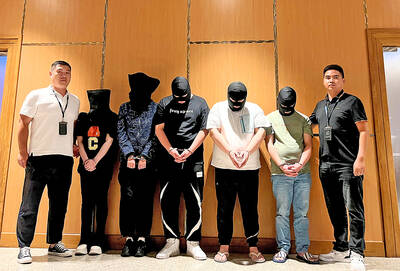
China executed 11 people linked to Myanmar criminal gangs, including “key members” of telecom scam operations, state media reported yesterday, as Beijing toughens its response to the sprawling, transnational industry. Fraud compounds where scammers lure Internet users into fake romantic relationships and cryptocurrency investments have flourished across Southeast Asia, including in Myanmar. Initially largely targeting Chinese speakers, the criminal groups behind the compounds have expanded operations into multiple languages to steal from victims around the world. Those conducting the scams are sometimes willing con artists, and other times trafficked foreign nationals forced to work. In the past few years, Beijing has stepped up cooperation


 RSS
RSS