


Iranian President Mahmoud Ahmadinejad has already stirred international anger by dismissing the Holocaust as a "myth," and now Iran is drumming up further anti-Israel rhetoric by staging the "International Holocaust Cartoon Contest."
The month-long competition opened on Monday in the Palestine Contemporary Art Museum, a recently renovated two-story house in downtown Tehran.
Visitors are greeted by a poster and the word "Holocust" in huge letters, with no explanation offered for the misspelling.
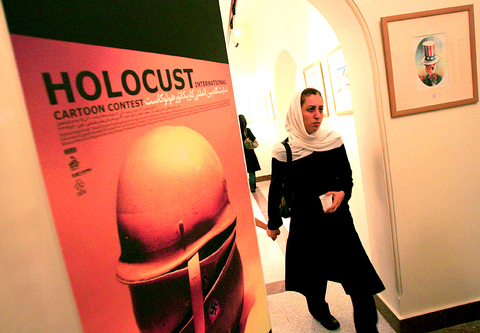
PHOTO: AFP
The poster also depicts a World War II German helmet emblazoned with the Jewish Star of David, equating the Nazis with "the Zionists" -- the term used by Iranian officials to refer to Israel.
On Tuesday the museum was packed with art students clutching invitations from the organizers, and also with ordinary people who had heard about the exhibition from television or read about it in Tehran's newspapers.
The contest was jointly arranged by Iran Cartoon, the country's caricature association, and the nation's largest-circulation newspaper Hamshahri, which is published by Tehran's conservative municipality.
It was staged in response to the publication in the Western press last September of caricatures of the Prophet Mohammed that were first printed in Denmark and then picked up and published throughout the world.
The cartoons enraged Muslims, and the Holocaust cartoon contest was announced in February in a tit-for-tat move, the organizers said.
"We staged this fair to explore the limits of freedom Westerners believe in," said Masoud Shojai, the head of Iran Cartoon.
"They can freely write anything they like about our prophet, but if one raises doubts about the Holocaust he is either fined or sent to prison," he told reporters.
"Though we do not deny that fact that Jews were killed in the war, why should the Palestinians pay for it?" said Shojai, 43, who holds a masters degree in graphics.
"Since the president had spoken about the Holocaust, I was curious to know more and I think some of the cartoons have taught me something," teenage visitor Toktam told reporters.
"The cartoons are diverse, and not all of them are about the Holocaust. I personally think that the matter is exaggerated," civil servant Hossein said.
Pinocchio's long nose, which grows longer when he tells lies, was a common motif among entries to the contest, as were the supposedly large noses of Jews.
The inability of the UN to secure the implementation of most of its resolutions concerning Israel also featured strongly, as did the US Statue of Liberty transformed into a skull.
The Nazi swastika turning into a barbed wire Star of David to strangle Palestinians -- and even depictions of Adolf Hitler ordering current Israeli leaders to launch a holocaust -- were also evident.
Shojai said that the top three cartoons will be announced on Sept. 2, with the winners awarded prizes of US$12,000, US$8,000 and US$5,000 respectively.
He did not elaborate on the source of the prize money, but said that it did not come from any governmental body.
Shojai dodged the question of who the three winners might be, but said a jury of five "famous" Iranian cartoonists had judged more than 1,100 entries submitted from over 60 countries.
Two hundred entries have been put on display for the exhibition.

SPEAKING OUT: After Siranudh Scott’s allegations surfaced, celebrities and public figures took to social media to share their own experiences of sexual misconduct and abuse A high-profile alleged sexual abuse case within a wealthy Thai beer brewing family has prompted a wave of painful accounts from survivors of unconnected abuse in the conservative nation. Siranudh Scott, a member of the billionaire Thai family that founded the ubiquitous Singha beer brand, posted an emotional video this month accusing his elder brother Sunit of repeatedly abusing him when he was a teenager. Sunit, who is in his 30s, later denied the allegations in a video posted online, but Singha parent Boonrawd dismissed him from his executive role with the company on Tuesday last week. “I felt I needed to speak

‘CROSSING THE LINE’: China’s embassy in Seoul criticized US Forces Korea Commander General Xavier Brunson, asking if his ‘hostile’ remarks were authorized by Washington South Korea and the US are in talks over recent public remarks by the commander of US Forces Korea, Seoul’s presidential office said yesterday, after the comments drew sharp criticism from China. In a recent podcast interview, US Forces Korea Commander General Xavier Brunson described South Korea as “the dagger in the heart of Asia” from China’s east coast, prompting the Chinese embassy in Seoul to say that he had “truly crossed the line.” The interview came amid growing speculation that Washington might seek to expand the role of US Forces Korea in countering the growing regional influence of China, a key

SEEKING ORDER: Rodrigo Paz said that ‘anyone who wants to destroy the nation will have to deal with this president and the full force of the constitution’ Bolivian President Rodrigo Paz on Wednesday said that the nation was at a “breaking point” after nearly a month of protests that have caused shortages of food, fuel and medicine. Paz, who took office six months ago amid the worst economic crisis there in four decades, is battling a groundswell of fury over his policies. The political capital, La Paz, has been besieged by low-income workers and members of the indigenous majority calling for his resignation. “The country needs order and is reaching breaking point,” the 58-year-old said at a public event in La Paz, renewing his appeal for dialogue. On Tuesday, the Bolivian
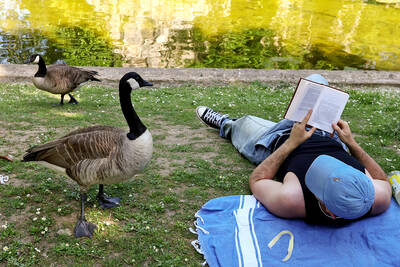
Forecasters in Europe yesterday warned of exceptional heat as record temperatures driven by a “heat dome” push temperatures well above seasonal norms across the continent. The surge follows a record-breaking Monday, with France logging its hottest day in the month of May on record, its weather agency said, and the UK also posting unprecedented highs. A so-called “heat dome” of warm air from northern Africa trapped under a high-pressure system over western Europe is behind the high temperatures not usually seen until high summer. Restrictions on outdoor work were imposed in parts of Italy, beaches in southwest France filled earlier than usual and


 RSS
RSS