


Government forces killed eight separatist Tamil Tiger rebels during a gunbattle in northern Sri Lanka, officials said yesterday, as air strikes and exchanges of artillery continued to threaten the country's fragile ceasefire.
The rebels attacked naval ground forces who were searching late on Tuesday for hidden weapons caches and ammunition in the northern port of Jaffna, a few kilometers from where soldiers and insurgents have clashed in recent days, a Defense Ministry official said.
The official, who spoke on condition of anonymity because he was not authorized to talk to the media, said five rebels were killed in the ensuing gunbattle, but that no soldiers or sailors were slain.
Separately yesterday, an elite police unit killed three rebels who had attacked a police patrol in eastern Sri Lanka, military spokesman Major Upali Rajapakse said.
The air strikes were concentrated in northern territories controlled by the Tigers, whose forces battled soldiers with artillery on the Jaffna Peninsula, the Tamil heartland.
"On and off, [the rebels] are firing artillery into government-controlled areas and we have successfully repulsed those attacks," Rajapakse said.
He said fighter jets bombed insurgent positions in an effort to aid the ground troops on the peninsula, which is controlled by the government but surrounded by rebel territory. He refused to say if there were any casualties.
Schools around Sri Lanka, meanwhile, remained empty after the government ordered them shut, fearing they could be targeted by the Tigers.
In Jaffna, daily 22-hour curfews have kept the city's 500,000 residents locked in their homes. With the city largely cut off, prices were rising fast, there was only about an hour of electricity a day and mobile phones were barely working.
Meanwhile, officials said yesterday that two weeks of fighting in north and eastern Sri Lanka has left more than 125,000 people displaced, prompting an immediate need for relief assistance.
Fighting in Jaffna since last Friday has forced at least 10,000 people to seek shelter in churches and temples, reported the Tamil Rehabilitation Organization (TRO), a front organization of the rebels.
President Mahinda Rajapaksa has ordered food and other supplies to be delivered to the peninsula after the closure of a key highway to the area resulted in mass shortages, according to a spokesman for the Ministry of Nation Building and Development.
Civilians within rebel controlled areas have also left their homes due to air and artillery strikes by security forces, but their numbers are not known in Colombo.
The TRO said that it was assisting 50,000 minority Tamils displaced in rebel controlled areas in the northeastern and eastern parts of the country.
In the government controlled areas of Trincomalee district 65,000 people, mostly from the majority Sinhala community and minority Muslims are in need of aid after being displaced by the conflict over control of a vital sluice gate in the district.
The Norwegian government has provided 150 million rupees (US$150,000) for immediate humanitarian relief operations in Trincomalee.
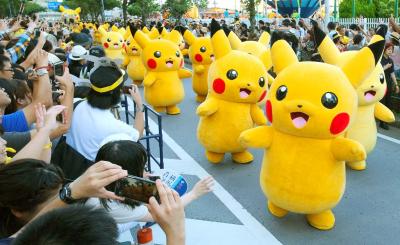
China’s military news agency yesterday warned that Japanese militarism is infiltrating society through series such as Pokemon and Detective Conan, after recent controversies involving events at sensitive sites. In recent days, anime conventions throughout China have reportedly banned participants from dressing as characters from Pokemon or Detective Conan and prohibited sales of related products. China Military Online yesterday posted an article titled “Their schemes — beware the infiltration of Japanese militarism in culture and sports.” The article referenced recent controversies around the popular anime series Pokemon, Detective Conan and My Hero Academia, saying that “the evil influence of Japanese militarism lives on in

DIPLOMATIC THAW: The Canadian prime minister’s China visit and improved Beijing-Ottawa ties raised lawyer Zhang Dongshuo’s hopes for a positive outcome in the retrial China has overturned the death sentence of Canadian Robert Schellenberg, a Canadian official said on Friday, in a possible sign of a diplomatic thaw as Canadian Prime Minister Mark Carney seeks to boost trade ties with Beijing. Schellenberg’s lawyer, Zhang Dongshuo (張東碩), yesterday confirmed China’s Supreme People’s Court struck down the sentence. Schellenberg was detained on drug charges in 2014 before China-Canada ties nosedived following the 2018 arrest in Vancouver of Huawei chief financial officer Meng Wanzhou (孟晚舟). That arrest infuriated Beijing, which detained two Canadians — Michael Spavor and Michael Kovrig — on espionage charges that Ottawa condemned as retaliatory. In January
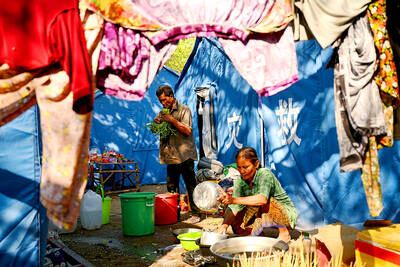
A sign hanging from a rusty ice-green shipping container installed by Thai forces on what they say is the border with Cambodia reads: “Cambodian citizens are strictly prohibited from entering this area.” On opposite sides of the makeshift barricade, fronted by coils of barbed wire, Cambodians lamented their lost homes and livelihoods as Thailand’s military showed off its gains. Thai forces took control of several patches of disputed land along the border during fighting last year, which could amount to several square kilometers in total. Cambodian Kim Ren said her house in Chouk Chey used to stand on what is now the Thai
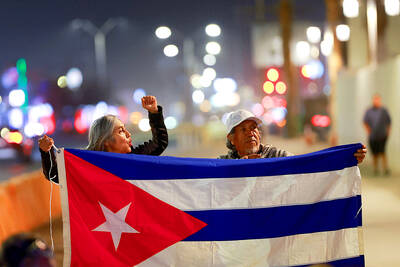
NEW RULES: There would be fewer school days, four-day workweeks, and a reduction in transportation services as the country battles a crisis exacerbated by US pressure The Cuban government on Friday announced emergency measures to address a crippling energy crisis worsened by US sanctions, including the adoption of a four-day work week for state-owned companies and fuel sale restrictions. Cuban Deputy Prime Minister Oscar Perez-Oliva Fraga blamed Washington for the crisis, telling Cuban television the government would “implement a series of decisions, first and foremost to guarantee the vitality of our country and essential services, without giving up on development.” “Fuel will be used to protect essential services for the population and indispensable economic activities,” he said. Among the new measures are the reduction of the working week in


 RSS
RSS