


A 20-year-old Pole who was freed last week from a prison-like labor camp in southern Italy said conditions there were so grim that he feared for his life from the moment he woke.
"The newspapers can never describe what we lived through," said the man, Lukasz, one of 113 Poles freed on Tuesday after Italian authorities raided places they described as forced labor camps in the Puglia region, in the far southeast, where they said they suspected torture, rape, forced prostitution and possibly killing occurred.
Italy is no stranger to the plight of immigrants, and stories of their exploitation by organized criminals are well known. But these camps involved not the usual North African immigrants but rather the citizens of another EU country, subjected to extreme brutality.
According to news briefings by the Italian and Polish police, an international criminal ring lured an estimated 1,000 Polish farm workers to Italy to labor for paltry wages in squalid conditions. The police said the ring began to operate one to two years ago.
For many of the victims, the trap was sprung when they responded to newspaper advertisements promising seasonal jobs picking fruit and vegetables. What they got was nightmarishly different.
After paying an initial travel fee of about US$190, the Poles traveled by bus to Orta Nova, Italy, where they were assigned to some five camps in the region. The Poles were forced to work 12 hours a day, and sometimes 16, picking tomatoes under the eyes of armed guards.
Their promised pay of US$6.25 to US$9 an hour was reduced to US$1.25 to US$3.75 an hour, half the legal rate, according to police reports. But deductions for their bread, water and sleeping quarters left many with nothing and others in debt. Anyone unable to work because of sickness was docked US$25 a day.
"People were not only exploited for their work but also kept in a state of slavery," Italy's national anti-Mafia prosecutor, Piero Grasso, told reporters at a news conference on Tuesday in Bari.
Workers were held in rooms without heat, light or gas and were watched by guards, even at night, the police and prosecutors said.
At his camp near Orta Nova, Lukasz said, he slept on a mattress on the floor among mice and cockroaches amid an unyielding stench.
"We were treated worse than animals," he said.
According to an Italian prosecutor whose office worked with Polish authorities on the investigation, beatings occurred regularly in the camps, and at least one case in which a rape is suspected to have occurred is being investigated.
Investigators are continuing to interview workers. Italian and Polish news media reported that the tools of intimidation the guards used included guns, metal batons, electric Taser sticks and dogs.
A spokesman at the Polish embassy in Rome said that at least four workers appeared to have committed suicide in the camps, but their deaths were being investigated by Italian authorities because of suspicious circumstances.
"The Italian authorities have some doubts, and they want to investigate deeper," Wojciech Unolt, the spokesman, said.
An Italian prosecutor working on the case said that 27 people had been arrested, including Poles, Ukrainians, an Algerian and an Italian. An additional seven are being sought.
Coincidentally, Italy announced on Friday that it would lift restrictions on workers from eight new EU member states in Eastern Europe, including Poland, who are seeking work in Italy.
The other seven countries are the Czech Republic, Estonia, Latvia, Lithuania, Hungary, Slovenia and Slovakia.
Lukasz, who declined to give his last name for fear of reprisal, spoke through an interpreter in a telephone interview hours before he was to leave Bari, a port city, to return to Poland.
Unlike many of the workers, he was at the camp only 10 days. He said he had spent more than US$500 and in the end had received nothing.
He said the supervisor of his work group was armed and often threatened them. And he said he had heard stories of workers disappearing.
When asked why he did not try to escape, he chuckled.
"If I would have had the money, I would have," he said. "But I didn't have any way to get back."
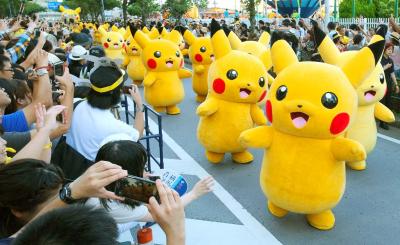
China’s military news agency yesterday warned that Japanese militarism is infiltrating society through series such as Pokemon and Detective Conan, after recent controversies involving events at sensitive sites. In recent days, anime conventions throughout China have reportedly banned participants from dressing as characters from Pokemon or Detective Conan and prohibited sales of related products. China Military Online yesterday posted an article titled “Their schemes — beware the infiltration of Japanese militarism in culture and sports.” The article referenced recent controversies around the popular anime series Pokemon, Detective Conan and My Hero Academia, saying that “the evil influence of Japanese militarism lives on in
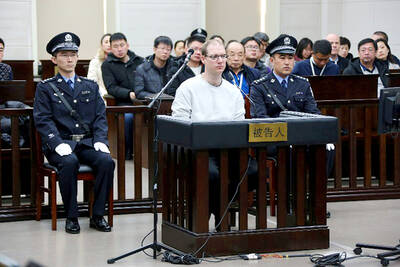
DIPLOMATIC THAW: The Canadian prime minister’s China visit and improved Beijing-Ottawa ties raised lawyer Zhang Dongshuo’s hopes for a positive outcome in the retrial China has overturned the death sentence of Canadian Robert Schellenberg, a Canadian official said on Friday, in a possible sign of a diplomatic thaw as Canadian Prime Minister Mark Carney seeks to boost trade ties with Beijing. Schellenberg’s lawyer, Zhang Dongshuo (張東碩), yesterday confirmed China’s Supreme People’s Court struck down the sentence. Schellenberg was detained on drug charges in 2014 before China-Canada ties nosedived following the 2018 arrest in Vancouver of Huawei chief financial officer Meng Wanzhou (孟晚舟). That arrest infuriated Beijing, which detained two Canadians — Michael Spavor and Michael Kovrig — on espionage charges that Ottawa condemned as retaliatory. In January
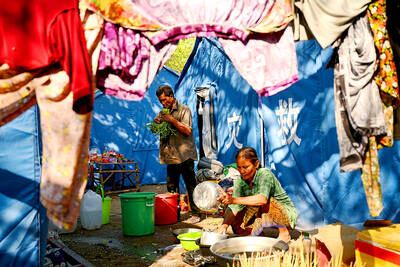
A sign hanging from a rusty ice-green shipping container installed by Thai forces on what they say is the border with Cambodia reads: “Cambodian citizens are strictly prohibited from entering this area.” On opposite sides of the makeshift barricade, fronted by coils of barbed wire, Cambodians lamented their lost homes and livelihoods as Thailand’s military showed off its gains. Thai forces took control of several patches of disputed land along the border during fighting last year, which could amount to several square kilometers in total. Cambodian Kim Ren said her house in Chouk Chey used to stand on what is now the Thai
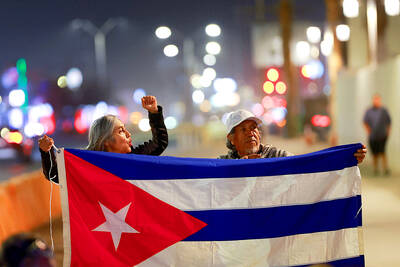
NEW RULES: There would be fewer school days, four-day workweeks, and a reduction in transportation services as the country battles a crisis exacerbated by US pressure The Cuban government on Friday announced emergency measures to address a crippling energy crisis worsened by US sanctions, including the adoption of a four-day work week for state-owned companies and fuel sale restrictions. Cuban Deputy Prime Minister Oscar Perez-Oliva Fraga blamed Washington for the crisis, telling Cuban television the government would “implement a series of decisions, first and foremost to guarantee the vitality of our country and essential services, without giving up on development.” “Fuel will be used to protect essential services for the population and indispensable economic activities,” he said. Among the new measures are the reduction of the working week in


 RSS
RSS