


Pope Benedict XVI praised marriage between a man and a woman as part of "a loving plan of God," as he defended the traditional family yesterday at a Mass attended by hundreds of thousands of people.
The service in a Valencia park was the highlight of a two-day trip challenging a Socialist government that has angered the Vatican by introducing such liberal reforms as gay marriage and fast track divorce.
The German-born pope, wearing green vestments and a gold miter, stressed that the family is "founded on indissoluble marriage between a man and a woman."
Benedict said every family has its origin, and that "at the origin of every human being there is not something haphazard or chance, but a loving plan of God."
A papal altar was erected on a bridge over what was once the city's river. Many of the pilgrims wore hats, T-shirts and backpacks with the Vatican's yellow and white colors as they set off at dawn to find places next to a museum and an aquarium.
Benedict's 26-hour trip was intended to address a worldwide church meeting on the family and support traditional values in Spain.
Spanish Prime Minister Jose Luis Rodriguez Zapatero had a 15-minute meeting with Benedict on Saturday afternoon, but aides said he would not be attending yesterday's Mass.
In a series of addresses after arriving from Rome, Benedict called the family "a unique institution in God's plan" and stressed the church considers a marriage proper only if between a man and a woman.
"I wish to set forth the central role, for the church and for society, proper to the family based on marriage," the pope said.
Zapatero was greeted by boos from neighborhood residents when he arrived for his meeting with Benedict.
The Vatican has warned that the family is under threat from such liberal reforms as gay marriage, which was recently legalized in Spain, as well as in the Netherlands, Belgium and Canada.
Many Spaniards have drifted away from the church in the three decades since the fall of the General Francisco Franco dictatorship, under which it enjoyed special privileges.
Spain has passed from being a bastion of Roman Catholicism to a predominantly lay society in less than a generation. Statistics show that while 80 percent of Spaniards still call themselves Catholics, only 42 percent believe in God and 20 percent go to Mass.
But tens of thousands turned out to greet Benedict when he arrived in Spain's third-largest city, and organizers expected as many as 1.5 million people to attend yesterday's papal Mass.
Benedict, visiting Valencia's 17th century cathedral, told his bishops he was aware of the secular drift in a country with "deep Christian roots" and urged them to "keep alive and vigorous this spirit, which has accompanied the life of Spaniards throughout their history."
Benedict addressed gay marriage before even getting off the plane.
"According to human nature, it is man and woman who are made for each other and to give humanity a future," he told reporters. "The church can't accept certain things. At the same time, it wants to help people and respect them."
Zapatero's government has also made it easier for Spaniards to divorce and halted a plan by a previous, conservative government to make religion classes mandatory in public schools.
Thousands of police helped provide security, which included sharpshooters atop buildings and AWACS planes from NATO patrolling the skies.
The pontiff also prayed for 42 people killed in a Valencia subway derailment last Monday.

China’s military news agency yesterday warned that Japanese militarism is infiltrating society through series such as Pokemon and Detective Conan, after recent controversies involving events at sensitive sites. In recent days, anime conventions throughout China have reportedly banned participants from dressing as characters from Pokemon or Detective Conan and prohibited sales of related products. China Military Online yesterday posted an article titled “Their schemes — beware the infiltration of Japanese militarism in culture and sports.” The article referenced recent controversies around the popular anime series Pokemon, Detective Conan and My Hero Academia, saying that “the evil influence of Japanese militarism lives on in

DIPLOMATIC THAW: The Canadian prime minister’s China visit and improved Beijing-Ottawa ties raised lawyer Zhang Dongshuo’s hopes for a positive outcome in the retrial China has overturned the death sentence of Canadian Robert Schellenberg, a Canadian official said on Friday, in a possible sign of a diplomatic thaw as Canadian Prime Minister Mark Carney seeks to boost trade ties with Beijing. Schellenberg’s lawyer, Zhang Dongshuo (張東碩), yesterday confirmed China’s Supreme People’s Court struck down the sentence. Schellenberg was detained on drug charges in 2014 before China-Canada ties nosedived following the 2018 arrest in Vancouver of Huawei chief financial officer Meng Wanzhou (孟晚舟). That arrest infuriated Beijing, which detained two Canadians — Michael Spavor and Michael Kovrig — on espionage charges that Ottawa condemned as retaliatory. In January

A sign hanging from a rusty ice-green shipping container installed by Thai forces on what they say is the border with Cambodia reads: “Cambodian citizens are strictly prohibited from entering this area.” On opposite sides of the makeshift barricade, fronted by coils of barbed wire, Cambodians lamented their lost homes and livelihoods as Thailand’s military showed off its gains. Thai forces took control of several patches of disputed land along the border during fighting last year, which could amount to several square kilometers in total. Cambodian Kim Ren said her house in Chouk Chey used to stand on what is now the Thai
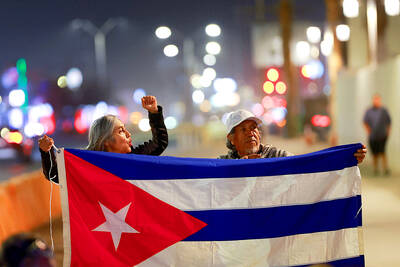
NEW RULES: There would be fewer school days, four-day workweeks, and a reduction in transportation services as the country battles a crisis exacerbated by US pressure The Cuban government on Friday announced emergency measures to address a crippling energy crisis worsened by US sanctions, including the adoption of a four-day work week for state-owned companies and fuel sale restrictions. Cuban Deputy Prime Minister Oscar Perez-Oliva Fraga blamed Washington for the crisis, telling Cuban television the government would “implement a series of decisions, first and foremost to guarantee the vitality of our country and essential services, without giving up on development.” “Fuel will be used to protect essential services for the population and indispensable economic activities,” he said. Among the new measures are the reduction of the working week in


 RSS
RSS