


Indonesia moved a step closer to becoming the world's hardest-hit bird flu country yesterday after tests confirmed a 14-year-old boy died from the disease, bringing its human toll to 39.
The boy from Jakarta died last week, and tests sent to a WHO-approved laboratory in Hong Kong came back positive, senior Health Ministry official Hariadi Wibisono said.
The teen had a history of contact with dead birds.
The results were announced a day before some of the world's top bird flu experts were set to meet with Indonesian officials to try to map out a plan to get a handle on the H5N1 virus.
The meeting -- which brings together scientists from WHO, the UN Food and Animal Organization and the US Centers for Disease Control and Prevention, among others -- comes a month after Indonesia grappled with the world's largest reported family cluster.
Six of seven family members from a remote farming village on Sumatra island died after testing positive for the bird flu virus. An eighth relative was buried before samples could be taken, but the WHO considers her part of the cluster.
Scientists have not been able to link the infected relatives to contact with sick birds and believe limited human-to-human transmission may have occurred. However, the virus has not mutated and no one outside the family has fallen ill.
Experts fear the current bird flu virus will mutate into a form that is highly contagious among humans, potentially sparking a pandemic.
So far, most human cases have been traced to contact with infected birds. At least 129 people have died worldwide since the virus began ravaging Asian poultry in late 2003.
Indonesia, which logged an average of one death every two-and-a-half days last month, is on the fast track to becoming the world's hardest hit, trailing only Vietnam where 42 people have died.
The Asian Development Bank's latest outlook report released in April said Indonesia's budget for this year allocates just US$14 million to combat the disease, despite the government's own estimate that at least 30 times that amount is needed.
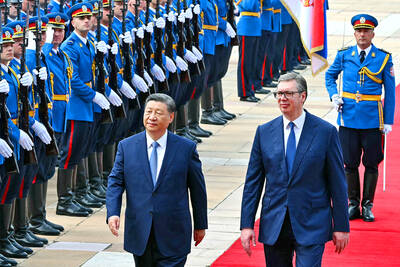
MONEY MATTERS: Xi was to highlight projects such as a new high-speed railway between Belgrade and Budapest, as Serbia is entirely open to Chinese trade and investment Serbian President Aleksandar Vucic yesterday said that “Taiwan is China” as he made a speech welcoming Chinese President Xi Jinping (習近平) to Belgrade, state broadcaster Radio Television of Serbia (RTS) said. “We have a clear and simple position regarding Chinese territorial integrity,” he told a crowd outside the government offices while Xi applauded him. “Yes, Taiwan is China.” Xi landed in Belgrade on Tuesday night on the second leg of his European tour, and was greeted by Vucic and most government ministers. Xi had just completed a two-day trip to France, where he held talks with French President Emmanuel Macron as the

With the midday sun blazing, an experimental orange and white F-16 fighter jet launched with a familiar roar that is a hallmark of US airpower, but the aerial combat that followed was unlike any other: This F-16 was controlled by artificial intelligence (AI), not a human pilot, and riding in the front seat was US Secretary of the Air Force Frank Kendall. AI marks one of the biggest advances in military aviation since the introduction of stealth in the early 1990s, and the US Air Force has aggressively leaned in. Even though the technology is not fully developed, the service is planning
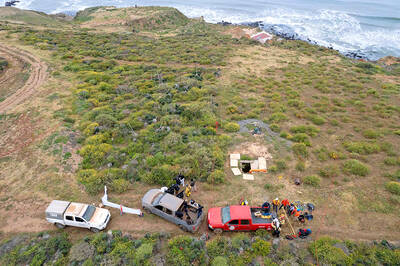
INTERNATIONAL PROBE: Australian and US authorities were helping coordinate the investigation of the case, which follows the 2015 murder of Australian surfers in Mexico Three bodies were found in Mexico’s Baja California state, the FBI said on Friday, days after two Australians and an American went missing during a surfing trip in an area hit by cartel violence. Authorities used a pulley system to hoist what appeared to be lifeless bodies covered in mud from a shaft on a cliff high above the Pacific. “We confirm there were three individuals found deceased in Santo Tomas, Baja California,” a statement from the FBI’s office in San Diego, California, said without providing the identities of the victims. Australian brothers Jake and Callum Robinson and their American friend Jack Carter
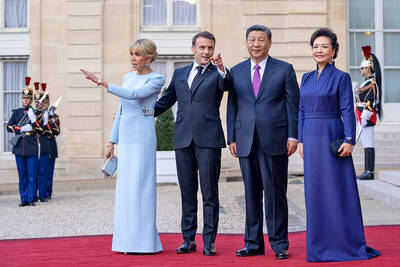
CUSTOMS DUTIES: France’s cognac industry was closely watching the talks, fearing that an anti-dumping investigation opened by China is retaliation for trade tensions French President Emmanuel Macron yesterday hosted Chinese President Xi Jinping (習近平) at one of his beloved childhood haunts in the Pyrenees, seeking to press a message to Beijing not to support Russia’s war against Ukraine and to accept fairer trade. The first day of Xi’s state visit to France, his first to Europe since 2019, saw respectful, but sometimes robust exchanges between the two men during a succession of talks on Monday. Macron, joined initially by EU Commission President Ursula von der Leyen, urged Xi not to allow the export of any technology that could be used by Russia in its invasion


 RSS
RSS