


International Middle East mediating powers agreed on Saturday on an aid scheme for Palestinians that bypasses the Hamas-led government, which has defied demands to recognize Israel.
The US, EU, UN and Russia said in a statement they endorsed an EU proposal for a temporary mechanism that includes aid for the health sector and utilities.
Known as the Quartet, the group said it hoped international donors including Israel would also contribute.
The scheme covers essential supplies to the health sector and payments to health-care service providers, utilities including fuel, and cash allowances to cover the basic needs of the poorest sections of the population.
The agreement was expected after the EU agreed to the plan on Friday and US Secretary of State Condoleezza Rice said the US was close to endorsing it.
The 25-member EU and the US suspended aid to the Palestinian Authority when the Islamic militant group Hamas, which won control of the Palestinian government in a January parliamentary election, refused to recognize Israel and failed to renounce violence.
But they acknowledged last month an emergency plan was needed to prevent the Palestinian territories from sliding into chaos.
Still, the Quartet urged Palestinian leaders to accept previous agreements and obligations, including the Middle East peace "roadmap," commit to nonviolence and recognize Israel.
"The Palestinian Authority government must fulfill its responsibilities with respect to basic human needs, including health services, as well as for proper fiscal management and provision of services," the group also said.
After three months the Quartet said it would decide whether the aid plan was still needed.
Earlier on Saturday, Palestinian President Mahmoud Abbas said the EU's plan was a good step but inadequate.
Abbas said it was not clear how the plan would be carried out and that it would "lead to abolition of the role of the government and the PA [Palestinian Authority]," according to the Egyptian news agency MENA.
In Gaza City, an official with the Hamas government who returned from a seven-nation trip with US$20 million in his luggage said he would continue to funnel money across the Egyptian border despite European objections.
The European monitoring mission has complained that the entry of money through the Rafah crossing violates a US-brokered agreement giving Palestinians control over the entry point after Israel's withdrawal from the Gaza Strip last year.
But the Hamas government is nearly bankrupt from international financial sanctions over its refusal to renounce violence against Israel, and Foreign Minister Mahmoud Zahar promised to ignore European pressure and carry cash across the border into Gaza.
"We are going to continue to bring money in through Rafah crossing. This is a legal process. We are not going to allow anyone to prevent us," Zahar told reporters on Saturday.
Zahar is one of two Cabinet ministers to cart in suitcases stuffed with cash in the past week to help the Palestinian administration, which has seen numerous protests and violent outbursts from its unpaid employees.
Speaking in English, Zahar also said a recent Iranian pledge of US$50 million in cash, 300 cars and two aircraft would be delivered soon to the Palestinian government.
He praised a plan endorsed on Friday by EU leaders to channel humanitarian aid to the impoverished Palestinian areas through non-governmental groups, but he condemned their freeze on funding for the Hamas-led administration.

Crowds in Bangladesh are flocking to snap photographs with an unlikely social media star — an albino buffalo with flowing blond hair nicknamed “Donald Trump” that is due to be sacrificed within days. Owner Zia Uddin Mridha, 38, said his brother named the 700kg bull over its flowing helmet of hair resembling the signature look of the US president. “My younger brother picked this name because of the buffalo’s extraordinary hair,” he said at his farm in Narayanganj, just outside the capital, Dhaka. Mridha said that a constant stream of curious visitors — social media fans, onlookers and children — have come throughout
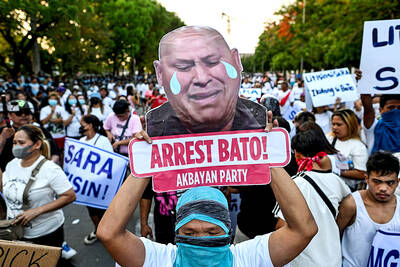
The Philippines said it has asked the country’s Supreme Court to allow it to arrest former Philippine president Rodrigo Duterte’s chief drug war enforcer to stand trial in an international tribunal. The International Criminal Court (ICC) last week unsealed an arrest warrant against Philippine Senator Ronald dela Rosa, accusing him along with Duterte and other “coperpetrators” of the “crime against humanity of murder.” Dela Rosa briefly sought refuge in the Philippine Senate last week while asking the Philippine Supreme Court to stop an ongoing attempt by government agents to arrest him. “By his own conduct, he has placed himself outside the protection of

It began as a satirical online project. Now millions of young people in India are flocking to it as an outlet for their frustration. A parody political party called the Cockroach Janta Party, with the insect as its symbol, has exploded across India’s social media by turning absurdist humor into protest. Memes and short videos mocking corruption, joblessness and political dysfunction have flooded social media sites, where millions of users are embracing the cockroach — known for its ability to survive harsh conditions — as a tongue-in-cheek symbol of endurance. The online movement’s rise has been unusually rapid. The Cockroach Janta Party (CJP)

The researchers in Ireland looked at their computer screen, marveling at a medieval book tracked down in a Roman library. They flipped through its digitized pages and found their sought-after treasure: the oldest surviving English poem. “We were extremely surprised. We were speechless. We couldn’t believe our eyes when we first saw that,” said Elisabetta Magnanti, a visiting research fellow at Trinity College Dublin’s school of English. The poem was also within the main body of Latin text, she said, calling it “extraordinary.” Composed in Old English by a Northumbrian agricultural worker in the 7th century, Caedmon’s Hymn appears within some copies of


 RSS
RSS