


When Denis Donaldson's past as a British spy emerged last December, he probably feared the traditional punishment meted out to informers: a bullet in the back of the head.
Even though the Provisional movement announced last summer that it had destroyed all its weapons and was following an exclusively political course, Donaldson decided to leave the family home in west Belfast. Some republicans had vowed that he would never be allowed to return to live in the city.
On Tuesday night it appeared his past had finally caught up with him. Donaldson, 56, was found dead in a squalid cottage in a valley in County Donegal, where he had taken refuge. Police found his body at 5pm after a tip-off from a neighbor. Donaldson's body had been mutilated.
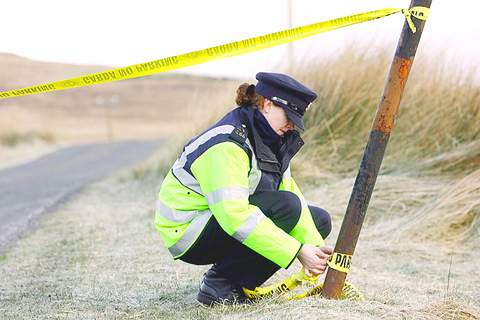
PHOTO: AP
The repercussions of his death could destabilize attempts to reinstate the power-sharing government and cause further sectarian tensions.
The former head of Sinn Fein's administration in Stormont had escaped to the Republic to begin a new, hermit-like existence but was tracked to his bolthole a few weeks ago by Hugh Jordan, a journalist for the Sunday World.
"He looked like a hunted animal," said Jordan last night. "He was extremely depressed. The nerves in his eyes were trembling."
The reporter also noted that Donaldson's previous swagger had disappeared and that he spent his days drawing water from a well, cooking over an open fire and reading.
"He seemed like a man who didn't think he would come to any harm. He did not see his life to be in any danger, but felt the only future he had was where he was, living in that dreadfully squalid situation," said Jordan. "It's desperate that something like this happened. He was alone and threatened no-one. He was no harm to anybody."
Although the article disclosed Donaldson's new location -- in County Donegal, an area of the Republic of Ireland known as the Costa del Provo because of the number of IRA members who have holiday homes there -- he had decided to stay put.
Those who had been in contact with him in recent weeks said he had not shown any indication of contemplating suicide.
When he was photographed earlier this year outside the cottage he appeared to be in reasonably good health.

‘CROSSING THE LINE’: China’s embassy in Seoul criticized US Forces Korea Commander General Xavier Brunson, asking if his ‘hostile’ remarks were authorized by Washington South Korea and the US are in talks over recent public remarks by the commander of US Forces Korea, Seoul’s presidential office said yesterday, after the comments drew sharp criticism from China. In a recent podcast interview, US Forces Korea Commander General Xavier Brunson described South Korea as “the dagger in the heart of Asia” from China’s east coast, prompting the Chinese embassy in Seoul to say that he had “truly crossed the line.” The interview came amid growing speculation that Washington might seek to expand the role of US Forces Korea in countering the growing regional influence of China, a key

Through the noise of rushing papers and whirring belts at a print factory in Kyoto, two creators watch their photo essay come to life in broadsheet form — part of an effort to win new audiences in the age of artificial intelligence (AI). Despite the decline of the publishing industry, self-publication and handmade “zine” magazines are growing in popularity in Japan, reflecting the nation’s enduring love of paper in the digital era. While speaking to Agence France-Presse at the plant, his hands black with ink, one of the creators, Kazuma Obara, said: “I think [paper] is a medium that engages all five

Australian researchers have trained lab-grown brain cells on a silicon computer chip to play the 1990s shooter game Doom and said they are just scratching the surface of what the neurons could be capable of doing. It is the science-fiction work of biotech boffins at Cortical Labs, who researched and developed the technology that harnesses the workings of the brain’s networking system. Each so-called “biological computer” contains about 200,000 living human brain cells, grown from stem cells that were harvested from blood donations. Having mastered the simple computer game Pong, where a paddle is moved up and down to send a ball

France experienced its hottest spring on record, the French weather service said on Tuesday, after an exceptional early heat wave that also broke highs for the season in England and Wales. Meteo-France said the average nationwide temperature over March to May was 13.8°C — about 1.7°C above the norm, and surpassing records set in 2011 and 2020. “The warmest spring since records began in 1900,” it said in a bulletin. All three months were warmer than average, but the onset of an “unprecedented heatwave” late last month pushed the mercury to highs typically seen at the height of the summer. “Our country had never


 RSS
RSS