


British Prime Minister Tony Blair called yesterday for an international agreement on tackling climate change, but warned that any deal would fail unless it included the US, China and India.
Speaking at the end of a brief stop in New Zealand in which global warming has dominated the agenda, Blair said failing to address the issue would leave an irresponsible legacy for future generations.
"What's necessary is to get an international agreement that has got a framework with a stabilization goal in it, so that we can set a very clear objective for everybody to aim at," he told journalists after talks with Prime Minister Helen Clark.
"Without the participation of America and the emerging economies of China and India there isn't going to be a solution," Blair said.
The US rejected the 1997 UN Kyoto Protocol to cut greenhouse gas emissions as too expensive for its oil-dependent economy. The booming economies of China and India are two of the fast-growing users of fossil fuels.
Blair said seizing the initiative on the issue would require changes in lifestyle and radical technological solutions.
"You've got to develop the science, the technology and the changes in behavior necessary to meet that goal," he said. "But it won't be done unless there is a development of the technology that, I think, needs to be as revolutionary as the Internet was for information technology."
His own government's climate policy review, published on Tuesday, indicated Britain is likely to better Kyoto's target of a 12.5 percent reduction in overall carbon emissions. But it also suggested London would fall short of its own long-standing commitment to cut carbon dioxide gases by 20 percent of 1990 levels by 2010. Instead emissions were likely to be cut by 15 to 18 percent, the report said.
Climate change figured high on the agenda of the New Zealand leg of Blair's Asia-Pacific tour. He earlier told a conference in Wellington that any failure to strike a deal would hand an appalling legacy to future generations.
Blair said the world must build on the emerging consensus about the man-made causes of climate change at meetings of the G8 and the G8 plus Five.
"If we operate on anything like the precautionary principle, you have to say that the science is sufficiently clear and, in my view, is pretty much certain that it would be deeply irresponsible not to take action," he said. "I do not want it on the conscience certainly of me and people of my generation that we were told what this problem was in the early part of the 21st century, did nothing about it and then my children and their children end up having to deal with the consequences."
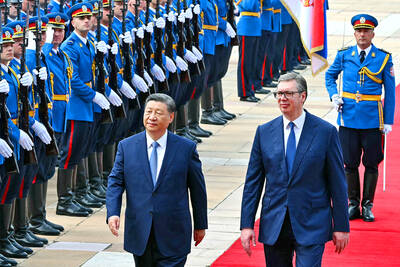
MONEY MATTERS: Xi was to highlight projects such as a new high-speed railway between Belgrade and Budapest, as Serbia is entirely open to Chinese trade and investment Serbian President Aleksandar Vucic yesterday said that “Taiwan is China” as he made a speech welcoming Chinese President Xi Jinping (習近平) to Belgrade, state broadcaster Radio Television of Serbia (RTS) said. “We have a clear and simple position regarding Chinese territorial integrity,” he told a crowd outside the government offices while Xi applauded him. “Yes, Taiwan is China.” Xi landed in Belgrade on Tuesday night on the second leg of his European tour, and was greeted by Vucic and most government ministers. Xi had just completed a two-day trip to France, where he held talks with French President Emmanuel Macron as the

With the midday sun blazing, an experimental orange and white F-16 fighter jet launched with a familiar roar that is a hallmark of US airpower, but the aerial combat that followed was unlike any other: This F-16 was controlled by artificial intelligence (AI), not a human pilot, and riding in the front seat was US Secretary of the Air Force Frank Kendall. AI marks one of the biggest advances in military aviation since the introduction of stealth in the early 1990s, and the US Air Force has aggressively leaned in. Even though the technology is not fully developed, the service is planning
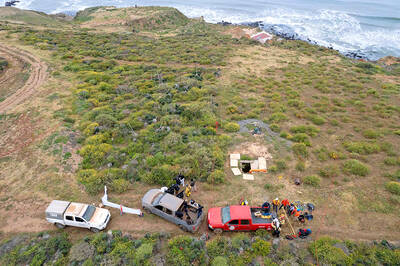
INTERNATIONAL PROBE: Australian and US authorities were helping coordinate the investigation of the case, which follows the 2015 murder of Australian surfers in Mexico Three bodies were found in Mexico’s Baja California state, the FBI said on Friday, days after two Australians and an American went missing during a surfing trip in an area hit by cartel violence. Authorities used a pulley system to hoist what appeared to be lifeless bodies covered in mud from a shaft on a cliff high above the Pacific. “We confirm there were three individuals found deceased in Santo Tomas, Baja California,” a statement from the FBI’s office in San Diego, California, said without providing the identities of the victims. Australian brothers Jake and Callum Robinson and their American friend Jack Carter
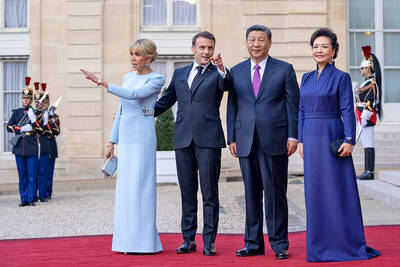
CUSTOMS DUTIES: France’s cognac industry was closely watching the talks, fearing that an anti-dumping investigation opened by China is retaliation for trade tensions French President Emmanuel Macron yesterday hosted Chinese President Xi Jinping (習近平) at one of his beloved childhood haunts in the Pyrenees, seeking to press a message to Beijing not to support Russia’s war against Ukraine and to accept fairer trade. The first day of Xi’s state visit to France, his first to Europe since 2019, saw respectful, but sometimes robust exchanges between the two men during a succession of talks on Monday. Macron, joined initially by EU Commission President Ursula von der Leyen, urged Xi not to allow the export of any technology that could be used by Russia in its invasion


 RSS
RSS