


Indian Prime Minister Manmohan Singh and US President George W. Bush yesterday announced an agreement on a landmark nuclear deal, a coup for Bush's first visit to India.
Under the accord, elusive until the last minute, the US would share its nuclear know-how and fuel with India to help power its fast-growing economy, even though India won't sign the Nuclear Nonproliferation Treaty. It would represent a major shift in policy for the US, which imposed temporary sanctions on India in 1998 after it conducted nuclear tests.
"We concluded an historic agreement today on nuclear power," Bush said. "It's not an easy job for the prime minister to achieve this agreement. I understand. It's not easy for the US president to achieve this agreement."
Bush, turning immediately toward selling the deal to skeptics in the US Congress, called it "a necessary agreement."
"It's one that will help both our peoples," he said.
Singh repeatedly thanked Bush for personally shepherding the deal.
"But for his leadership, this day probably would not have come so soon," Singh said.
Bush and Singh signed an agreement in July to provide India with nuclear fuel for the country's booming but energy-starved economy. But it hinged upon determining how to segregate India's nuclear weapons work from its commercial nuclear program, and place the latter under international inspection, in a way that satisfied both sides.
Some lawmakers in Washington contend that the Bush administration is essentially making a side deal to the international nonproliferation treaty. Critics in India, meanwhile, are wary that the US is meddling in Indian affairs, and is using India as a counterweight to China's growing economic and political influence.
The president acknowledged that convincing lawmakers would be difficult.
"Proliferation is certainly a concern and a part of our discussions and we've got a good-faith gesture by the Indian government that I'll be able to take to the Congress," Bush said.
"But the other thing that our Congress has got to understand that it's in our economic interests that India have a civilian nuclear power industry to help take the pressure off the global demand for energy. ... To the extent that we can reduce demand for fossil fuels, it will reduce the cost to the US consumer," he added.
Also acknowledging the deal falls outside the limits of traditional international agreements, Bush argued it was responsible and would not increase proliferation risks.
"What this agreement says is -- things change, times change, that leadership can make a difference ... So I'm trying to think differently, not stay stuck in the past," he said.
The frantic negotiations for the nuclear pact, coupled with protests planned throughout Bush's stay, reflected India's mixed feelings about the visit by the leader of the US -- a country seen as a loyal friend by some and a global bully by others.
Many business and government leaders of this nation of more than 1 billion people are eager to strengthen ties with the US.

SPEAKING OUT: After Siranudh Scott’s allegations surfaced, celebrities and public figures took to social media to share their own experiences of sexual misconduct and abuse A high-profile alleged sexual abuse case within a wealthy Thai beer brewing family has prompted a wave of painful accounts from survivors of unconnected abuse in the conservative nation. Siranudh Scott, a member of the billionaire Thai family that founded the ubiquitous Singha beer brand, posted an emotional video this month accusing his elder brother Sunit of repeatedly abusing him when he was a teenager. Sunit, who is in his 30s, later denied the allegations in a video posted online, but Singha parent Boonrawd dismissed him from his executive role with the company on Tuesday last week. “I felt I needed to speak
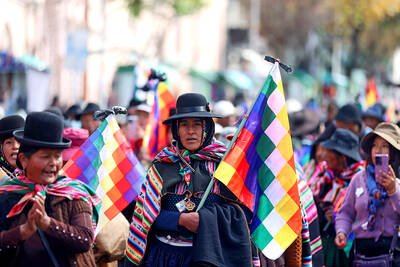
SEEKING ORDER: Rodrigo Paz said that ‘anyone who wants to destroy the nation will have to deal with this president and the full force of the constitution’ Bolivian President Rodrigo Paz on Wednesday said that the nation was at a “breaking point” after nearly a month of protests that have caused shortages of food, fuel and medicine. Paz, who took office six months ago amid the worst economic crisis there in four decades, is battling a groundswell of fury over his policies. The political capital, La Paz, has been besieged by low-income workers and members of the indigenous majority calling for his resignation. “The country needs order and is reaching breaking point,” the 58-year-old said at a public event in La Paz, renewing his appeal for dialogue. On Tuesday, the Bolivian
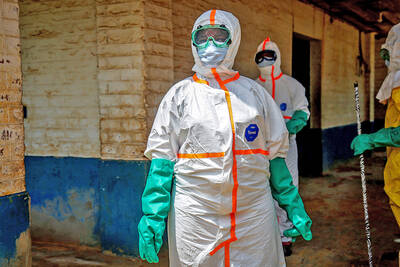
COMMUNITY CONFLICT: Concerns about disease spread from corpses has run up against friends and families’ desire to bury their dead as infection spreads in the area Angry residents of a town at the epicenter of the Ebola outbreak in the Democratic Republic of the Congo (DR Congo) attacked and burned a tent that was part of a health center where people are being treated for the virus, the staff there said Saturday. It was the second such attack in the region in a week. No one was hurt in the attack, according to reports but as patients ran out to escape the fire, 18 people with suspected Ebola infections fled the facility and are unaccounted for, a hospital director said. Angry residents arrived at the clinic in the

Forecasters in Europe yesterday warned of exceptional heat as record temperatures driven by a “heat dome” push temperatures well above seasonal norms across the continent. The surge follows a record-breaking Monday, with France logging its hottest day in the month of May on record, its weather agency said, and the UK also posting unprecedented highs. A so-called “heat dome” of warm air from northern Africa trapped under a high-pressure system over western Europe is behind the high temperatures not usually seen until high summer. Restrictions on outdoor work were imposed in parts of Italy, beaches in southwest France filled earlier than usual and


 RSS
RSS