


The US ambassador delivered a blunt warning to Iraqi leaders that they risk losing US support unless they establish a national unity government with the police and keep the army out of the hands of religious parties.
Ambassador Zalmay Khalilzad on Monday delivered the warning as another 24 people, including a US soldier, died in a string of bombings, underscoring the need for the country to establish a government capable of winning the trust of all communities and ending the violence.
Such a government is also essential to the US strategy for handing over security to Iraqi soldiers and police so the 138,000 US troops can go home.
But talks among Iraqi parties that won parliament seats in the Dec. 15 election have stalled over deep divisions among Shiites, Sunni Arabs and Kurds.
During a rare news conference, Khalilzad said division among the country's sectarian and ethnic communities was "the fundamental problem in Iraq," fueling the Sunni Arab-dominated insurgency and the wave of reprisal killings.
"To overcome this there is a need for a government of national unity," which "is the difference between what exists now and the next government," he said.
The outgoing government is dominated by Shiites and Kurds.
Khalilzad said Iraq's next Cabinet ministers, particularly those heading the Interior and Defense ministries, "have to be people who are nonsectarian, broadly acceptable and who are not tied to militias" run by political parties.
Otherwise, he warned that "Iraq faces the risk of warlordism that Afghanistan went through for a period."
To underscore his remarks, Khalilzad reminded the Iraqis that the US has spent billions to build up Iraq's police and army and said "we are not going to invest the resources of the American people and build forces that are run by people who are sectarian" and tied to the militias -- some of which the ambassador said received "arms and training" from Iran.
There was no response from al-Jaafari's government to Khalilzad's warning, but a prominent Shiite politician, Jalaladin al-Saghir, said the comments were "unacceptable" and constituted interference in the affairs of a sovereign state.
``We all want a national unity government and the U.S. ambassador is no more eager than we are to reach such a government,'' al-Saghir said.
``It is the Americans who push toward sectarianism by their ever-changing points of view. We feel uneasy about some of the U.S. agenda,'' he said.
In the latest bloodshed, a US soldier was killed on Monday by a roadside bomb near Karbala, about 80km southwest of Baghdad.
A suicide bomber detonated an explosives belt on a bus on Monday in Baghdad killing 12 people and wounding 15, police said.
Earlier, a bomb exploded in central Baghdad, killing at least four men and wounding 14, police said.
In Mosul, northwest of Baghdad, a suicide attacker blew himself up in a restaurant packed with policemen eating breakfast, killing at least five people and wounding 21 officials said.
The Shura Council for Mujahedeen in Iraq claimed responsibility in a statement posted on an Islamic Web site, saying one of the "lions of monotheism" attacked the restaurant because it was "frequented by apostate policemen."
Two more civilians died when a car bomb exploded in Madain, southeast of Baghdad, police said. Eleven people were wounded.

Crowds in Bangladesh are flocking to snap photographs with an unlikely social media star — an albino buffalo with flowing blond hair nicknamed “Donald Trump” that is due to be sacrificed within days. Owner Zia Uddin Mridha, 38, said his brother named the 700kg bull over its flowing helmet of hair resembling the signature look of the US president. “My younger brother picked this name because of the buffalo’s extraordinary hair,” he said at his farm in Narayanganj, just outside the capital, Dhaka. Mridha said that a constant stream of curious visitors — social media fans, onlookers and children — have come throughout
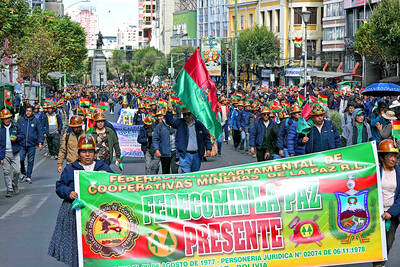
The Bolivian government on Friday struck a deal with protesting miners, but was still grappling with blockades and demonstrations by other workers across La Paz. Other groups are still blocking access roads into the city, which is also the seat of the government. Police on Thursday prevented the miners from entering the main square by using tear gas, while the demonstrators hurled stones and explosives with slingshots. Protests against the policies of Bolivian President Rodrigo Paz have convulsed the Andean nation since early this month, and roadblocks were choking routes into La Paz throughout Friday, the national road authority said. Miners demanded that Paz
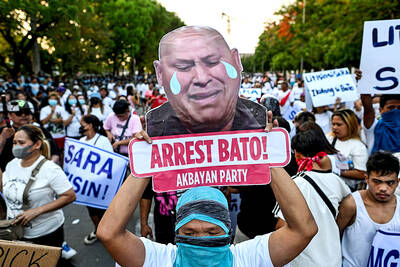
The Philippines said it has asked the country’s Supreme Court to allow it to arrest former Philippine president Rodrigo Duterte’s chief drug war enforcer to stand trial in an international tribunal. The International Criminal Court (ICC) last week unsealed an arrest warrant against Philippine Senator Ronald dela Rosa, accusing him along with Duterte and other “coperpetrators” of the “crime against humanity of murder.” Dela Rosa briefly sought refuge in the Philippine Senate last week while asking the Philippine Supreme Court to stop an ongoing attempt by government agents to arrest him. “By his own conduct, he has placed himself outside the protection of

The researchers in Ireland looked at their computer screen, marveling at a medieval book tracked down in a Roman library. They flipped through its digitized pages and found their sought-after treasure: the oldest surviving English poem. “We were extremely surprised. We were speechless. We couldn’t believe our eyes when we first saw that,” said Elisabetta Magnanti, a visiting research fellow at Trinity College Dublin’s school of English. The poem was also within the main body of Latin text, she said, calling it “extraordinary.” Composed in Old English by a Northumbrian agricultural worker in the 7th century, Caedmon’s Hymn appears within some copies of


 RSS
RSS