


A British judge has sentenced radical Muslim cleric Abu Hamza al-Masri to seven years in prison for promoting the slaying of non-Muslims as a "religious duty" when he led a London mosque seen as the spiritual haven for two al-Qaeda-linked terrorists.
Judge Anthony Hughes told the former imam of the Finsbury Park mosque on Tuesday that his speeches had endangered people around the world. The mosque -- described by the head of London's Metropolitan Police anti-terrorism unit Peter Clarke as a "honeypot for extremists" -- was attended by both Sept. 11 plotter Zacarias Moussaoui and "shoe bomber" Richard Reid.
Moussaoui pleaded guilty last year to plotting with al-Qaeda to fly planes into US buildings, he faces trial in the US on terrorism conspiracy charges. Reid was convicted of attempting to blow up an American Airlines flight in 2001 with a shoe bomb.
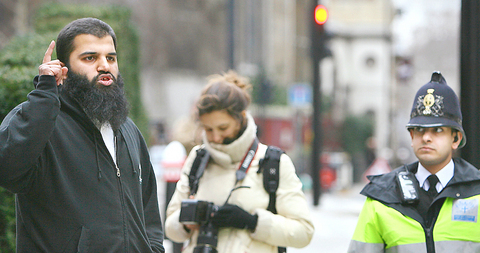
PHOTO: AFP
"You helped to create an atmosphere in which to kill has become regarded by some as not only a legitimate course but as a moral and religious duty in pursuit of perceived justice," the judge told al-Masri.
The one-eyed, hook-handed preacher sat impassively in the wood-paneled dock as the foreman of the jury read out guilty verdicts on 11 out of 15 counts, including incitement to murder, fomenting racial hatred, possessing a terrorist document and possessing abusive recordings. He had faced a maximum of life in prison.
Hughes sentenced al-Masri to seven years on the most serious charges of soliciting murder, and allowed him to serve his sentences on the other charges concurrently.
"I am quite satisfied that you are and were a person whose views created a real danger to the lives of innocent people in different parts of the world," he said.
The cleric's attorneys said he planned to appeal. Defense lawyer Muddassar Arani said al-Masri believed he was "a prisoner of faith, and this is a slow martyrdom for him."
A supporter in the public gallery shouted "God Bless You Sheik Hamza" as the cleric was led out of the courtroom. Others shouted to him in Arabic.
Authorities in Britain and the US claim al-Masri was at the center of a web of terrorist activity from the 1990s until police raided the Finsbury Park mosque in 2003.
He has been charged in the US on an 11-count indictment with trying to establish a terrorist training camp in Oregon, conspiring to take hostages in Yemen and facilitating terror training in Afghanistan.
Under British law, the domestic charges took precedence over the extradition case, but al-Masri could now be sent to the US for prosecution there if US authorities request it.
In Washington, US Justice Department spokesman Bryan Sierra said the US "stands ready to resume the extradition proceedings against Abu Hamza when British law allows."
In his trial at London's Central Criminal Court, al-Masri, whose real name is Mustafa Kamel Mustafa, faced charges of soliciting the murder of others, "namely a person or persons who did not believe in the Islamic faith; using threatening or abusive language designed to stir racial hatred; possessing threatening or abusive recordings; and possessing a document likely to be useful in terrorism -- the Encyclopedia of the Afghani Jihad."
The cleric, who claims to have lost his eye and both hands in Afghanistan during the Soviet occupation, became a high-profile radical and a hate figure for British tabloids, who called him "Hooky" and "Dr. Hook."
After he was expelled from the mosque by administrators in 2003, he led Friday prayers on the street outside until his 2004 arrest on a US extradition warrant. He has been detained in the high-security Belmarsh prison ever since.
During the trial, al-Masri took the stand and denied any involvement in violence.
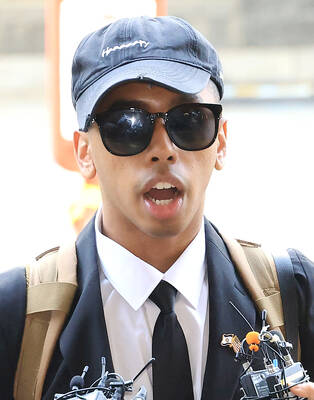
A US YouTuber who caused outrage for filming himself kissing a statue commemorating Korean wartime sex slaves has been sentenced to six months in prison, a court in Seoul said yesterday. Johnny Somali, 25, gained notoriety several years ago for recording himself doing a series of provocative stunts in South Korea and Japan, and streaming them on platforms such as YouTube and Twitch. South Korean authorities indicted Somali — whose real name is Ramsey Khalid Ismael — in 2024 on public order violations and obstruction of business, and banned him from leaving the country. “The court has sentenced him to six months in

Former Lima mayor Rafael Lopez Aliaga, a Peruvian presidential hopeful, gathered hundreds of supporters in Lima on Tuesday and gave authorities 24 hours to annul the first round of the country’s election over allegations of fraud. Lopez Aliaga is locked in a tight three-way race with two other candidates for second place in Sunday’s vote. The election runner-up wins a ticket to June’s presidential run-off against front-runner Keiko Fujimori. “I am giving them 24 hours to declare this electoral fraud null and void,” said Lopez Aliaga, surrounded by a crowd of several hundred supporters. “If it is not declared null and void tomorrow,

PAPAL RETORT: Pope Leo told reporters that he has ‘no fear, neither of the Trump administration nor speaking out loudly about the message of the Gospel’ US President Donald Trump has feuded with Pope Leo XIV over the Iran conflict — setting off an unholy row that could have serious political implications for the Republican leader back in the US. Trump has drawn barbs even from some allies over the attacks on the US-born pontiff, who has criticized the Trump administration over its immigration crackdown, the intervention in Venezuela and the Iran war. The president risks alienating the religious right in November’s crucial US midterm elections. So far the unprecedented clash between the leader of the most powerful military on Earth and the head of the world’s 1.4 billion

A 16-year-old boy has been charged with murder and aggravated sexual abuse in Florida in the death of his 18-year-old stepsister on a Carnival Cruise ship, the US Department of Justice said on Monday. Timothy Hudson was initially charged in February and subsequently indicted on March 10, but the breadth of the case was not known until a seal was lifted on Friday last week, weeks after US District Judge Beth Bloom in Miami said that he would be prosecuted as an adult at the request of the government. Anna Kepner had been traveling on the Carnival Horizon ship in November last


 RSS
RSS