


Five people died on Tuesday as Haitians voted in their first parliamentary and presidential election in six years with the hope that the new leaders will bring the Western Hemisphere's poorest nation out of political chaos and violence.
International organizations declared the election historical and a success despite the deaths, dozens of injuries and lines sometimes as long as 2km as voters queued under heavy security for an election that had been delayed four times since last fall.
Two people died in a clash in a village when a police officer shot and killed one person in a melee and the crowd turned on and killed the officer, Radio Metropole said.

PHOTO: AP
Two older voters died of heart attacks in crushes of voters outside polling stations in Port-au-Prince, while the fifth fatality was a man who died in an accident in front of another polling place, the radio station said.
The scene outside many polling stations was one of chaos, disorder and flaring tempers as Haitians began lining up before the 6am start of voting and as some stations opened hours late.
As a result, Haiti's electoral commission extended voting hours through the night until everyone in line had a chance to vote in the country's first election since former president Jean-Bertrand Aristide was ousted in February 2004.
More than 9,000 UN troops and Haitian police provided security, which was stepped up around the polling stations after the first death.
Election results were expected in a few days, but the frontrunner for a five-year presidential term, according to opinion polls, was Rene Preval, an Aristide confidant from the Lavalas Party.
His nearest rival was expected to be entrepreneur Charles Henri Baker, who campaigned on a platform of economic recovery under the slogan "Order, Discipline, Work."
Apart from a president, about 3.5 million registered voters were choosing 99 lower-house deputies and 30 senators.
The head of the UN mission in the Caribbean country, Juan Gabriel Valdes, and the secretary-general of the Organization of American States, Jose Miguel Insulza, said that while there were problems, the vote was a success and marked an extraordinary day in the history of Latin America.
A majority of Haitians exercised their right to vote, showing a determination to do so despite long lines and other obstacles, they told reporters in Port-au-Prince.
"We did what was possible," interim President Gerald Latortue said after the chaotic voting.

MONEY MATTERS: Xi was to highlight projects such as a new high-speed railway between Belgrade and Budapest, as Serbia is entirely open to Chinese trade and investment Serbian President Aleksandar Vucic yesterday said that “Taiwan is China” as he made a speech welcoming Chinese President Xi Jinping (習近平) to Belgrade, state broadcaster Radio Television of Serbia (RTS) said. “We have a clear and simple position regarding Chinese territorial integrity,” he told a crowd outside the government offices while Xi applauded him. “Yes, Taiwan is China.” Xi landed in Belgrade on Tuesday night on the second leg of his European tour, and was greeted by Vucic and most government ministers. Xi had just completed a two-day trip to France, where he held talks with French President Emmanuel Macron as the

With the midday sun blazing, an experimental orange and white F-16 fighter jet launched with a familiar roar that is a hallmark of US airpower, but the aerial combat that followed was unlike any other: This F-16 was controlled by artificial intelligence (AI), not a human pilot, and riding in the front seat was US Secretary of the Air Force Frank Kendall. AI marks one of the biggest advances in military aviation since the introduction of stealth in the early 1990s, and the US Air Force has aggressively leaned in. Even though the technology is not fully developed, the service is planning
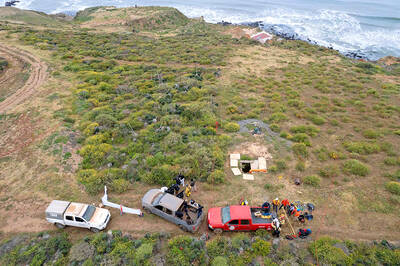
INTERNATIONAL PROBE: Australian and US authorities were helping coordinate the investigation of the case, which follows the 2015 murder of Australian surfers in Mexico Three bodies were found in Mexico’s Baja California state, the FBI said on Friday, days after two Australians and an American went missing during a surfing trip in an area hit by cartel violence. Authorities used a pulley system to hoist what appeared to be lifeless bodies covered in mud from a shaft on a cliff high above the Pacific. “We confirm there were three individuals found deceased in Santo Tomas, Baja California,” a statement from the FBI’s office in San Diego, California, said without providing the identities of the victims. Australian brothers Jake and Callum Robinson and their American friend Jack Carter
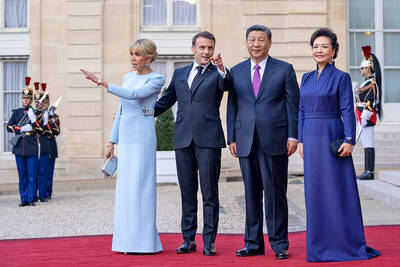
CUSTOMS DUTIES: France’s cognac industry was closely watching the talks, fearing that an anti-dumping investigation opened by China is retaliation for trade tensions French President Emmanuel Macron yesterday hosted Chinese President Xi Jinping (習近平) at one of his beloved childhood haunts in the Pyrenees, seeking to press a message to Beijing not to support Russia’s war against Ukraine and to accept fairer trade. The first day of Xi’s state visit to France, his first to Europe since 2019, saw respectful, but sometimes robust exchanges between the two men during a succession of talks on Monday. Macron, joined initially by EU Commission President Ursula von der Leyen, urged Xi not to allow the export of any technology that could be used by Russia in its invasion


 RSS
RSS