


One by one, two by two, they moved to the edge of the beach, sat down and stared silently at the sea which killed their loved ones.
Tears rolled down cheeks as memories of those killed by the tsunami on the once paradise Thai island of Phi Phi overflowed from eyes fixed on the azure waters of the bay from where the giant waves came.
Memories, said relatives on the backpacker island where 700 people died a year ago yesterday, which will never go away.
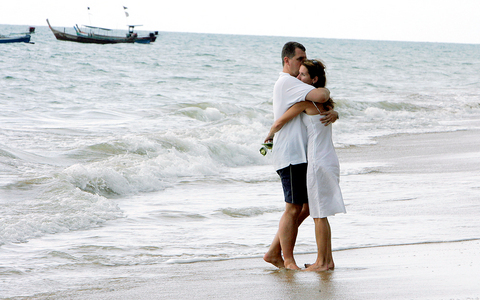
PHOTO: AFP
"There's never going to be closure," said Trisha Broadbridge, whose Australian Rules footballer husband Troy was killed, as gentle waves slapped at fishing boats riding at anchor off the backdrop to cult movie The Beach.
"But at least now you've got through all those first dates, those first anniversaries, so hopefully it should get easier," she said.
On Phi Phi, on nearby Phuket island and Khao Lak beach to the north, people from all over the world joined Thais in remembering the 5,395 people known to have been killed in Thailand by the tsunami, which left nearly 3,000 people missing.
"I just want to cry. I find it hard to believe the whole thing," Australian Joy Vogel said at Khao Lak, clutching a wedding photograph of her daughter, who was three months pregnant when the tsunami took her and nearly 2,000 other foreigners.
"But I feel all the tsunami people who died are with us. The essence of my daughter lives on," she said by a police patrol boat swept 2km inland, which has become a memorial.
Like many other relatives of the tsunami dead, Vogel is involved in an aid program to help Thais who suffered.
"I want to make my daughter's life count for something," she said.
Mourners laid flowers -- white, the symbol of purity.
On Phi Phi, it was at the foot of a huge banyan tree and at a simple shrine where people laid flowers, along with paper doves, a symbol of peace, something mourners hoped for but found hard to imagine.
"We just wanted to come, to come to see them," said 49-year-old Jaysar Gul, who came from Istanbul with her husband Ali to mourn their daughter Seda and her British fiance Justin.
"We miss them so much. We just want to be together," she said tears, streaming down her cheeks.
Seda's body has never been found.
Thai leaders, in memorial speeches at resorts on Thailand's usually idyllic Andaman Sea coast, promised the dead would not be forgotten.
"I wish to express my deep sympathy to those who lost their loved ones," Tourism Minister Pracha Maleenont said in Thai and English before laying a Buddhist flower garland on a memorial to the tsunami victims.
"We are not alone. There are still many others in the world who are willing to lend their help and support," he said on Phuket's Patong beach.
But some Thais were upset by the government's memorials.
"The government is organizing a jolly celebration party, not a memorial service, not a peaceful merit-making. The government does not think of the hearts and minds of the people who lost their beloved ones," said Nantaya Saphanthong, a representative of the all-but-obliterated Ban Nam Khem village.
Some foreigners were disturbed by a crowd of photographers preventing them laying down flowers.
One tearful woman yelled at them to "just go away, please."
"We don't care about the pictures in the paper," she shouted angrily.

‘CROSSING THE LINE’: China’s embassy in Seoul criticized US Forces Korea Commander General Xavier Brunson, asking if his ‘hostile’ remarks were authorized by Washington South Korea and the US are in talks over recent public remarks by the commander of US Forces Korea, Seoul’s presidential office said yesterday, after the comments drew sharp criticism from China. In a recent podcast interview, US Forces Korea Commander General Xavier Brunson described South Korea as “the dagger in the heart of Asia” from China’s east coast, prompting the Chinese embassy in Seoul to say that he had “truly crossed the line.” The interview came amid growing speculation that Washington might seek to expand the role of US Forces Korea in countering the growing regional influence of China, a key

SEEKING ORDER: Rodrigo Paz said that ‘anyone who wants to destroy the nation will have to deal with this president and the full force of the constitution’ Bolivian President Rodrigo Paz on Wednesday said that the nation was at a “breaking point” after nearly a month of protests that have caused shortages of food, fuel and medicine. Paz, who took office six months ago amid the worst economic crisis there in four decades, is battling a groundswell of fury over his policies. The political capital, La Paz, has been besieged by low-income workers and members of the indigenous majority calling for his resignation. “The country needs order and is reaching breaking point,” the 58-year-old said at a public event in La Paz, renewing his appeal for dialogue. On Tuesday, the Bolivian

Through the noise of rushing papers and whirring belts at a print factory in Kyoto, two creators watch their photo essay come to life in broadsheet form — part of an effort to win new audiences in the age of artificial intelligence (AI). Despite the decline of the publishing industry, self-publication and handmade “zine” magazines are growing in popularity in Japan, reflecting the nation’s enduring love of paper in the digital era. While speaking to Agence France-Presse at the plant, his hands black with ink, one of the creators, Kazuma Obara, said: “I think [paper] is a medium that engages all five

Australian researchers have trained lab-grown brain cells on a silicon computer chip to play the 1990s shooter game Doom and said they are just scratching the surface of what the neurons could be capable of doing. It is the science-fiction work of biotech boffins at Cortical Labs, who researched and developed the technology that harnesses the workings of the brain’s networking system. Each so-called “biological computer” contains about 200,000 living human brain cells, grown from stem cells that were harvested from blood donations. Having mastered the simple computer game Pong, where a paddle is moved up and down to send a ball


 RSS
RSS