


This much they know: Someone has been murdering older women in Mexico City, strangling them in their homes, pocketing a keepsake and vanishing into the city's streets.
But investigators do not know whether the killer is a man or a woman, whether there is an accomplice or how the victims are chosen.
After two years and at least 24 unsolved murders, they have one fingerprint that matches partial prints from five other cases, a modus operandi and a police sketch of what appears to be a man made up as a woman.
Investigators pieced together much of the killer's technique from evidence at the crime scenes. The rest resulted from a break in July when the son of a possible prospective victim dropped by his mother's house unexpectedly and caught a glimpse of someone fleeing. The person left behind a full fingerprint.
To the residents of this capital and its unbounded suburbs, inured to street violence as they are, the presence of a serial killer is something alien. Such killers are seen as peculiarly American, a perversity born from a society many Mexicans believe long ago abandoned family ties, one that breeds hostile loners. Even the largely unsolved killings of more than 350 women over the past decade in Ciudad Juarez is seen as distant, a product of the city's closeness to the US and the fractured families that migration to the US has left behind.
Mexico City's apparently homegrown serial killer rattles the cultural myth here that older people are protected within the cocoon of loving extended families. The truth is that increasing numbers of older Mexicans live alone in a city where families are dispersed.
Bernardo Batiz, the attorney-general for Mexico City, took a long time to admit that the city was dealing with a serial killer, although newspapers have been referring to the mataviejitas, or "little old lady killer," for almost two years.
"It cost us more than a year for the authorities to take it seriously," said Pedro Borda, director of Mexico's National Institute for Elderly People. "Now we know that the prosecutor feels the pressure."
With the fingerprint offering evidence of a serial killer, the attorney general's office formed a task force and sought help from criminologists at the National Institute of Penal Sciences, who are creating a psychological profile of the killer.
"It's like looking for a needle in a haystack in a city so gigantic where anonymity is the rule, where people don't know each other," Batiz said.
The criminologists are looking for shared traits among the victims and clues from the crime scenes, and are comparing the profile of this killer with cases documented elsewhere.
"These are not casual victims, they are chosen victims," said Miguel Ontiveros, a criminologist at the institute.
Investigators believe that they can attribute nine homicides over the last two years to one person and that the same person may be responsible for 15 more in the same period. Others believe that the murderer may be responsible for more. Borda said there had been 66 murders of people older than 60 since 1998. They have been spread out all over the city, in middle-class and lower middle-class neighborhoods, in no evident pattern.
Public pressure has grown over the past few months with the killing of Maria de los Angeles Repper, 92, in the modest central neighborhood of Escandon, who was strangled with her scarf in her ground-floor apartment in October.
"The big problem is the scant data they have to work with," said Rafael Ruiz Harrell, a criminologist.
Until recently, many prosecutions relied solely on a confession, often extracted under torture. Preserving a crime scene has only recently become standard procedure.
"It's just inexcusable that after fingerprints have been taken from a crime scene, they turn out to be the prints of police themselves. It happens all over Mexico," Ontiveros said.

Four contenders are squaring up to succeed Antonio Guterres as secretary-general of the UN, which faces unprecedented global instability, wars and its own crushing budget crisis. Chile’s Michelle Bachelet, Argentina’s Rafael Grossi, Costa Rica’s Rebeca Grynspan and Senegal’s Macky Sall are each to face grillings by 193 member states and non-governmental organizations for three hours today and tomorrow. It is only the second time the UN has held a public question-and-answer, a format created in 2016 to boost transparency. Ultimately the five permanent members of the UN’s top body, the Security Council, hold the power, wielding vetoes over who leads the

A humanoid robot that won a half-marathon race for robots in Beijing on Sunday ran faster than the human world record in a show of China’s technological leaps. The winner from Honor, a Chinese smartphone maker, completed the 21km race in 50 minutes and 26 seconds, said a WeChat post by the Beijing Economic-Technological Development Area, also known as Beijing E-Town, where the race began. That was faster than the human world record holder, Ugandan Jacob Kiplimo, who finished the same distance in about 57 minutes in March at the Lisbon road race. The performance by the robot marked a significant step forward

An earthquake registering a preliminary magnitude of 7.7 off northern Japan on Monday prompted a short-lived tsunami alert and the advisory of a higher risk of a possible mega-quake for coastal areas there. The Cabinet Office and the Japan Meteorological Agency said there was a 1% chance for a mega-quake, compared to a 0.1% chance during normal times, in the next week or so following the powerful quake near the Chishima and Japan trenches. Officials said the advisory was not a quake prediction but urged residents in 182 towns along the northeastern coasts to raise their preparedness while continuing their daily lives. Prime
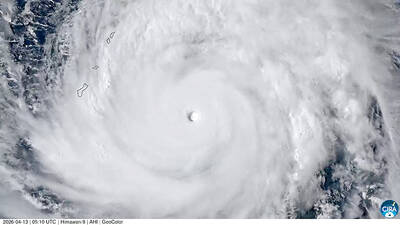
HAZARDOUS CONDITION: The typhoon’s sheer size, with winds extending 443km from its center, slowed down the ability of responders to help communities, an official said The US Coast Guard was searching for six people after losing contact with their disabled boat off the coast of Guam following Typhoon Sinlaku. The crew of the 44m dry cargo vessel, the US-registered Mariana, on Wednesday notified the coast guard that the boat had lost its starboard engine and needed assistance, Petty Officer 3rd Class Avery Tibbets said yesterday. The coast guard set up a one-hour communication schedule with the vessel, but lost contact on Thursday. A Coast Guard HC-130 Hercules aircraft was launched to search for the six people on board, but it had to return to Guam because of


 RSS
RSS