


Smoking is set to be completely banned throughout pubs and restaurants in England after senior cabinet ministers united to demand a U-turn on plans for a partial ban.
Prime Minister Tony Blair has let it be known that he will not block Health Secretary Patricia Hewitt's calls to overturn the current plans, under which smoking would be banned only in places where food is served.
Toughening up the ban risks a public backlash from smokers driven into the street. However, the current compromise is now widely considered unworkable, because it is opposed by both brewers -- who argue it would be simpler to apply the same rules to all pubs -- and doctors who believe more lives could be saved by an outright ban.
Blair has let it be known that if the Cabinet, which meets shortly to consider Hewitt's proposals, can agree on an outright ban he will not stand in the way. Hewitt has now won the backing of Cabinet big hitters -- including the Chancellor Gordon Brown, Tessa Jowell, whose Culture Department oversees the pub industry, and Trade Secretary Alan Johnson.
The Deputy Prime Minister, John Prescott, who once opposed the ban, has also indicated he will not block a majority of colleagues.
This leaves only opposition from John Reid, who as Health Secretary drew up the original plans for a limited ban.
"We are broadly supportive and we can see the reasons for this: we are happy for the debate to be opened up," said a senior Downing Street source. "If cabinet wants to go for it, that's fine. Then we say `What do the people think'?"
Smoking will be banned in Scotland next year after the Scottish Parliament passed legislation. The Welsh Assembly has applied for powers to impose a ban, leaving England alone as a place where people can still smoke in some pubs.
In England, one possible compromise if agreement cannot be reached is forso-called "smoking carriages," or rooms that pubs would set aside with no bar staff, no food and no drink, where smokers could simply go for a cigarette before returning to the bar. Private members' clubs would also be excluded.
The pressure for change follows research showing pubs in poorer areas would respond to a limited ban by stopping serving food so that they can allow smoking -- making a mockery of the ban and worsening the gulf that already exists between the rich and poor over smoking- related deaths.
There are also concerns over the health of bar staff forced to breathe customers' smoke, while ministers have argued that once-controversial smoking bans in New York and Dublin have now proved popular.
Hewitt has worked closely with Jowell to rally cabinet support. "Tessa has always been in favor of a total ban but John Reid was against it, and this time last year for all sorts of political reasons the Prime Minister was not willing to override him," said a senior Whitehall source close to the negotiations.
"But a number of things have happened now which have changed the politics of this. One is that we have a new Health Secretary, and we have evidence from Dublin and New York that the initiatives there have settled down."
Ministers argue a total ban would be a brave step and popular in retrospect, like Ken Livingstone's controversial introduction of a London congestion charge. "The Prime Minister is minded for a complete ban but doesn't want to impose his own view. He wants Patricia to build a consensus," the source added.
Sources close to Hewitt however warned that the deal was far from done, arguing that smoking was not Blair's current priority while sources close to Reid said he stood by the partial ban that was in Labour's election manifesto.
If the cabinet agrees the outright ban, Blair is expected to order a swift public consultation to ensure there is no major backlash and to proceed with caution.
However health groups last night welcomed the move forward. "This simple step will be more effective than anything else the government could now do to lessen the dreadful burden of pain and grief and waste of life caused by smoking-related disease," said Deborah Arnott, director of Action on Smoking and Health.
Kevin Barron, the Labour chair of the Commons health select committee and a long-term campaigner against smoking, also welcomed it: "We need something that people can understand. This compromise is a dog's dinner."

MONEY MATTERS: Xi was to highlight projects such as a new high-speed railway between Belgrade and Budapest, as Serbia is entirely open to Chinese trade and investment Serbian President Aleksandar Vucic yesterday said that “Taiwan is China” as he made a speech welcoming Chinese President Xi Jinping (習近平) to Belgrade, state broadcaster Radio Television of Serbia (RTS) said. “We have a clear and simple position regarding Chinese territorial integrity,” he told a crowd outside the government offices while Xi applauded him. “Yes, Taiwan is China.” Xi landed in Belgrade on Tuesday night on the second leg of his European tour, and was greeted by Vucic and most government ministers. Xi had just completed a two-day trip to France, where he held talks with French President Emmanuel Macron as the

With the midday sun blazing, an experimental orange and white F-16 fighter jet launched with a familiar roar that is a hallmark of US airpower, but the aerial combat that followed was unlike any other: This F-16 was controlled by artificial intelligence (AI), not a human pilot, and riding in the front seat was US Secretary of the Air Force Frank Kendall. AI marks one of the biggest advances in military aviation since the introduction of stealth in the early 1990s, and the US Air Force has aggressively leaned in. Even though the technology is not fully developed, the service is planning
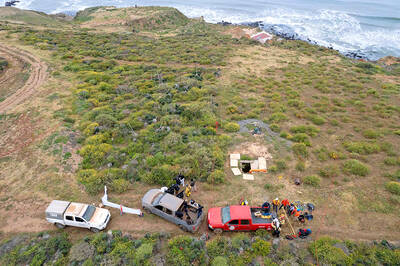
INTERNATIONAL PROBE: Australian and US authorities were helping coordinate the investigation of the case, which follows the 2015 murder of Australian surfers in Mexico Three bodies were found in Mexico’s Baja California state, the FBI said on Friday, days after two Australians and an American went missing during a surfing trip in an area hit by cartel violence. Authorities used a pulley system to hoist what appeared to be lifeless bodies covered in mud from a shaft on a cliff high above the Pacific. “We confirm there were three individuals found deceased in Santo Tomas, Baja California,” a statement from the FBI’s office in San Diego, California, said without providing the identities of the victims. Australian brothers Jake and Callum Robinson and their American friend Jack Carter

CUSTOMS DUTIES: France’s cognac industry was closely watching the talks, fearing that an anti-dumping investigation opened by China is retaliation for trade tensions French President Emmanuel Macron yesterday hosted Chinese President Xi Jinping (習近平) at one of his beloved childhood haunts in the Pyrenees, seeking to press a message to Beijing not to support Russia’s war against Ukraine and to accept fairer trade. The first day of Xi’s state visit to France, his first to Europe since 2019, saw respectful, but sometimes robust exchanges between the two men during a succession of talks on Monday. Macron, joined initially by EU Commission President Ursula von der Leyen, urged Xi not to allow the export of any technology that could be used by Russia in its invasion


 RSS
RSS