


New York's subways were under increased security yesterday after receiving what local officials described as the most specific threat to date of a terrorist attack in the coming days.
"This is the first time that we have had a threat with this level of specificity," Mayor Michael Bloomberg said on Thursday. "It was more specific as to target, it was more specific as to timing."
Although the intelligence behind the alert had yet to be corroborated, Police Commissioner Ray Kelly said that it had been deemed of "sufficient concern" to enhance counter-terrorism operations on the subway network, as well as buses and ferries.
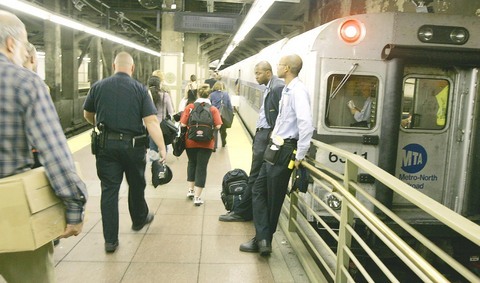
PHOTO: AP
Officials refused to provide details of the precise nature of the threat, although Kelly said an existing policy of random searches on the subway would be intensified, with a particular emphasis on baggage and baby strollers.
Despite the increased security, subways were running as normal and New York City remained on the second highest alert level, where it has been since the Sept. 11, 2001, attacks.
US media quoted Department of Homeland Security officials as saying they doubted the credibility of the threat.
"The intelligence community has concluded that this information is of doubtful credibility," the department said in a statement.
CNN quoted a senior Pentagon official as saying US troops, acting on the same intelligence, had taken part in a raid south of Baghdad late Wednesday and rounded up several al-Qaeda operatives.
The head of the FBI's New York field office, Mark Mershon, said the new threat had been "partially disrupted" but declined to elaborate beyond confirming that no arrests had been made in the city itself.
Bloomberg said the warning of the attack had come several days ago, but a public announcement was delayed.
"There were operations taking place that we thought were in the interest of ending the threat, and to release the information earlier could have jeopardized the lives of those conducting those operations," he said.
The new warning came just hours after a major speech on terrorism by US President George W. Bush in which he sought to convince Americans that Iraq was a central front of the anti-terror campaign.
Bush said the US had foiled three al-Qaeda terror strikes on its soil since the Sept. 11 attacks, and stopped terror groups casing US targets and infiltrating operatives into the country.
"Evil men obsessed with ambition and unburdened by conscience must be taken very seriously and we must stop them before their crimes multiply," Bush said.
In the immediate wake of the July suicide bombings on the London transport system that claimed 52 lives, New York flooded its subway network with police patrols and introduced a policy of random bag searches.
The New York subway -- fourth largest in the world in passenger volume -- carries 4.5 million passengers on an average working day.
"We've never had before a specific threat to our subway system," Bloomberg said.
"There have been people all the time on the Internet and every place else, saying you know, `I'm going to go get those guys,'" he said. "But suffice it to say [this time] its importance was enhanced above the normal level, by the detail that was available to us," he said.
In a city that still bears the physical and psychological scars of the Sept. 11 attack four years ago, the presence of police, anti-terrorist units and National Guard troopers has become a common feature of subway travel.
Bloomberg's announcement came in the middle of the evening rush hour and many subway passengers said that they were unaware of the new threat.
Others said they had heard the news but felt few qualms about going home as usual.
"This isn't the first time and it won't be the last," said Marion Cox, 32, as she prepared to board a downtown train at Manhattan's Grand Central Station.

It began as a satirical online project. Now millions of young people in India are flocking to it as an outlet for their frustration. A parody political party called the Cockroach Janta Party, with the insect as its symbol, has exploded across India’s social media by turning absurdist humor into protest. Memes and short videos mocking corruption, joblessness and political dysfunction have flooded social media sites, where millions of users are embracing the cockroach — known for its ability to survive harsh conditions — as a tongue-in-cheek symbol of endurance. The online movement’s rise has been unusually rapid. The Cockroach Janta Party (CJP)
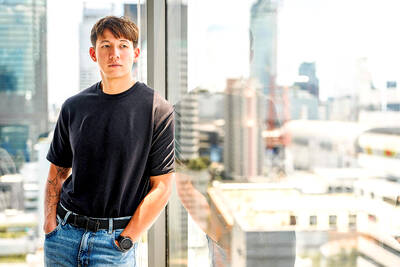
SPEAKING OUT: After Siranudh Scott’s allegations surfaced, celebrities and public figures took to social media to share their own experiences of sexual misconduct and abuse A high-profile alleged sexual abuse case within a wealthy Thai beer brewing family has prompted a wave of painful accounts from survivors of unconnected abuse in the conservative nation. Siranudh Scott, a member of the billionaire Thai family that founded the ubiquitous Singha beer brand, posted an emotional video this month accusing his elder brother Sunit of repeatedly abusing him when he was a teenager. Sunit, who is in his 30s, later denied the allegations in a video posted online, but Singha parent Boonrawd dismissed him from his executive role with the company on Tuesday last week. “I felt I needed to speak
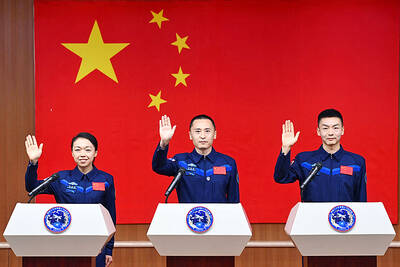
A Hong Kong astronaut is to join a Chinese space mission for the first time as part of a three-person crew launching today, as Beijing edges closer to its goal of landing people on the moon. The Tiangong space station — crewed by teams of three astronauts that are typically rotated every six months — is the crown jewel of China’s space program, boosted by billions in state investment in a bid to catch up with the US and Russia. The Shenzhou-23 mission is to blast off at 11:08pm from the Jiuquan Satellite Launch Center in northwestern China, carrying three astronauts to
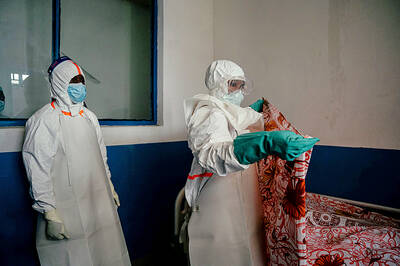
UPGRADED ALERT: The risk inside DR Congo is now considered ‘very high,’ while neighboring countries face a ‘high’ threat as the outbreak continues, the WHO said Ebola is spreading faster than responders can track it in eastern Congo, where health workers managed to follow up with barely one in five identified contacts in a single day. Authorities in the Democratic Republic of the Congo (DR Congo) reported 83 confirmed infections, 746 suspected cases and 1,603 identified contacts as of Thursday, but health workers were able to follow up on only 342 contacts that day — about 21 percent of the total under monitoring — data released by the DR Congo Ministry of Public Health on Friday showed. The figures suggest the response is falling behind the outbreak itself,


 RSS
RSS