


Hurricane Rita pummeled east Texas and the Louisiana coast, battering communities with floods and intense winds. But residents were relieved the once-dreaded storm proved far less fierce and deadly than Katrina.
After the storm passed Saturday, authorities pleaded with the roughly 3 million evacuees not to hurry home too soon, fearing more chaos.
"Be patient, stay put," said Texas Governor Rick Perry. "If you are in a safe place with food, water, bedding, you are better remaining there for the time being."
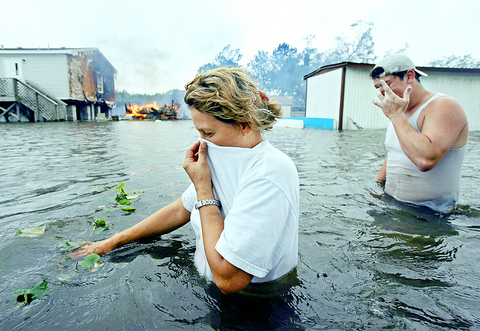
PHOTO: AP
In any other hurricane season, Rita might have seemed devastating. It knocked out power for more than 1 million customers, sparked fires across the hurricane zone and swamped Louisiana shoreline towns with a 4.5m storm surge that required daring boat and helicopter rescues of hundreds of people.
But the new storm came in the wake of Hurricane Katrina, with its 1,000-plus death toll, cataclysmic flooding of New Orleans and staggering destruction in Mississippi. By contrast, Rita spared Houston, New Orleans and other major cities a direct hit. By Saturday evening, the only reported death was in Mississippi, where one person was killed when a tornado that spun off the remains of the hurricane overturned a mobile home.
"The damage is not as serious as we had expected it to be," said R. David Paulison, acting director of the Federal Emergency Management Agency. "The evacuations worked."
Damage to the vital concentration of oil refineries along the coast appeared relatively light, although industry officials said it was too early to assess whether there would be an impact on oil prices. Valero Energy Corp. said its 255,000-barrel-per-day Port Arthur refinery sustained significant damage to two cooling towers and a flare stack and would need at least two weeks for repairs.
Late Saturday, two environmental cleanup workers spread booms and oil-absorbent pads along a perimeter fence at the refinery. Knee-deep floodwaters were stained with dark brown crude oil, and the odor of petroleum hung thick in the air.
Rita roared ashore Saturday morning close to the Texas-Louisiana border as a Category 3 hurricane with top winds of 193kph and warnings of up to 63.5cm of rain. By mid-afternoon, it was downgraded to a tropical storm with top sustained winds of 80kph as it moved slowly through east Texas toward Shreveport, Louisiana.
Before it weakened, Rita showed its strength across a broad region between Houston and New Orleans.
In Beaumont, trees of all sizes and power lines were down, street signs were shredded, and one brick wall of an office building had collapsed. Said Dr. Gaylon Gonzalez, a surgeon who spent the night at Christus Hospital St. Elizabeth as Rita arrived: "It sounded like a power washer hitting the windows."
Perry surveyed Beaumont by air Saturday.
"Considering it was a Category 5 storm 48 hours ago, I think we're probably pretty fortunate," he said.
The Texas Department of Transportation dispatched a 30-vehicle convoy from Beaumont to clear a debris-covered highway to the north toward Lufkin. Authorities used military helicopters and a bus to move some nursing home residents who had been stranded since Friday at an elementary school without power in the small town of Fred.

South Korea’s air force yesterday apologized for a 2021 midair collision involving two fighter jets, a day after auditors said the pilots were taking selfies and filming during the flight and held them responsible for the accident. “We sincerely apologize to the public for the concern caused by the accident that occurred in 2021,” an air force spokesman told a news conference, adding that one of the pilots involved had been suspended from flying duties, received severe disciplinary action and has since left the military. The apology followed a report released on Wednesday by the South Korean Board of Audit and Inspection,

Indonesian police have arrested 13 people after shocking images of alleged abuse against small children at a daycare center went viral, sparking outrage across the nation, officials said on Monday. Police on Friday last week raided Little Aresha, a daycare center in Yogyakarta on Java island, following a report from a former employee. CCTV footage circulating on social media showed children, most younger than two, lying on the floor wearing only diapers, their hands and feet bound with rags. The police have confirmed that the footage is authentic. Police said they also found 20 children crammed into a room just 3m by 3m. “So

About 240 Indians claiming descent from a Biblical tribe landed at Tel Aviv airport on Thursday as part of a government operation to relocate them to Israel. The newcomers passed under a balloon arch in blue and white, the colors of the Israeli flag, as dozens of well-wishers welcomed them with a traditional Jewish song. They were the first “bnei Menashe” (“sons of Manasseh”) to arrive in Israel since the government in November last year announced funding for the immigration of about 6,000 members of the community from the states of Manipur and Mizoram in northeast India. The community claims to descend from

‘TROUBLING’: The firing of Phelan, who was an adviser to a nonprofit that supported the defense of Taiwan, was another example of ‘dysfunction’ under Trump, a US senator said US Secretary of the Navy John Phelan has been fired, a US official and a person familiar with the matter said on Wednesday, in another wartime shakeup at the Pentagon coming just weeks after US Secretary of Defense Pete Hegseth ousted the Army’s top general. The Pentagon announced his departure in a brief statement, saying he was leaving the administration “effective immediately,” but it did not provide a reason or say whether it was his decision to go. The sources, who spoke on condition of anonymity, said Phelan was dismissed in part because he was moving too slowly to implement reforms to


 RSS
RSS