


The former chief of the Iraq oil-for-food program resigned just a day before investigators release a report that is expected to accuse him of taking kickbacks under the US$64 billion humanitarian operation.
Benon Sevan announced his decision on Sunday in a scathing letter that lambasted UN Secretary-General Kofi Annan, the UN Security Council, the UN's critics, and the Independent Inquiry Committee investigating the allegations of corruption against him.
"As I predicted, a high-profile investigative body invested with absolute power would feel compelled to target someone and that someone turned out to be me," Sevan wrote in the letter. "The charges are false, and you, who have known me for all these years, should know that they are false."
The resignation is largely symbolic because the UN was paying Sevan just US$1 a year to keep him on payroll so he would cooperate with the committee. But it removes his diplomatic immunity and could leave him open to prosecution.
Sevan, a Cypriot citizen, is also being investigated by the Manhattan District Attorney's office.
Last Thursday, Sevan's lawyer Eric Lewis said the committee would find in its upcoming report that Sevan got kickbacks for steering contracts under oil-for-food to a small trading company called African Middle East Petroleum Co Ltd Inc (AMEP). Lewis said it would also accuse Sevan of failing to cooperate with the investigation.
The amount of money Sevan allegedly took wasn't immediately known -- and may be as little as US$160,000.
In a February report, the committee, led by former US Federal Reserve chairman Paul Volcker, concluded that Sevan solicited oil allocations on behalf of AMEP between 1998 and 2001. It accused him of a "grave conflict of interest."
That report questioned US$160,000 in cash which Sevan said he received from his aunt in Cyprus between 1999 and 2003. The report called the money "unexplained wealth" and noted that the aunt, who has passed away, was a retired photographer living on a modest pension.
The oil-for-food program was launched in December 1996 to help ordinary Iraqis cope with UN sanctions imposed after former Iraqi president Saddam Hussein's 1990 invasion of Kuwait. Saddam's regime could sell oil, provided the proceeds went to buy humanitarian goods or pay war reparations. His government decided on the goods it wanted, who should provide them and who could buy Iraqi oil. But the Security Council committee overseeing sanctions monitored the contracts.
Saddam allegedly sought to curry favor by giving former government officials, activists, journalists and UN officials vouchers for Iraqi oil that could then be resold at a profit.
In his letter, Sevan lashed out at Annan and said the oil-for-food program was far better run than the Development Fund for Iraq (DFI), the US, British and later Iraqi-run operation which replaced it. Auditors have said billions of dollars in DFI money has been mismanaged and contracts were awarded without competitive bidding.
"The real Oil-for-Food `scandal' is in the distortion and misrepresentation of the accomplishments and the record of the program by now well-established UN bashers," Sevan said.
US critics, particularly Republicans in the US Congress, have frequently cited oil-for-food as emblematic of perceived UN bungling and outright corruption. Some have called for Annan to resign.
The UN has fired one staffer over findings made by Volcker's team. Joseph Stephanides was dismissed over accusations that he illegally altered the competitive bidding process for a company to inspect humanitarian goods.
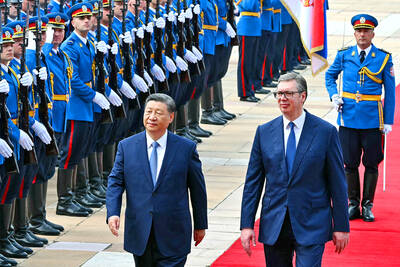
MONEY MATTERS: Xi was to highlight projects such as a new high-speed railway between Belgrade and Budapest, as Serbia is entirely open to Chinese trade and investment Serbian President Aleksandar Vucic yesterday said that “Taiwan is China” as he made a speech welcoming Chinese President Xi Jinping (習近平) to Belgrade, state broadcaster Radio Television of Serbia (RTS) said. “We have a clear and simple position regarding Chinese territorial integrity,” he told a crowd outside the government offices while Xi applauded him. “Yes, Taiwan is China.” Xi landed in Belgrade on Tuesday night on the second leg of his European tour, and was greeted by Vucic and most government ministers. Xi had just completed a two-day trip to France, where he held talks with French President Emmanuel Macron as the

With the midday sun blazing, an experimental orange and white F-16 fighter jet launched with a familiar roar that is a hallmark of US airpower, but the aerial combat that followed was unlike any other: This F-16 was controlled by artificial intelligence (AI), not a human pilot, and riding in the front seat was US Secretary of the Air Force Frank Kendall. AI marks one of the biggest advances in military aviation since the introduction of stealth in the early 1990s, and the US Air Force has aggressively leaned in. Even though the technology is not fully developed, the service is planning
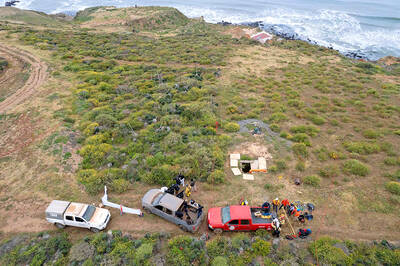
INTERNATIONAL PROBE: Australian and US authorities were helping coordinate the investigation of the case, which follows the 2015 murder of Australian surfers in Mexico Three bodies were found in Mexico’s Baja California state, the FBI said on Friday, days after two Australians and an American went missing during a surfing trip in an area hit by cartel violence. Authorities used a pulley system to hoist what appeared to be lifeless bodies covered in mud from a shaft on a cliff high above the Pacific. “We confirm there were three individuals found deceased in Santo Tomas, Baja California,” a statement from the FBI’s office in San Diego, California, said without providing the identities of the victims. Australian brothers Jake and Callum Robinson and their American friend Jack Carter
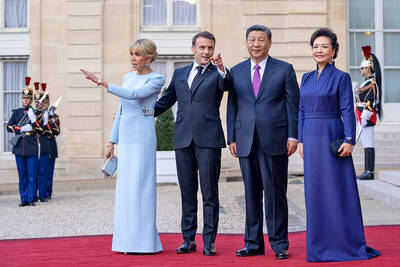
CUSTOMS DUTIES: France’s cognac industry was closely watching the talks, fearing that an anti-dumping investigation opened by China is retaliation for trade tensions French President Emmanuel Macron yesterday hosted Chinese President Xi Jinping (習近平) at one of his beloved childhood haunts in the Pyrenees, seeking to press a message to Beijing not to support Russia’s war against Ukraine and to accept fairer trade. The first day of Xi’s state visit to France, his first to Europe since 2019, saw respectful, but sometimes robust exchanges between the two men during a succession of talks on Monday. Macron, joined initially by EU Commission President Ursula von der Leyen, urged Xi not to allow the export of any technology that could be used by Russia in its invasion


 RSS
RSS