


In Niger, a desert country twice the size of France, most of the 11 million people live on US$1 a day. Forty percent of children are underfed, and one out of four die before they turn five.
And that's when things are normal. Throw in a plague of locusts and a familiar spectacle emerges: skeletal babies, distended bellies, people too famished to brush the flies from their faces.
To the aid workers charged with saving the dying, the immediate challenge is to raise relief money and get supplies to the stricken areas. They have to leave it to the economists and politicians to come up with a lasting remedy. One such economist is James Shikwati. He blames foreign aid.
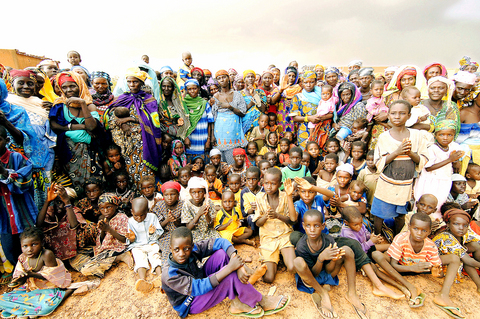
PHOTO: AFP
"When aid money keeps coming, all our policy-makers do is strategize on how to get more," the Kenya-based director of the Inter Region Economic Network, an African think tank, said.
"They forget about getting their own people working to solve these very basic problems. In Africa, we look to outsiders to solve our problems, making the victim not take responsibility to change," he said.
Moving the aid can be a nightmare in itself. Africa's good roads are few and often pass through the front lines of civil wars. But Shikwati notes an additional problem: Even African countries that have food to spare can't easily share it because tariffs on agricultural products within sub-Saharan Africa average as high as 33 percent, compared with 12 percent on similar products imported from Europe.
"It doesn't make sense when they can't even allow their neighbors to feed them. They have to wait for others in Europe or Asia to help," he said. "We don't have any excuses in Africa. We can't blame nature. We have to tell our leadership to open up and get people producing food."
Nature, of course, does bear some of the blame. Recurring drought is a part of life -- nature's way of culling human and animal populations that land cannot support. Farmers have learned to cope but exploding population growth sucks up water, pasture and livestock.
Many food crises result from bad government and civil wars. For 30 years after winning independence from France, Niger was ruled by coup and military dictatorship. Now it's a peaceful multiparty democracy, but its desert is getting bigger and drought is unrelenting
All it took was the locust swarms of a year ago, the worst in 15 years, to start tipping Niger over the edge. The crop-devouring insects ravaged some 18,000km2 of Niger farmland. The combined drought-locust onslaught cut cereal production by 15 percent last year, according to the UN.
At first, few noticed. Places like Niger "were never on anybody's radar screen. They're not considered important, geopolitically or resource-wise," said Cathy Skoula, executive director of US-based Action Against Hunger. "It comes down to a question of priorities. But any human life is important."
Aid groups say Niger's catastrophe could have been averted -- that early warning systems were in place, and the UN and other humanitarian agencies warned of imminent food shortages late last year.
In November, Niger's government issued an emergency appeal for 70,200 metric tonnes of food. Donors, busy with higher-profile crises, barely responded. The following month came the Indian Ocean tsunami that entirely eclipsed Africa's misery on the world's TV screens. Aid workers say heading off famine needs long-term, steady funding.
"Prevention doesn't sell that much," said Stefanie Savariaud, spokeswoman for the UN World Food Program in Niger's capital, Niamey. "The world has to wait for images of dying children to react. The question is, how to mobilize the international community when it's still preventable?"
Ironically, only three weeks ago the world's attention was fixed on Africa again, when the G8 summit pledged to double African aid to US$50 billion and granted 18 of its countries debt forgiveness, including Niger. At the same time, rock concerts televised worldwide made sure Africa's troubles stayed high on the global agenda.
A week later, TV pictures of hungry people began beaming out of Niger and donors reached for their wallets.
But the World Food Program has only raised US$9 million of the US$16 million it appealed for, Savariaud said.
At a feeding center in Mada Roufa, in eastern Niger, Mai Sali, a local employee of the international relief organization Doctors Without Borders, praised those efforts, but agreed that crisis aid was not the answer.
"We need to find other long-term solutions. We can't just address emergencies," he said.

Indonesia was to sign an agreement to repatriate two British nationals, including a grandmother languishing on death row for drug-related crimes, an Indonesian government source said yesterday. “The practical arrangement will be signed today. The transfer will be done immediately after the technical side of the transfer is agreed,” the source said, identifying Lindsay Sandiford and 35-year-old Shahab Shahabadi as the people being transferred. Sandiford, a grandmother, was sentenced to death on the island of Bali in 2013 after she was convicted of trafficking drugs. Customs officers found cocaine worth an estimated US$2.14 million hidden in a false bottom in Sandiford’s suitcase when
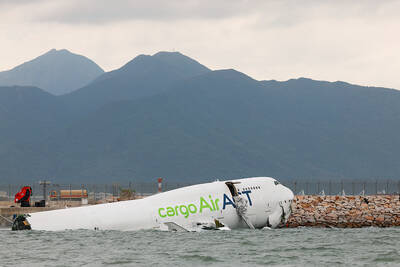
CAUSE UNKNOWN: Weather and runway conditions were suitable for flight operations at the time of the accident, and no distress signal was sent, authorities said A cargo aircraft skidded off the runway into the sea at Hong Kong International Airport early yesterday, killing two ground crew in a patrol car, in one of the worst accidents in the airport’s 27-year history. The incident occurred at about 3:50am, when the plane is suspected to have lost control upon landing, veering off the runway and crashing through a fence, the Airport Authority Hong Kong said. The jet hit a security patrol car on the perimeter road outside the runway zone, which then fell into the water, it said in a statement. The four crew members on the plane, which
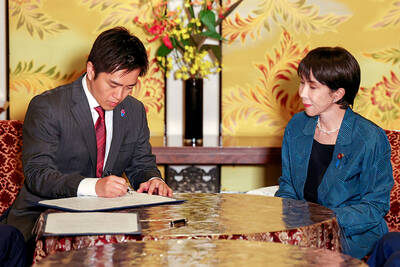
Japan’s ruling Liberal Democratic Party (LDP) and its junior partner yesterday signed a coalition deal, paving the way for Sanae Takaichi to become the nation’s first female prime minister. The 11th-hour agreement with the Japan Innovation Party (JIP) came just a day before the lower house was due to vote on Takaichi’s appointment as the fifth prime minister in as many years. If she wins, she will take office the same day. “I’m very much looking forward to working with you on efforts to make Japan’s economy stronger, and to reshape Japan as a country that can be responsible for future generations,”

SEVEN-MINUTE HEIST: The masked thieves stole nine pieces of 19th-century jewelry, including a crown, which they dropped and damaged as they made their escape The hunt was on yesterday for the band of thieves who stole eight priceless royal pieces of jewelry from the Louvre Museum in the heart of Paris in broad daylight. Officials said a team of 60 investigators was working on the theory that the raid was planned and executed by an organized crime group. The heist reignited a row over a lack of security in France’s museums, with French Minister of Justice yesterday admitting to security flaws in protecting the Louvre. “What is certain is that we have failed, since people were able to park a furniture hoist in the middle of


 RSS
RSS