


Modified genes from crops in a GM crop trial have transferred into local wild plants, creating a form of herbicide-resistant "superweed."
The cross-fertilization between GM oilseed rape and a distantly related plant, charlock, had been discounted as virtually impossible by scientists with the British government's environment department. It was found during a follow up to the government's three-year trials of GM crops which ended two years ago.
The new form of charlock was growing among many others in a field which had been used to grow GM rape. When scientists treated it with lethal herbicide it showed no ill-effects.
Unlike the results of the original trials, which were the subject of large-scale press briefings from scientists, the discovery of hybrid plants that could cause a serious problem to farmers has not been announced. The scientists also collected seeds from other weeds in the oilseed rape field and grew them in the laboratory. They found that two -- both wild turnips -- were herbicide resistant.
The five scientists from the Center for Ecology and Hydrology, the government research station at Winfrith in Dorset, placed their findings on the department's Web site last week.
A reviewer of the paper has appended to its front page: "The frequency of such an event [the cross-fertilization of charlock] in the field is likely to be very low, as highlighted by the fact it has never been detected in numerous previous assessments." However, he adds: "This unusual occurrence merits further study in order to adequately assess any potential risk of gene transfer."
Brian Johnson, an ecological geneticist and member of the government's scientific group which assessed the farm trials, has no doubt of the significance.
"You only need one event in several million. As soon as it has taken place the new plant has a huge selective advantage. That plant will multiply rapidly," he said.
Johnson, who is head of the biotechnology advisory unit and head of the land management technologies group at English Nature, the government nature advisers, said: "Unlike the researchers I am not surprised by this. If you apply herbicide to plants which is lethal, eventually a resistant survivor will turn up."
The glufosinate-ammonium herbicide used in this case put "huge selective pressure likely to cause rapid evolution of resistance," he said.
To assess the potential of herbicide-resistant weeds as a danger to crops, a French researcher placed a single triazine-resistant weed, known as fat hen, in maize fields where atrazine was being used to control weeds. After four years the plants had multiplied to 103,000 plants, Johnson said.
What is not clear in the English case is whether the charlock was fertile. Scientists collected eight seeds from the plant but they failed to germinate them and concluded the plant was "not viable."
But Johnson points out that the plant was very large and produced many flowers.
"There is every reason to suppose that the GM trait could be in the plant's pollen and thus be carried to other charlock in the neighborhood, spreading the GM genes in that way. This is after all how the cross-fertilization between the rape and charlock must have occurred in the first place," he said.

MONEY MATTERS: Xi was to highlight projects such as a new high-speed railway between Belgrade and Budapest, as Serbia is entirely open to Chinese trade and investment Serbian President Aleksandar Vucic yesterday said that “Taiwan is China” as he made a speech welcoming Chinese President Xi Jinping (習近平) to Belgrade, state broadcaster Radio Television of Serbia (RTS) said. “We have a clear and simple position regarding Chinese territorial integrity,” he told a crowd outside the government offices while Xi applauded him. “Yes, Taiwan is China.” Xi landed in Belgrade on Tuesday night on the second leg of his European tour, and was greeted by Vucic and most government ministers. Xi had just completed a two-day trip to France, where he held talks with French President Emmanuel Macron as the

With the midday sun blazing, an experimental orange and white F-16 fighter jet launched with a familiar roar that is a hallmark of US airpower, but the aerial combat that followed was unlike any other: This F-16 was controlled by artificial intelligence (AI), not a human pilot, and riding in the front seat was US Secretary of the Air Force Frank Kendall. AI marks one of the biggest advances in military aviation since the introduction of stealth in the early 1990s, and the US Air Force has aggressively leaned in. Even though the technology is not fully developed, the service is planning
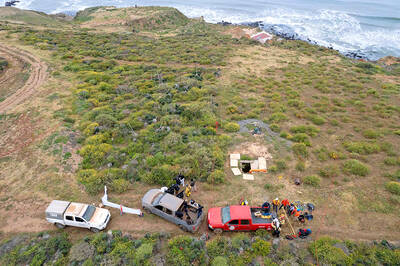
INTERNATIONAL PROBE: Australian and US authorities were helping coordinate the investigation of the case, which follows the 2015 murder of Australian surfers in Mexico Three bodies were found in Mexico’s Baja California state, the FBI said on Friday, days after two Australians and an American went missing during a surfing trip in an area hit by cartel violence. Authorities used a pulley system to hoist what appeared to be lifeless bodies covered in mud from a shaft on a cliff high above the Pacific. “We confirm there were three individuals found deceased in Santo Tomas, Baja California,” a statement from the FBI’s office in San Diego, California, said without providing the identities of the victims. Australian brothers Jake and Callum Robinson and their American friend Jack Carter

CUSTOMS DUTIES: France’s cognac industry was closely watching the talks, fearing that an anti-dumping investigation opened by China is retaliation for trade tensions French President Emmanuel Macron yesterday hosted Chinese President Xi Jinping (習近平) at one of his beloved childhood haunts in the Pyrenees, seeking to press a message to Beijing not to support Russia’s war against Ukraine and to accept fairer trade. The first day of Xi’s state visit to France, his first to Europe since 2019, saw respectful, but sometimes robust exchanges between the two men during a succession of talks on Monday. Macron, joined initially by EU Commission President Ursula von der Leyen, urged Xi not to allow the export of any technology that could be used by Russia in its invasion


 RSS
RSS