


The US Air Force is eyeing a seldom-used region of the Earth's atmosphere called "near space" for communications and intelligence-gathering with one of the oldest types of aircraft -- balloons.
The air at 20,000m and higher is too thin for most traditional airplanes, so military officials are testing unmanned helium balloons at those altitudes. This frigid part of the atmosphere is above most weather but well below low Earth orbit, where the far costlier space station and satellites operate.
"It's a region of the atmosphere that historically has really not been exploited," said Lieutenant-Colonel Toby Volz, who oversees near-space programs at Air Force Space Command at Peterson Air Force Base, Colorado.
A key advantage of balloons and blimps is they may be able to stay aloft much longer than an airplane, providing a communications or surveillance platform that can last days or even weeks. They are also much cheaper than satellites, and could let ground forces communicate over far greater ranges than the line-of-sight radios they often carry.
"I've been intrigued by near space's potential for persistent space-like effects on the battlefield ever since I first heard about it. Near-space has been a cultural blind spot -- too high up for aircraft, but too low for satellites," the air force's chief of staff, General John Jumper, wrote earlier this year in a foreword to a paper on the subject.
One simple prototype, dubbed "Combat SkySat," was tested in the skies over Arizona in January through March with a series of 12 test launches.
The Air Force is considering seeking up to US$15 million for near-space operations and research in its 2007 budget, officials said. Volz said he hopes to see operational near-space systems during the next five years.
For the idea to work, the Air Force will have to overcome a series of potential problems.
Winds are relatively low between 20,000m and 24,000m, usually less than 32km per hour. But levels of corrosive ozone and ultraviolet radiation are much higher than at the Earth's surface.
Another downside is that balloons take many hours to fill with helium and launch, and sometimes require hangars to steady them while they are being filled.
In addition, the Air Force regards near-space altitudes as part of a country's sovereign air space, unlike orbital space that is open to all, according to officials at Air Force Space Command. So the military would be violating internationally accepted practices and law if it sent an intelligence-gathering balloon over another country without permission -- except, of course, if the US was at war with that nation.
Proposals for near-space craft vary in complexity. Some free-floating balloons would cost only a few hundred dollars and be expendable if lost to the winds.
Others would launch a glider to carry a payload down to the Earth. Still others would have some capability to maneuver and be able to stay over their target longer.
More expensive proposals, such as a massive blimp called the High Altitude Airship, move beyond the realm of expendable balloons. These would cost tens of millions of dollars and stay aloft for years. Such a design could also carry bombs or other weapons to drop on ground targets, according to Lieutenant-Colonel Edward Tomme of the Air Force Space Command's Space Warfare Center
As spies, near-space craft will take better pictures than satellites because they are 10 to 20 times closer than a camera in orbit, Tomme wrote earlier this year. If outfitted to eavesdrop on communications, a near-space craft would be likelier to pick up low-power transmissions that satellites cannot hear, he wrote.
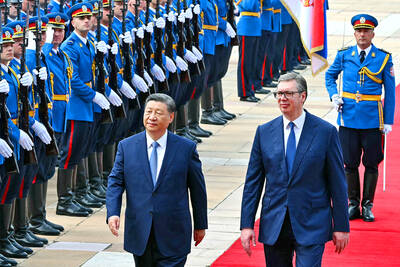
MONEY MATTERS: Xi was to highlight projects such as a new high-speed railway between Belgrade and Budapest, as Serbia is entirely open to Chinese trade and investment Serbian President Aleksandar Vucic yesterday said that “Taiwan is China” as he made a speech welcoming Chinese President Xi Jinping (習近平) to Belgrade, state broadcaster Radio Television of Serbia (RTS) said. “We have a clear and simple position regarding Chinese territorial integrity,” he told a crowd outside the government offices while Xi applauded him. “Yes, Taiwan is China.” Xi landed in Belgrade on Tuesday night on the second leg of his European tour, and was greeted by Vucic and most government ministers. Xi had just completed a two-day trip to France, where he held talks with French President Emmanuel Macron as the
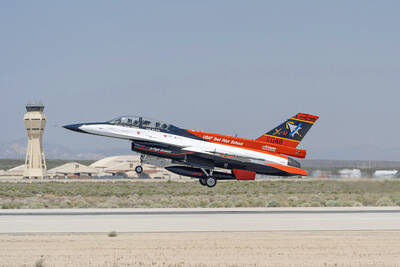
With the midday sun blazing, an experimental orange and white F-16 fighter jet launched with a familiar roar that is a hallmark of US airpower, but the aerial combat that followed was unlike any other: This F-16 was controlled by artificial intelligence (AI), not a human pilot, and riding in the front seat was US Secretary of the Air Force Frank Kendall. AI marks one of the biggest advances in military aviation since the introduction of stealth in the early 1990s, and the US Air Force has aggressively leaned in. Even though the technology is not fully developed, the service is planning
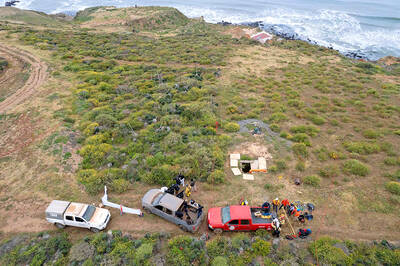
INTERNATIONAL PROBE: Australian and US authorities were helping coordinate the investigation of the case, which follows the 2015 murder of Australian surfers in Mexico Three bodies were found in Mexico’s Baja California state, the FBI said on Friday, days after two Australians and an American went missing during a surfing trip in an area hit by cartel violence. Authorities used a pulley system to hoist what appeared to be lifeless bodies covered in mud from a shaft on a cliff high above the Pacific. “We confirm there were three individuals found deceased in Santo Tomas, Baja California,” a statement from the FBI’s office in San Diego, California, said without providing the identities of the victims. Australian brothers Jake and Callum Robinson and their American friend Jack Carter
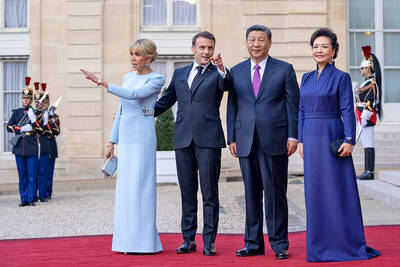
CUSTOMS DUTIES: France’s cognac industry was closely watching the talks, fearing that an anti-dumping investigation opened by China is retaliation for trade tensions French President Emmanuel Macron yesterday hosted Chinese President Xi Jinping (習近平) at one of his beloved childhood haunts in the Pyrenees, seeking to press a message to Beijing not to support Russia’s war against Ukraine and to accept fairer trade. The first day of Xi’s state visit to France, his first to Europe since 2019, saw respectful, but sometimes robust exchanges between the two men during a succession of talks on Monday. Macron, joined initially by EU Commission President Ursula von der Leyen, urged Xi not to allow the export of any technology that could be used by Russia in its invasion


 RSS
RSS