


The men flocked to the cafe under the sign with the cedar tree, symbol of their Mideast home. In this alien border land, it was the beacon that led to an Arab "brother" who would help them complete their journey from Lebanon into the US.
They would come to find Salim Boughader Mucharrafille -- the cafe owner who catered to some of Tijuana's more affluent denizens, including workers at the US consulate. His US customers were unaware that the boss of La Libanesa cafe ran a less reputable business on the side.
Until his arrest in December 2002, Boughader smuggled about 200 Lebanese compatriots into the US, including sympathizers of Hezbollah, designated a terrorist organization by US authorities. One client worked for a Hezbollah-owned television network, which glorifies suicide bombers and is itself on a US terror watch list.
"If they had the cedar on their passport, you were going to help them," Boughader told reporters from a Mexico City prison, where he faces charges following a human-smuggling conviction in the United States. "What's the crime in bringing your brother so that he can get out of a war zone?"
A report released by the Sept. 11 commission staff last year examining how terrorists travel the world cited Boughader as the only "human smuggler with suspected links to terrorists" convicted to date in the US.
But he is not unique.
After Boughader was locked up, other smugglers continued to help Hezbollah-affiliated migrants in their effort to illicitly enter from Tijuana, a US immigration investigator said in Mexican court documents obtained by the AP.
Another smuggling network controlled by Sri Lanka's Tamil Tiger rebel group -- a US-designated terror organization -- tried sneaking four Tigers over the California-Mexico border not long after the Sept. 11, 2001, terrorist attacks, said Steven Schultz, of US Immigration and Customs Enforcement, or ICE. The four were caught.
An AP investigation found these are just some of the many pipelines in Latin America and Canada that have illegally channeled thousands of people into the US from so-called "special-interest" countries -- those identified by the US government as sponsors or supporters of terrorism.
The AP reviewed hundreds of pages of court indictments, affidavits, congressional testimony and government reports, and conducted dozens of interviews in Mexico and the US to determine how migrants from countries with terrorist ties were brought illegally to the US -- and how the smugglers they hired operated.
Many of the travelers, unassociated with any extremist group, genuinely came fleeing war or in search of work. But some, once in the US, committed fraud to obtain Social Security numbers, driver's licenses or false immigration documents.
In January 2001, Maksoud was taken to a house on the Mexican side where migrants of "different nationalities" were awaiting passage, he told investigators. One morning, he was crammed into the trunk of a vehicle and driven through the border port of entry.
Other people-couriers, including convicted smuggler Mohammed Hussein Assadi, use altered passports to fly clients to the US. Assadi schooled his Iraqi customers to carry nothing identifying them as Arab.
He advised one migrant to shave his mustache, still another to get a "European."
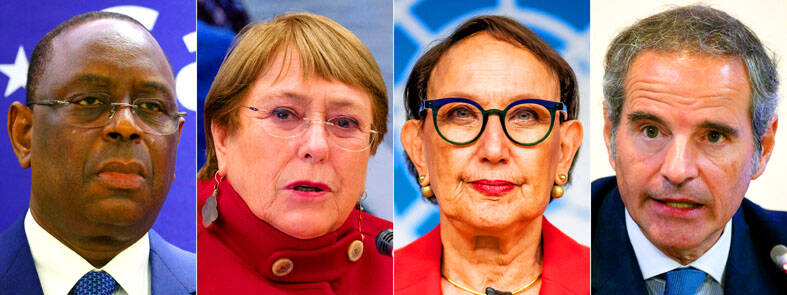
Four contenders are squaring up to succeed Antonio Guterres as secretary-general of the UN, which faces unprecedented global instability, wars and its own crushing budget crisis. Chile’s Michelle Bachelet, Argentina’s Rafael Grossi, Costa Rica’s Rebeca Grynspan and Senegal’s Macky Sall are each to face grillings by 193 member states and non-governmental organizations for three hours today and tomorrow. It is only the second time the UN has held a public question-and-answer, a format created in 2016 to boost transparency. Ultimately the five permanent members of the UN’s top body, the Security Council, hold the power, wielding vetoes over who leads the
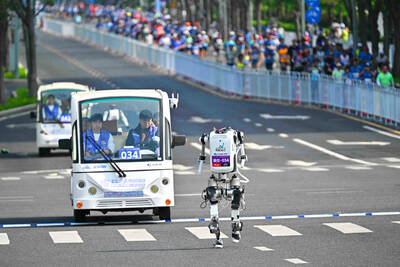
A humanoid robot that won a half-marathon race for robots in Beijing on Sunday ran faster than the human world record in a show of China’s technological leaps. The winner from Honor, a Chinese smartphone maker, completed the 21km race in 50 minutes and 26 seconds, said a WeChat post by the Beijing Economic-Technological Development Area, also known as Beijing E-Town, where the race began. That was faster than the human world record holder, Ugandan Jacob Kiplimo, who finished the same distance in about 57 minutes in March at the Lisbon road race. The performance by the robot marked a significant step forward
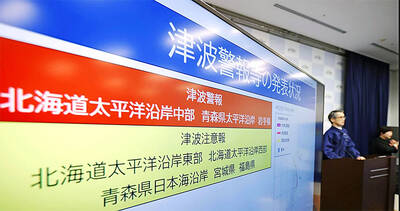
An earthquake registering a preliminary magnitude of 7.7 off northern Japan on Monday prompted a short-lived tsunami alert and the advisory of a higher risk of a possible mega-quake for coastal areas there. The Cabinet Office and the Japan Meteorological Agency said there was a 1% chance for a mega-quake, compared to a 0.1% chance during normal times, in the next week or so following the powerful quake near the Chishima and Japan trenches. Officials said the advisory was not a quake prediction but urged residents in 182 towns along the northeastern coasts to raise their preparedness while continuing their daily lives. Prime
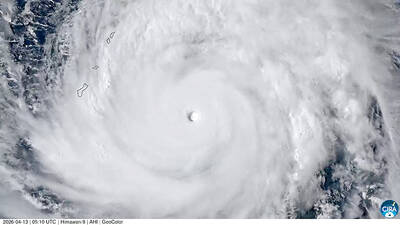
HAZARDOUS CONDITION: The typhoon’s sheer size, with winds extending 443km from its center, slowed down the ability of responders to help communities, an official said The US Coast Guard was searching for six people after losing contact with their disabled boat off the coast of Guam following Typhoon Sinlaku. The crew of the 44m dry cargo vessel, the US-registered Mariana, on Wednesday notified the coast guard that the boat had lost its starboard engine and needed assistance, Petty Officer 3rd Class Avery Tibbets said yesterday. The coast guard set up a one-hour communication schedule with the vessel, but lost contact on Thursday. A Coast Guard HC-130 Hercules aircraft was launched to search for the six people on board, but it had to return to Guam because of


 RSS
RSS