


If serial killers are still considered an American phenomenon, it's because the US produces so many of them.
Two admitted to their crimes on Monday: "BTK" serial killer Dennis Rader who described in grisly detail how he strangled, stabbed and shot 10 victims to satisfy his sexual fantasies and Charles Cullen, a former nurse who killed as many as 40 patients in New Jersey and Pennsylvania.
Cullen on Monday also admitted to a further five murders.
These two men have joined a growing list of notorious killers who have sent chills through the nation and provided ample fodder for filmmakers and novelists.
From 1900 to 1999, at least 236 serial killers haunted the US, killing 3,130 people, according to Steven Egger, a police officer turned professor who has written extensively on the topic.
And it has been estimated that anywhere from 10 to 500 serial killers are active in the US at any given time.
"There are more serial killers among us than we know. When you start counting serial killers you're counting the ones we've caught," said Tomas Guillen, a professor at Seattle University and author of The Search for the Green River Killer.
When serial killers are finally caught it is often a shock to those who know them. Unlike the monsters and recluses of the movies, many serial killers are relatively personable, despite their sometime obsession with sex and death.
That's one reason why they are able to evade police.
"They're very, very smart -- not intellectually, but very, very streetwise," Guillen said. "They're very good at disarming people, especially women and children."
Serial killers are also able to evade detection because of the very nature of their crimes. Because they rarely know their victims they don't fall in the traditional circle of murder suspects. And they rarely leave behind evidence that links them to their victims.
DNA analysis is changing that.
Police had long suspected Gary Leon Ridgway of the Green River murders that terrified Seattle in the 1980s.
It was not until they compared a swab of his saliva to evidence found on his victims that police were able to charge him in 2001 with 48 murders.
The truck-driving Ridgway did not have the charms of another notorious US serial killer.
Ted Bundy was a handsome, charming former Boy Scout who admitted to killing 30 women but is believed to have slaughtered at least 100 during the 1970s.
A serial killer's death toll does not always measure their notoriety. David Falco Berkowitz, known as the "Son of Sam," killed just six people in the mid-1970s, but his letters to local media in New York City made him an apt character for a recent Spike Lee film.
Ed Gein, who inspired the films Psycho, Texas Chainsaw Massacre and The Silence of the Lambs, has only been linked to two murders.
It was what police found when they arrived at his dilapidated farmhouse in Wisconsin in 1957 that made him famous: bedposts made of severed heads, lampshades and chairs made of human skin, a necklace of human lips and an entire wardrobe made of human skin that he would wear while dancing in the moonlight.
Gein told police that most of his creations were made from the bodies of middle-aged women he dug out of a nearby grave yard.
Jeffrey Dahmer is perhaps one of the more gruesome modern serial killers.
A necrophiliac and cannibal who killed 17 mostly African-American men between 1978 and 1991, Dahmer kept several of the bodies of his victims in acid vats in his apartment.
Severed heads were also found in his refrigerator while an alter of candles and human skulls was discovered in his closet.
Cult leader Charles Manson became a pop icon after his "Family" carried out two ritualistic mass murders in Los Angeles over two nights in August 1969.
Inspired by the Beatles' White Album, they stabbed the victims dozens of times and wrote "pig" and "Helter Skelter" on the walls in blood.

MONEY MATTERS: Xi was to highlight projects such as a new high-speed railway between Belgrade and Budapest, as Serbia is entirely open to Chinese trade and investment Serbian President Aleksandar Vucic yesterday said that “Taiwan is China” as he made a speech welcoming Chinese President Xi Jinping (習近平) to Belgrade, state broadcaster Radio Television of Serbia (RTS) said. “We have a clear and simple position regarding Chinese territorial integrity,” he told a crowd outside the government offices while Xi applauded him. “Yes, Taiwan is China.” Xi landed in Belgrade on Tuesday night on the second leg of his European tour, and was greeted by Vucic and most government ministers. Xi had just completed a two-day trip to France, where he held talks with French President Emmanuel Macron as the

With the midday sun blazing, an experimental orange and white F-16 fighter jet launched with a familiar roar that is a hallmark of US airpower, but the aerial combat that followed was unlike any other: This F-16 was controlled by artificial intelligence (AI), not a human pilot, and riding in the front seat was US Secretary of the Air Force Frank Kendall. AI marks one of the biggest advances in military aviation since the introduction of stealth in the early 1990s, and the US Air Force has aggressively leaned in. Even though the technology is not fully developed, the service is planning
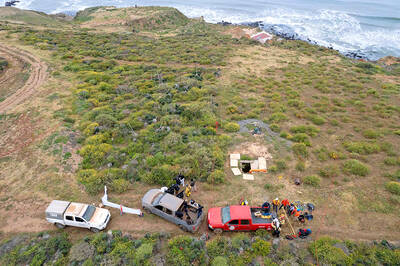
INTERNATIONAL PROBE: Australian and US authorities were helping coordinate the investigation of the case, which follows the 2015 murder of Australian surfers in Mexico Three bodies were found in Mexico’s Baja California state, the FBI said on Friday, days after two Australians and an American went missing during a surfing trip in an area hit by cartel violence. Authorities used a pulley system to hoist what appeared to be lifeless bodies covered in mud from a shaft on a cliff high above the Pacific. “We confirm there were three individuals found deceased in Santo Tomas, Baja California,” a statement from the FBI’s office in San Diego, California, said without providing the identities of the victims. Australian brothers Jake and Callum Robinson and their American friend Jack Carter
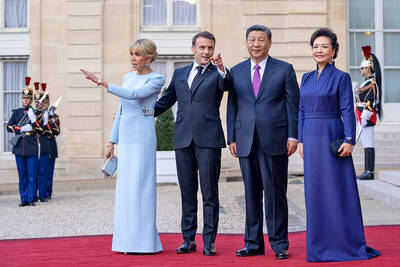
CUSTOMS DUTIES: France’s cognac industry was closely watching the talks, fearing that an anti-dumping investigation opened by China is retaliation for trade tensions French President Emmanuel Macron yesterday hosted Chinese President Xi Jinping (習近平) at one of his beloved childhood haunts in the Pyrenees, seeking to press a message to Beijing not to support Russia’s war against Ukraine and to accept fairer trade. The first day of Xi’s state visit to France, his first to Europe since 2019, saw respectful, but sometimes robust exchanges between the two men during a succession of talks on Monday. Macron, joined initially by EU Commission President Ursula von der Leyen, urged Xi not to allow the export of any technology that could be used by Russia in its invasion


 RSS
RSS