


France, Brazil, Chile and Germany called for a tax on airline tickets to help finance the global fight against poverty, and urged all countries to support the proposal.
The idea for a "solidarity levy" was presented by France's Minister of Economy and Finance Thierry Breton at a two-day UN ministerial meeting to follow up on commitments made three years ago at the UN summit on financing development in Monterrey, Mexico.
In the search for new ways of funding the UN goal of halving extreme poverty by 2015, Breton said an airline tax was "one of the most promising solutions for the developing countries and for the international aid architecture."
He said airline tickets were chosen because airlines benefit from globalization and pay low tax rates, because airline passengers "are rarely among the poorest citizens," and because the practical and legal feasibility of similar levels has been proven in Britain and elsewhere.
"In view of the need for immediate action and for proof that this is a workable approach, France, Brazil, Chile and Germany are therefore calling for the rapid implementation of a pilot solidarity levy based on airline tickets," Breton said.
He said the tax could be different for domestic and international travel and for economy and business seats, and it could also vary depending on a country's wealth. The proceeds would go through existing institutions "to avoid needless bureaucracy" and could be used to finance urgent programs such as vaccination campaigns or AIDS treatment, he said.
As an example, Breton said, if all countries participated a tax of 5 euros (US$6.08) per passenger, with a 20 euro (US$24.32) surcharge for business class, it would generate about 10 billion euros (US$12.16 billion) a year.
That's almost one-quarter of the estimated annual funding shortfall to meet the UN development goals, which also include ensuring universal primary education and stemming the AIDS pandemic by 2015, he said.
A year ago, he said, "the very idea of an international levy was taboo and considered inappropriate" but today it is on the agenda of the UN, the International Monetary Fund, the World Bank, the EU and the Group of Eight major industrialized nations who are meeting in Scotland from July 6-8.
"Many countries in both the northern and the southern hemisphere have already pledged support while others are planning to support us in the near future," he said.
Breton urged all countries to back the ticket tax in the run-up to the UN summit in September that Secretary-General Kofi Annan has called to tackle UN reform and adopt measures to achieve the UN development goals.
With more than 2 billion people living on less than US$2 a day, Annan called for "dramatic action" by developed and developing countries to ensure the goals are met, saying "never, perhaps, have a few weeks mattered so much for the world's poor."
Britain's International Development Secretary Hilary Benn warned that at the present rate of progress, "poverty will not be halved until 2150 -- 135 years too late" and "primary education for all will not be achieved until 2130 -- 115 years too late."
Since the 1960s, the UN has called for rich countries to increase aid to 0.7 percent of their national incomes. All 25 EU nations have recently pledged to reach that target by 2015.
Benn said that would double EU aid from US$40 billion to US$80 billion in 2010, with half going to Africa. He said the test of the G8 summit, in Gleneagles, Scotland, will be whether it comes up with the additional US$25 billion a year needed for Africa in 2010.
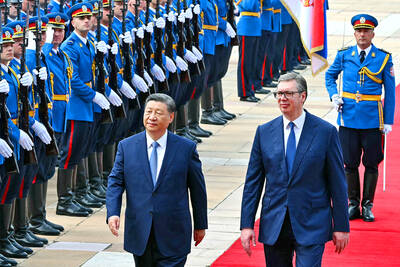
MONEY MATTERS: Xi was to highlight projects such as a new high-speed railway between Belgrade and Budapest, as Serbia is entirely open to Chinese trade and investment Serbian President Aleksandar Vucic yesterday said that “Taiwan is China” as he made a speech welcoming Chinese President Xi Jinping (習近平) to Belgrade, state broadcaster Radio Television of Serbia (RTS) said. “We have a clear and simple position regarding Chinese territorial integrity,” he told a crowd outside the government offices while Xi applauded him. “Yes, Taiwan is China.” Xi landed in Belgrade on Tuesday night on the second leg of his European tour, and was greeted by Vucic and most government ministers. Xi had just completed a two-day trip to France, where he held talks with French President Emmanuel Macron as the
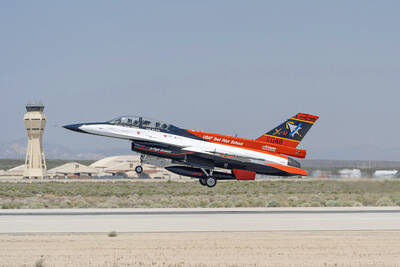
With the midday sun blazing, an experimental orange and white F-16 fighter jet launched with a familiar roar that is a hallmark of US airpower, but the aerial combat that followed was unlike any other: This F-16 was controlled by artificial intelligence (AI), not a human pilot, and riding in the front seat was US Secretary of the Air Force Frank Kendall. AI marks one of the biggest advances in military aviation since the introduction of stealth in the early 1990s, and the US Air Force has aggressively leaned in. Even though the technology is not fully developed, the service is planning
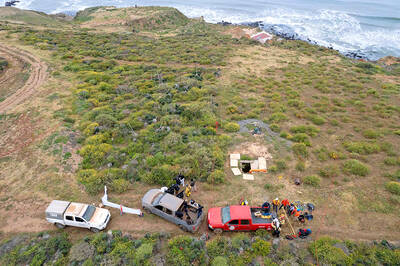
INTERNATIONAL PROBE: Australian and US authorities were helping coordinate the investigation of the case, which follows the 2015 murder of Australian surfers in Mexico Three bodies were found in Mexico’s Baja California state, the FBI said on Friday, days after two Australians and an American went missing during a surfing trip in an area hit by cartel violence. Authorities used a pulley system to hoist what appeared to be lifeless bodies covered in mud from a shaft on a cliff high above the Pacific. “We confirm there were three individuals found deceased in Santo Tomas, Baja California,” a statement from the FBI’s office in San Diego, California, said without providing the identities of the victims. Australian brothers Jake and Callum Robinson and their American friend Jack Carter
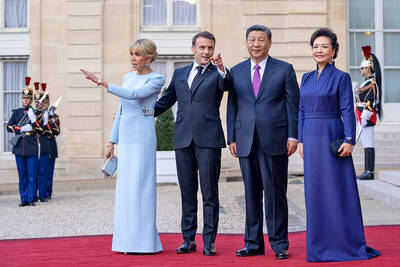
CUSTOMS DUTIES: France’s cognac industry was closely watching the talks, fearing that an anti-dumping investigation opened by China is retaliation for trade tensions French President Emmanuel Macron yesterday hosted Chinese President Xi Jinping (習近平) at one of his beloved childhood haunts in the Pyrenees, seeking to press a message to Beijing not to support Russia’s war against Ukraine and to accept fairer trade. The first day of Xi’s state visit to France, his first to Europe since 2019, saw respectful, but sometimes robust exchanges between the two men during a succession of talks on Monday. Macron, joined initially by EU Commission President Ursula von der Leyen, urged Xi not to allow the export of any technology that could be used by Russia in its invasion


 RSS
RSS