


More frozen bodies were recovered from an area of the Chilean Andes Saturday, bringing to 21 the number of confirmed dead after 45 young conscripts were lost in a blizzard in the Chilean army's worst peacetime disaster.
The commander in chief of the Chilean army vowed to continue the search "until the last one of them is with us," but he has admitted that those still missing since the blizzard struck Wednesday are probably dead.
"The bodies were found in the same condition as the others, perfectly identifiable," General Juan Emilio Cheyre said, announcing the latest recoveries at a military base in the town of Los Angeles, near where the tragedy occurred.
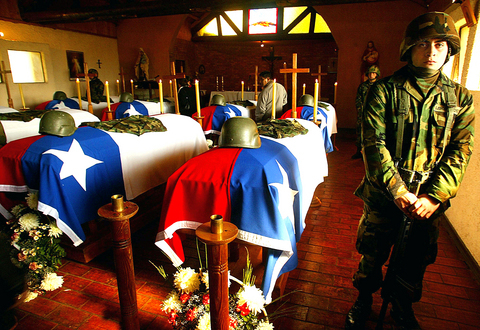
PHOTO: AP
Wrenching scenes of relatives receiving the bodies of their loved ones contrasted with the jubilation of families reunited with 112 soldiers who returned to Los Angeles on Saturday. They survived by crowding into a mountain shelter when the blizzard struck, military sources said.
Search teams, at times hindered by new storms, have combed the area since then as the nation reeled and President Ricardo Lagos announced three days of national mourning.
The soldiers went missing on Wednesday when they were caught in a sudden blizzard while on a march in the high Andes near Antuco, not far from Los Angeles, some 500km south of Santiago.
Lagos flew into the area Saturday to attend a religious service for the lost soldiers and personally express condolences to relatives of the victims, most of whom were conscripts doing mandatory military service who got caught in a snowstorm "whiteout."
Standing before the coffins containing the recovered soldiers' bodies, Lagos said: "Today we bid farewell to these soldiers of the Chilean Army as heroes of peace."
Speaking to the families of soldiers, Lagos gave his and his wife Luisa Duran's condolences, speaking "not as authorities but as parents ... who know how hard it is to lose a child."
"We would like to be able to hold you in a strong embrace, the embrace of the millions of Chileans whose thoughts have been with each and every one of you these past few days," he said, barely able to contain his emotion.
Earlier, in his annual address to lawmakers, made at Valparaiso before he headed south to the area of the tragedy, an emotional Lagos said "our souls and our hearts are in Antuco."
"I think that the tragedy that has befallen us must help us, as have other tragic times in our history, to overcome them," said Lagos, who called for "building a better Chile."
As Lagos spoke in Valparaiso, students took to the streets clashing with police there amid a demonstration against a new law that gives students who attend private universities access to the state scholarship system.
At least 75 students were arrested in the incident which was not related to the mountain tragedy.
Cheyre told reporters at a briefing Friday that the snow training "never should have been carried out."
"There is a responsibility on the part of the command here, a responsibility for having done a march that never should have been done," Cheyre acknowledged.

‘CROSSING THE LINE’: China’s embassy in Seoul criticized US Forces Korea Commander General Xavier Brunson, asking if his ‘hostile’ remarks were authorized by Washington South Korea and the US are in talks over recent public remarks by the commander of US Forces Korea, Seoul’s presidential office said yesterday, after the comments drew sharp criticism from China. In a recent podcast interview, US Forces Korea Commander General Xavier Brunson described South Korea as “the dagger in the heart of Asia” from China’s east coast, prompting the Chinese embassy in Seoul to say that he had “truly crossed the line.” The interview came amid growing speculation that Washington might seek to expand the role of US Forces Korea in countering the growing regional influence of China, a key

SEEKING ORDER: Rodrigo Paz said that ‘anyone who wants to destroy the nation will have to deal with this president and the full force of the constitution’ Bolivian President Rodrigo Paz on Wednesday said that the nation was at a “breaking point” after nearly a month of protests that have caused shortages of food, fuel and medicine. Paz, who took office six months ago amid the worst economic crisis there in four decades, is battling a groundswell of fury over his policies. The political capital, La Paz, has been besieged by low-income workers and members of the indigenous majority calling for his resignation. “The country needs order and is reaching breaking point,” the 58-year-old said at a public event in La Paz, renewing his appeal for dialogue. On Tuesday, the Bolivian

Through the noise of rushing papers and whirring belts at a print factory in Kyoto, two creators watch their photo essay come to life in broadsheet form — part of an effort to win new audiences in the age of artificial intelligence (AI). Despite the decline of the publishing industry, self-publication and handmade “zine” magazines are growing in popularity in Japan, reflecting the nation’s enduring love of paper in the digital era. While speaking to Agence France-Presse at the plant, his hands black with ink, one of the creators, Kazuma Obara, said: “I think [paper] is a medium that engages all five

Australian researchers have trained lab-grown brain cells on a silicon computer chip to play the 1990s shooter game Doom and said they are just scratching the surface of what the neurons could be capable of doing. It is the science-fiction work of biotech boffins at Cortical Labs, who researched and developed the technology that harnesses the workings of the brain’s networking system. Each so-called “biological computer” contains about 200,000 living human brain cells, grown from stem cells that were harvested from blood donations. Having mastered the simple computer game Pong, where a paddle is moved up and down to send a ball


 RSS
RSS