


Japan and China agreed in their latest meeting to keep talking to sort out high tensions, but the dialogue only confirms the wide gap between them on issues from past history to future energy excavation.
Foreign ministers late Saturday held the two nations' third major talks since their relations nose-dived last month and said they would look forward in the wake of virulent anti-Japanese demonstrations in China.
Meeting at an Asia-Europe foreign ministers meeting in Kyoto, Japan, the ministers agreed to set up a joint study of their common history and to hold talks on a potentially huge disputed gas field in the East China Sea.

PHOTO: AP
But even if the nations will keep talking, there is no sign they will come to any consensus.
"The meeting showed their real intention of mending bilateral ties and it also clarified what the problems are," said Masahiro Wakabayashi, professor of international politics at the University of Tokyo.
"What they need is self-restraint and continued dialogue. But it seems it will take some time to repair relations, especially as they are heading toward the sensitive time of World War II commemorations," Wakabayashi said.
The history issue was the immediate trigger for the current spat, with China furious at Tokyo's approval of a textbook written by avowed nationalists who believe Japan is too apologetic about the past.
The foreign ministers clashed bitterly about textbooks during Saturday's meeting, according to a Japanese official.
Li Zhaoxing (李肇星) of China blasted as "wrong" the "textbook of the Japanese rightists" and his counterpart Nobutaka Machimura voiced concern over "extreme expressions" on Japan in Chinese books such as not recognizing its post-war aid to Beijing, the official said.
On the other issue where they agreed to expand dialogue -- energy -- the foreign ministers were also at loggerheads.
Japan demanded China give information on its drilling in the East China Sea and Li responded that the demarcation line set by Tokyo was invalid, the official said.
The official said Li also renewed China's strong opposition to visits by Prime Minister Junichiro Koizumi to the Yasukuni shrine, which honors Japanese war dead including convicted war criminals.
Koizumi, who has gone each year to the Shinto sanctuary in Tokyo since taking office in 2001, has defended his pilgrimages as a sign of respect for the dead.
On April 22, he used a Jakarta summit of Asian and African leaders to offer a fresh apology for suffering caused by Japan, a day before he met with Chinese President Hu Jintao (胡錦濤).
Machimura also visited Beijing before the Jakarta conference for a round of tense talks.
China said after the latest meeting that Japan needed to show more than words to exorcise its war ghosts.
Chinese foreign ministry spokesman Qin Gang (秦剛) said Li hoped Japan can "implement in action its introspection and apology over history."
Li again refused to apologize for the demonstrations in China, although Japanese officials said he promised at least to study compensation and that Machimura voiced appreciation that the protests have subsided.
The two foreign ministers in general terms said they wanted stable relations. The issue is all the more important as China is Japan's biggest trading partner, with a growing number of Japanese firms using China as a manufacturing base.
But Li was also unsparing on another issue -- Taiwan -- after Japan and the US declared the island claimed by China a common security concern.
"I would like to say calmly to Japan: The Taiwan issue is a domestic affair and a matter of life or death to us. It is dangerous to touch China's matter of life or death," Li was quoted as saying by the Japanese official.
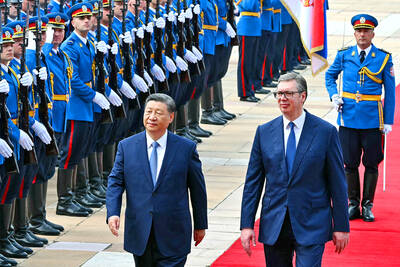
MONEY MATTERS: Xi was to highlight projects such as a new high-speed railway between Belgrade and Budapest, as Serbia is entirely open to Chinese trade and investment Serbian President Aleksandar Vucic yesterday said that “Taiwan is China” as he made a speech welcoming Chinese President Xi Jinping (習近平) to Belgrade, state broadcaster Radio Television of Serbia (RTS) said. “We have a clear and simple position regarding Chinese territorial integrity,” he told a crowd outside the government offices while Xi applauded him. “Yes, Taiwan is China.” Xi landed in Belgrade on Tuesday night on the second leg of his European tour, and was greeted by Vucic and most government ministers. Xi had just completed a two-day trip to France, where he held talks with French President Emmanuel Macron as the

With the midday sun blazing, an experimental orange and white F-16 fighter jet launched with a familiar roar that is a hallmark of US airpower, but the aerial combat that followed was unlike any other: This F-16 was controlled by artificial intelligence (AI), not a human pilot, and riding in the front seat was US Secretary of the Air Force Frank Kendall. AI marks one of the biggest advances in military aviation since the introduction of stealth in the early 1990s, and the US Air Force has aggressively leaned in. Even though the technology is not fully developed, the service is planning
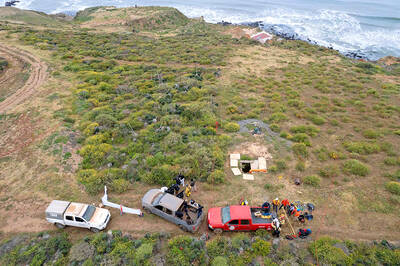
INTERNATIONAL PROBE: Australian and US authorities were helping coordinate the investigation of the case, which follows the 2015 murder of Australian surfers in Mexico Three bodies were found in Mexico’s Baja California state, the FBI said on Friday, days after two Australians and an American went missing during a surfing trip in an area hit by cartel violence. Authorities used a pulley system to hoist what appeared to be lifeless bodies covered in mud from a shaft on a cliff high above the Pacific. “We confirm there were three individuals found deceased in Santo Tomas, Baja California,” a statement from the FBI’s office in San Diego, California, said without providing the identities of the victims. Australian brothers Jake and Callum Robinson and their American friend Jack Carter
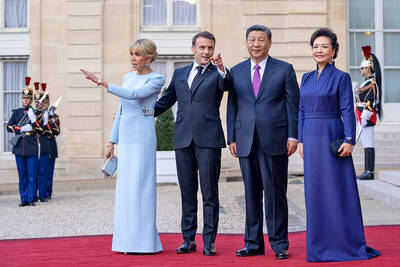
CUSTOMS DUTIES: France’s cognac industry was closely watching the talks, fearing that an anti-dumping investigation opened by China is retaliation for trade tensions French President Emmanuel Macron yesterday hosted Chinese President Xi Jinping (習近平) at one of his beloved childhood haunts in the Pyrenees, seeking to press a message to Beijing not to support Russia’s war against Ukraine and to accept fairer trade. The first day of Xi’s state visit to France, his first to Europe since 2019, saw respectful, but sometimes robust exchanges between the two men during a succession of talks on Monday. Macron, joined initially by EU Commission President Ursula von der Leyen, urged Xi not to allow the export of any technology that could be used by Russia in its invasion


 RSS
RSS