


A congressional investigation found airport screeners employed by private companies do a better job of detecting dangerous objects than government screeners, according to a US House of Representatives member who has seen the classified report.
The Government Accountability Office found statistically significant evidence that passenger screeners, who work at five airports under a pilot program, performed better than their federal counterparts at some 450 airports, Republican Representative John Mica of Florida, chairman of the House Transportation aviation subcommittee, said on Tuesday.
"You get a statistically significant improvement if you go to federal supervision with private screening companies," Mica said.
After the Sept. 11, 2001 terror attacks, Congress ordered every commercial airport but five to switch from privately employed screeners to a government work force.
The five exceptions -- in San Francisco, California; Tupelo, Mississippi; Rochester, New York; Kansas City, Missouri; and Jackson Hole, Wyoming -- have private workers supervised by Transportation Security Administration (TSA) officials.
Mica wants to see that system at all US airports.
Oregon Representative Peter DeFazio, a senior Democrat on the aviation subcommittee, opposes private screeners.
DeFazio, who has seen the classified GAO report, said the difference between the screeners was statistically significant but still slight.
"Neither number is adequate or reassuring to me, and the difference is not very large," DeFazio said.
TSA screeners' ability to find guns and other weapons and dangerous items since the Sept. 11 attacks has been a continuing problem.
The Homeland Security Department's acting inspector general, Richard Skinner, issued a separate report on Tuesday that said the screeners' performance hadn't improved since the previous audit, which indicated screeners had not improved since before the 2001 terror attacks.

Kouri Richins, a Utah mother who published a children’s book about grief after the death of her husband is to serve a life sentence for his murder without the possibility of parole, a judge ruled on Wednesday. Richins was convicted in March of aggravated murder for lacing a cocktail given to her husband, Eric Richins, with five times the lethal dose of fentanyl at their home near Park City in 2022. A jury also found her guilty of four other felonies, including insurance fraud, forgery and attempted murder for trying to poison her husband weeks earlier on Feb. 14, 2022, with a
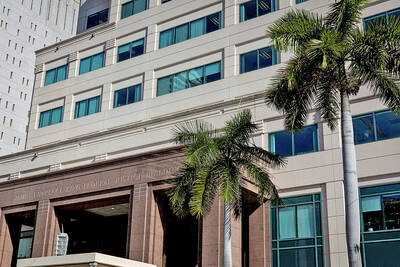
‘GROSS NEGLIGENCE?’ Despite a spleen typically being significantly smaller than a liver, the surgeon said he believed Bryan’s spleen was ‘double the size of what is normal’ A Florida surgeon who is facing criminal charges after allegedly removing a patient’s liver instead of his spleen has said he is “forever traumatized” by that person’s death. In a deposition from November last year that was recently obtained by NBC, 44-year-old Thomas Shaknovsky described the death of 70-year-old William Bryan as an “incredibly unfortunate event that I regret deeply.” Bryan died after the botched surgery; and last month, a grand jury in Tallahassee indicted Shaknovsky on a charge of manslaughter. “I’m forever traumatized by it and hurt by it,” Shaknovsky added, also saying that wrong-site surgeries can happen “during

‘PERSONAL MISTAKES’: Eileen Wang has agreed to plead guilty to the felony, which comes with a maximum sentence of 10 years in federal prison A southern California mayor has agreed to plead guilty to acting as an illegal agent for the Chinese government and has resigned from her city position, officials said on Monday. Eileen Wang (王愛琳), mayor of Arcadia, was charged last month with one count of acting in the US as an illegal agent of a foreign government. She was accused of doing the bidding of Chinese officials, such as sharing articles favorable to Beijing, without prior notification to the US government as required by law. The 58-year-old was elected in November 2022 to a five-person city council, from which the mayor is selected
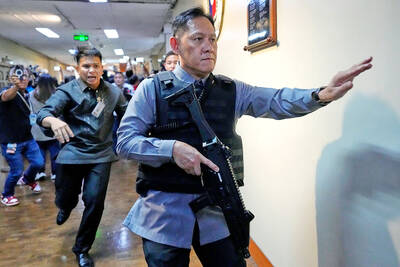
DELA ROSA CASE: The whereabouts of the senator, who is wanted by the ICC, was unclear, while President Marcos faces a political test over the senate situation Philippine authorities yesterday were seeking confirmation of reports that a top politician wanted by the International Criminal Court (ICC) had fled, a day after gunfire rang out at the Philippine Senate where he had taken refuge fearing his arrest. Senator Ronald “Bato” dela Rosa, the former national police chief and top enforcer of former Philippine president Rodrigo Duterte’s “war on drugs,” has been under Senate protection and is wanted for crimes against humanity, the same charges Duterte is accused of. “Several sources confirmed that the senator, Senator Bato, is no longer in the Senate premises, but we are still getting confirmation,” Presidential


 RSS
RSS