


The world's most wired country is raiding cyberspace's red-light district in a campaign pitting Confucian morals against modern technology.
Since January, the main prosecutor's office in Seoul has issued arrest warrants for about 100 people charged with spreading obscene material under South Korea's telecommunications law, a crime carrying penalties of up to a year in jail or a nearly US$10,000 fine.
In a highly publicized case last month, police in the southern city of Busan arrested the operator of a Web site that offers a forum to arrange swaps of sex partners. The 36-year-old man, whose name hasn't been released, is charged with spreading obscene material and remains jailed while the investigation continues, said Busan police officer Lee Nam-sik, who is heading the probe. The campaign comes amid a wider moral crackdown starting last year, when penalties for prostitution-related crimes were also doubled.
Korea has an active sex trade -- both online and off.
According to the Korean Institute of Criminology, the amount spent on prostitution alone amounted to US$23.6 billion in 2002, the last year for which figures were available.
At a recent Cabinet meeting, where the campaign against prostitution was discussed, President Roh Moo-hyun stressed the need for establishing a "healthy consumption culture," implying money should be spent on things other than the sex trade.
In a country where more than 70 percent of homes have high-speed Internet connections, access to cyberporn is easy.
That means traditional taboos in Korea's conservative, Confucian-based society have quickly shattered, said Lee Mee-sook, a sociology professor at Paichai University in the central city of Daejeon.
"The code of ethics became weak, and people started satisfying their sexual desires through the Internet -- anonymously," she said.
On a busy street in the center of the South Korean capital Seoul, "adult" Internet cafes aren't hard to find, where customers can surf the Web in private booths as opposed to the open rows of computers found in typical cybercafes.
Authorities "can't really control it because it's the Internet, it's impossible," said Lee, 28, a worker at the Red Box adult Internet cafe, who gave only his last name. "We should have the freedom to see whatever we want."

SPEAKING OUT: After Siranudh Scott’s allegations surfaced, celebrities and public figures took to social media to share their own experiences of sexual misconduct and abuse A high-profile alleged sexual abuse case within a wealthy Thai beer brewing family has prompted a wave of painful accounts from survivors of unconnected abuse in the conservative nation. Siranudh Scott, a member of the billionaire Thai family that founded the ubiquitous Singha beer brand, posted an emotional video this month accusing his elder brother Sunit of repeatedly abusing him when he was a teenager. Sunit, who is in his 30s, later denied the allegations in a video posted online, but Singha parent Boonrawd dismissed him from his executive role with the company on Tuesday last week. “I felt I needed to speak

A Hong Kong astronaut is to join a Chinese space mission for the first time as part of a three-person crew launching today, as Beijing edges closer to its goal of landing people on the moon. The Tiangong space station — crewed by teams of three astronauts that are typically rotated every six months — is the crown jewel of China’s space program, boosted by billions in state investment in a bid to catch up with the US and Russia. The Shenzhou-23 mission is to blast off at 11:08pm from the Jiuquan Satellite Launch Center in northwestern China, carrying three astronauts to
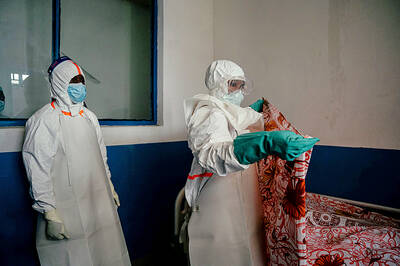
UPGRADED ALERT: The risk inside DR Congo is now considered ‘very high,’ while neighboring countries face a ‘high’ threat as the outbreak continues, the WHO said Ebola is spreading faster than responders can track it in eastern Congo, where health workers managed to follow up with barely one in five identified contacts in a single day. Authorities in the Democratic Republic of the Congo (DR Congo) reported 83 confirmed infections, 746 suspected cases and 1,603 identified contacts as of Thursday, but health workers were able to follow up on only 342 contacts that day — about 21 percent of the total under monitoring — data released by the DR Congo Ministry of Public Health on Friday showed. The figures suggest the response is falling behind the outbreak itself,

SEEKING ORDER: Rodrigo Paz said that ‘anyone who wants to destroy the nation will have to deal with this president and the full force of the constitution’ Bolivian President Rodrigo Paz on Wednesday said that the nation was at a “breaking point” after nearly a month of protests that have caused shortages of food, fuel and medicine. Paz, who took office six months ago amid the worst economic crisis there in four decades, is battling a groundswell of fury over his policies. The political capital, La Paz, has been besieged by low-income workers and members of the indigenous majority calling for his resignation. “The country needs order and is reaching breaking point,” the 58-year-old said at a public event in La Paz, renewing his appeal for dialogue. On Tuesday, the Bolivian


 RSS
RSS