


ASEAN foreign ministers said yesterday they have deferred the issue of Myanmar's controversial chairmanship of the regional trade group until at least July, saying it is up to the military-ruled country's leadership to make a decision.
At issue is Myanmar's poor human rights record, lack of democratic reform and detention of hundreds of political activists, including pro-democracy leader Aung San Suu Kyi.
The US and the EU warn they would stall funding of ASEAN development projects and boycott meetings if Myanmar is allowed to take its turn in charge next year.
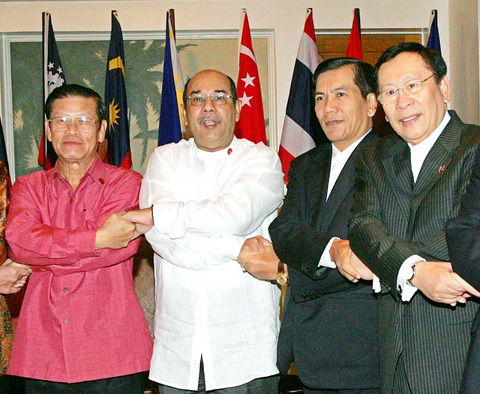
PHOTO: REUTERS
The foreign ministers found themselves in a quandary because one of ASEAN's basic tenets is noninterference in each country's internal affairs. Singapore Foreign Affairs Minister George Yeo called it "an unpleasant family problem."
"There is a reluctance on the part of the ASEAN to say: `You don't chair. Move on to the next person,' because once you establish that precedent, there will be problems downstream," Yeo said. "Understandably, the foreign ministers would rather not make that move, but we communicated our concerns."
Malaysian Foreign Minister Syed Hamid Albar said there was no indication what Myanmar will do.
"We leave it up to Myanmar to make their sovereign decision," he said.
Trying to put a veneer of unity on the divisive issue, Laos Foreign Minister Somsavat Lengsavat said the ASEAN ministers decided that their annual informal retreat wasn't the proper place to decide the issue, which will be discussed further at their ministerial meeting in Laos.
"If you insist on asking about Myanmar, you better go to Vientiane," Somsavat told reporters at a news conference wrapping up the retreat.
While Somsavat said twice that the issue had not been on the agenda here, Syed Hamid said it was discussed during the coffee break for 45 minutes, when countries expressed concerns about Myanmar's failure to implement a roadmap to democracy.
Myanmar Foreign Minister Nyan Win said he would convey the concerns to his leader, Syed Hamid said.
Cambodia, Laos and Vietnam reportedly back Myanmar's right to the chairmanship. Malaysia, the Philippines and Singapore have indicated they want to see progress in implementing reforms first.
Philippine Foreign Secretary Alberto Romulo was visibly upset as he left the closed-door meeting and did not reply to questions from reporters about Myanmar.
Romulo had said he would reiterate calls for Myanmar to free Nobel Peace laureate Suu Kyi, craft a Constitution with input from the political opposition, and allow a UN special envoy to revisit.
"What we don't want is for ASEAN to be dragged into their domestic, political process which is at a critical, sensitive phase," Yeo said. "It is their turn to host, by right. But we know that looking further down the road, there will be a problem. So if we can avert the problem now, early, we should.
"We recognize while we tell them to release Aung San Suu Kyi and put a time frame on the roadmap, in the end, whether this all will lead to great joy or tragedy, it is the Myanmar people and not the rest of us who will bear the consequences," he said.
Myanmar could voluntarily give up the role, but that's an option Yangon was unlikely to heed, the diplomat said, and ASEAN could also allow Myanmar to assume the leadership unconditionally.

‘CROSSING THE LINE’: China’s embassy in Seoul criticized US Forces Korea Commander General Xavier Brunson, asking if his ‘hostile’ remarks were authorized by Washington South Korea and the US are in talks over recent public remarks by the commander of US Forces Korea, Seoul’s presidential office said yesterday, after the comments drew sharp criticism from China. In a recent podcast interview, US Forces Korea Commander General Xavier Brunson described South Korea as “the dagger in the heart of Asia” from China’s east coast, prompting the Chinese embassy in Seoul to say that he had “truly crossed the line.” The interview came amid growing speculation that Washington might seek to expand the role of US Forces Korea in countering the growing regional influence of China, a key

SEEKING ORDER: Rodrigo Paz said that ‘anyone who wants to destroy the nation will have to deal with this president and the full force of the constitution’ Bolivian President Rodrigo Paz on Wednesday said that the nation was at a “breaking point” after nearly a month of protests that have caused shortages of food, fuel and medicine. Paz, who took office six months ago amid the worst economic crisis there in four decades, is battling a groundswell of fury over his policies. The political capital, La Paz, has been besieged by low-income workers and members of the indigenous majority calling for his resignation. “The country needs order and is reaching breaking point,” the 58-year-old said at a public event in La Paz, renewing his appeal for dialogue. On Tuesday, the Bolivian

Australian researchers have trained lab-grown brain cells on a silicon computer chip to play the 1990s shooter game Doom and said they are just scratching the surface of what the neurons could be capable of doing. It is the science-fiction work of biotech boffins at Cortical Labs, who researched and developed the technology that harnesses the workings of the brain’s networking system. Each so-called “biological computer” contains about 200,000 living human brain cells, grown from stem cells that were harvested from blood donations. Having mastered the simple computer game Pong, where a paddle is moved up and down to send a ball

Through the noise of rushing papers and whirring belts at a print factory in Kyoto, two creators watch their photo essay come to life in broadsheet form — part of an effort to win new audiences in the age of artificial intelligence (AI). Despite the decline of the publishing industry, self-publication and handmade “zine” magazines are growing in popularity in Japan, reflecting the nation’s enduring love of paper in the digital era. While speaking to Agence France-Presse at the plant, his hands black with ink, one of the creators, Kazuma Obara, said: “I think [paper] is a medium that engages all five


 RSS
RSS