


Arab television stations have launched a media blitz for the death of Pope Paul John II, giving Mideast viewers hours of live broadcasts from the Vatican and programs on the pontiff's life -- coverage rarely seen even for the region's autocrats.
The lavish airtime made the Arab world a participant in the giant outpouring of grief that took place in Rome and was aired heavily on pan-Arab stations like Al-Jazeera and Al-Arabiya, which have been increasing their coverage of major events outside the Arab world.
But it also generated a backlash. Islamic fundamentalists in particular criticized the parade of Muslim leaders on TV praising the head of a faith that they consider an enemy of Islam.

PHOTO: EPA
"How can the death of a non-Muslim be a loss to the Muslim world?" said Gamal Sultan, an Egyptian Islamic activist and editor of Al-Manar, a journal that serves as a mouthpiece of Islamic fundamentalists.
The pope had a mixed legacy among Arabs, particularly the region's Muslim majority. He was widely respected for criticizing the US invasion of Iraq and for calling for a just peace between Palestinians and Israelis, meeting several times with the late Palestinian leader Yasser Arafat.
He was also the first pope to visit a mosque -- the revered Omayyad Mosque in Damascus during a 2001 trip to Syria -- and he promoted Muslim-Christian dialogue.
On Arab television stations, numerous Muslim clerics went on the air to praise John Paul.
"His death is a great loss not only to the Catholic church but to the Islamic world," Sheik Mohammed Seyed Tantawi, the leader of Cairo's Al-Azhar, one of the world's top Islamic institutions, said in a statement read over the Egyptian state-run television.
In Web sites known as clearing houses for Islamic militant materials, criticism was even harsher.
"How is it that these [Muslim] clerics of the royal courts heap praise on an infidel and an enemy of Islam," wrote a participant on one of Web forum.

Through the noise of rushing papers and whirring belts at a print factory in Kyoto, two creators watch their photo essay come to life in broadsheet form — part of an effort to win new audiences in the age of artificial intelligence (AI). Despite the decline of the publishing industry, self-publication and handmade “zine” magazines are growing in popularity in Japan, reflecting the nation’s enduring love of paper in the digital era. While speaking to Agence France-Presse at the plant, his hands black with ink, one of the creators, Kazuma Obara, said: “I think [paper] is a medium that engages all five

‘CROSSING THE LINE’: China’s embassy in Seoul criticized US Forces Korea Commander General Xavier Brunson, asking if his ‘hostile’ remarks were authorized by Washington South Korea and the US are in talks over recent public remarks by the commander of US Forces Korea, Seoul’s presidential office said yesterday, after the comments drew sharp criticism from China. In a recent podcast interview, US Forces Korea Commander General Xavier Brunson described South Korea as “the dagger in the heart of Asia” from China’s east coast, prompting the Chinese embassy in Seoul to say that he had “truly crossed the line.” The interview came amid growing speculation that Washington might seek to expand the role of US Forces Korea in countering the growing regional influence of China, a key
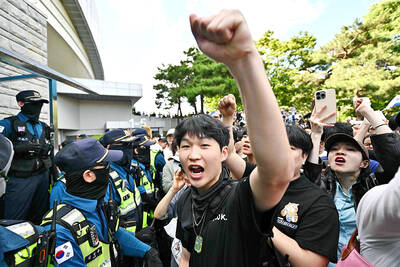
‘ABSURD MISTAKE’: The election commission said that there had been a failure to anticipate turnout after 14 polling stations ran short of ballot papers South Korean riot police yesterday cleared protesters from a Seoul polling station after a 35-hour blockade sparked by a shortage of ballot papers during local elections earlier this week. Wednesday’s election was the first nationwide vote since South Korean President Lee Jae-myung took office following the ouster of Yoon Suk-yeol over his short-lived martial law declaration. Lee’s ruling Democratic Party swept most races, but failed to flip the crucial Seoul mayoral seat. The South Korean National Election Commission apologized, blaming a failure to anticipate turnout after 14 polling stations in Seoul ran short of ballot papers. Some polling stations stayed open until 10pm to

Australian researchers have trained lab-grown brain cells on a silicon computer chip to play the 1990s shooter game Doom and said they are just scratching the surface of what the neurons could be capable of doing. It is the science-fiction work of biotech boffins at Cortical Labs, who researched and developed the technology that harnesses the workings of the brain’s networking system. Each so-called “biological computer” contains about 200,000 living human brain cells, grown from stem cells that were harvested from blood donations. Having mastered the simple computer game Pong, where a paddle is moved up and down to send a ball


 RSS
RSS