


Prime Minister Tony Blair yesterday called a national election on May 5, triggering a four-week campaign that will test a volatile electorate's judgment of the Iraq war.
Despite lingering anger over the US-led invasion, Blair's governing Labor Party is widely expected to win a third term in office, bolstered by a strong economy.
"We are proud of what we have achieved in the last eight years," Blair said, after asking Queen Elizabeth II's permission to dissolve Parliament.
"It's a big choice and there's a lot at stake," he added, standing on the steps of his Downing Street office. "The British people are the boss and they are the ones who will make it."
Several opinion polls published yesterday showed Labor giving ground slightly to the main opposition Conservative Party, although still with leads of between 2 and 5 percentage points.
Given the margin of error, the parties were virtually neck and neck. Analysts say, however, the Conservatives would need a lead of several points to win the election, due to an uneven spread of constituencies across Britain's electoral map.
The poll will be an important personal test for Blair. A charismatic and dynamic leader, he helped catapult Labor to power in 1997 and win a second landslide election victory in 2001.
But the war, and the government's use of intelligence on Iraqi weapons of mass destruction, which turned out to be wrong, have severely dented his credibility.
Blair's popularity has been further eroded by his close relationship with US President George W. Bush and the perception that he slavishly follows Washington's foreign policy without exerting any real influence.
The alliance has caused tension within the Labor party and one of its parliamentary candidates, Stephen Wilkinson, announced yesterday he would now stand for the Liberal Democrats, the only major party to oppose the war.
"Who could have thought that a Labor government would become a lapdog to George Bush's right-wing Republican administration?" he said.
However, many analysts believe Blair has weathered the worst of the Iraq storm. His personal ratings have improved markedly from last year's slump and the successful elections in Iraq have provided some vindication for the war.
The government's position is also strengthened by a strong economy and the fact that the Conservatives also backed the war and have failed to land significant punches on Blair over the conflict.
Labor has a massive lead in the 659-seat House of Commons, with 410 lawmakers -- 161 more than all the other parties combined. Most believe that such a lead is insurmountable. But Labor officials fear that a low turnout by core Labor supporters, coupled with a voter backlash over the war, could substantially cut the government's majority.
Such a scenario was underlined by a MORI poll published yesterday in the Financial Times. The survey of people who said they would definitely vote put the Conservatives at 39 percent, five points ahead of Labor. MORI surveyed 1,001 adults between April 1-3.
Domestic issues such as health care, education, crime and immigration are likely to dominate the four week election campaign.
Under Britain's parliamentary system, the leader of the party with the most seats automatically becomes prime minister. Blair must fight for re-election to his parliamentary seat in the constituency of Sedgefield, northern England, which he has held since 1983.
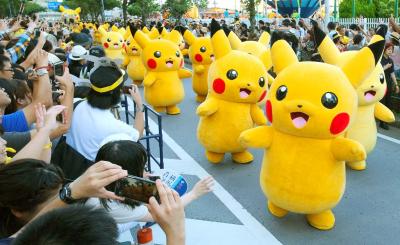
China’s military news agency yesterday warned that Japanese militarism is infiltrating society through series such as Pokemon and Detective Conan, after recent controversies involving events at sensitive sites. In recent days, anime conventions throughout China have reportedly banned participants from dressing as characters from Pokemon or Detective Conan and prohibited sales of related products. China Military Online yesterday posted an article titled “Their schemes — beware the infiltration of Japanese militarism in culture and sports.” The article referenced recent controversies around the popular anime series Pokemon, Detective Conan and My Hero Academia, saying that “the evil influence of Japanese militarism lives on in

DIPLOMATIC THAW: The Canadian prime minister’s China visit and improved Beijing-Ottawa ties raised lawyer Zhang Dongshuo’s hopes for a positive outcome in the retrial China has overturned the death sentence of Canadian Robert Schellenberg, a Canadian official said on Friday, in a possible sign of a diplomatic thaw as Canadian Prime Minister Mark Carney seeks to boost trade ties with Beijing. Schellenberg’s lawyer, Zhang Dongshuo (張東碩), yesterday confirmed China’s Supreme People’s Court struck down the sentence. Schellenberg was detained on drug charges in 2014 before China-Canada ties nosedived following the 2018 arrest in Vancouver of Huawei chief financial officer Meng Wanzhou (孟晚舟). That arrest infuriated Beijing, which detained two Canadians — Michael Spavor and Michael Kovrig — on espionage charges that Ottawa condemned as retaliatory. In January

A sign hanging from a rusty ice-green shipping container installed by Thai forces on what they say is the border with Cambodia reads: “Cambodian citizens are strictly prohibited from entering this area.” On opposite sides of the makeshift barricade, fronted by coils of barbed wire, Cambodians lamented their lost homes and livelihoods as Thailand’s military showed off its gains. Thai forces took control of several patches of disputed land along the border during fighting last year, which could amount to several square kilometers in total. Cambodian Kim Ren said her house in Chouk Chey used to stand on what is now the Thai
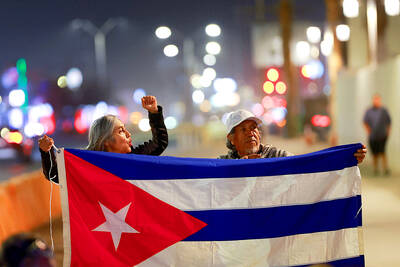
NEW RULES: There would be fewer school days, four-day workweeks, and a reduction in transportation services as the country battles a crisis exacerbated by US pressure The Cuban government on Friday announced emergency measures to address a crippling energy crisis worsened by US sanctions, including the adoption of a four-day work week for state-owned companies and fuel sale restrictions. Cuban Deputy Prime Minister Oscar Perez-Oliva Fraga blamed Washington for the crisis, telling Cuban television the government would “implement a series of decisions, first and foremost to guarantee the vitality of our country and essential services, without giving up on development.” “Fuel will be used to protect essential services for the population and indispensable economic activities,” he said. Among the new measures are the reduction of the working week in


 RSS
RSS