


President Hamid Karzai has announced that parliamentary elections planned for May will be postponed until September, confirming that logistical glitches have delayed a vote supposed to complete the country's transition to democracy.
A bomb attack that killed five people further underlined the challenges Afghanistan faces more than three years after the fall of the Taliban. Visiting US Secretary of State Condoleezza Rice pledged sustained support for Afghanistan's democratic transition, though she said Washington has yet to decide whether to keep long-term military bases.
The bomb exploded Thursday on the side of a street in the southern city of Kandahar, killing at least five people and wounding 32. Police blamed Taliban-led rebels for the attack, which hit a passing taxi carrying women and children, a roadside restaurant and other people.
A purported Taliban spokesman denied responsibility for the attack, which took place while Rice was in the capital, Kabul, 240km to the northeast.
The bombing happened 10 days after a British consultant to the Afghan government was assassinated in Kabul, casting doubt on assertions by Karzai and the US military that the country is becoming secure.
The city's police chief Khan Mohammed said that about two hours before the bombing, another explosion 10km west of Kandahar broke the window of a passing UN vehicle. No one was hurt.
The parliamentary vote was scheduled for May but the UN and the Afghan electoral commission have been grappling with problems, including a lack of census data and logistics of registering thousands of returning refugees.
"The preparations are going on and now they told us, the commission chairman, that the elections will be held in September," Karzai said at a news conference with Rice at his Kabul palace. "The Afghan people are waiting very eagerly to send their members to parliament."
Afghanistan adopted a new constitution early in 2004 and successfully held the presidential vote in October, despite worries of violence.
The country's booming heroin industry was a "serious problem," Rice said, though one which both she and Karzai said was being tackled with a crackdown on opium farmers and smugglers and millions in aid to promote legal crops. She said the US made a mistake by losing its focus on Afghanistan following the Soviet withdrawal in 1989, which plunged the country into civil war.
Rice wouldn't elaborate on whether it wanted long-term bases in the country, which borders Iran and other oil-rich Central Asian countries.

SPEAKING OUT: After Siranudh Scott’s allegations surfaced, celebrities and public figures took to social media to share their own experiences of sexual misconduct and abuse A high-profile alleged sexual abuse case within a wealthy Thai beer brewing family has prompted a wave of painful accounts from survivors of unconnected abuse in the conservative nation. Siranudh Scott, a member of the billionaire Thai family that founded the ubiquitous Singha beer brand, posted an emotional video this month accusing his elder brother Sunit of repeatedly abusing him when he was a teenager. Sunit, who is in his 30s, later denied the allegations in a video posted online, but Singha parent Boonrawd dismissed him from his executive role with the company on Tuesday last week. “I felt I needed to speak

SEEKING ORDER: Rodrigo Paz said that ‘anyone who wants to destroy the nation will have to deal with this president and the full force of the constitution’ Bolivian President Rodrigo Paz on Wednesday said that the nation was at a “breaking point” after nearly a month of protests that have caused shortages of food, fuel and medicine. Paz, who took office six months ago amid the worst economic crisis there in four decades, is battling a groundswell of fury over his policies. The political capital, La Paz, has been besieged by low-income workers and members of the indigenous majority calling for his resignation. “The country needs order and is reaching breaking point,” the 58-year-old said at a public event in La Paz, renewing his appeal for dialogue. On Tuesday, the Bolivian
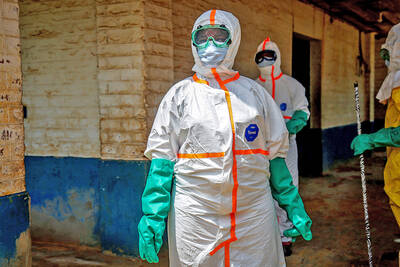
COMMUNITY CONFLICT: Concerns about disease spread from corpses has run up against friends and families’ desire to bury their dead as infection spreads in the area Angry residents of a town at the epicenter of the Ebola outbreak in the Democratic Republic of the Congo (DR Congo) attacked and burned a tent that was part of a health center where people are being treated for the virus, the staff there said Saturday. It was the second such attack in the region in a week. No one was hurt in the attack, according to reports but as patients ran out to escape the fire, 18 people with suspected Ebola infections fled the facility and are unaccounted for, a hospital director said. Angry residents arrived at the clinic in the

Forecasters in Europe yesterday warned of exceptional heat as record temperatures driven by a “heat dome” push temperatures well above seasonal norms across the continent. The surge follows a record-breaking Monday, with France logging its hottest day in the month of May on record, its weather agency said, and the UK also posting unprecedented highs. A so-called “heat dome” of warm air from northern Africa trapped under a high-pressure system over western Europe is behind the high temperatures not usually seen until high summer. Restrictions on outdoor work were imposed in parts of Italy, beaches in southwest France filled earlier than usual and


 RSS
RSS