


US President George W. Bush said in an interview published yesterday in The New York Times that US troops would pull out of Iraq if the new leaders to be elected Sunday requested it.
The statement came as insurgents stepped up attacks against polling centers across Iraq, killing at least a dozen people, including a US Marine, in the rebel campaign to frighten Iraqis away from participating in this weekend's election.
Also, a car bomb exploded near a Baghdad police station yesterday, killing four people and injuring two others, police said.
Officers guarding the police station in the capital's southern Dora neighborhood opened fire on the vehicle as it sped toward them and exploded, a police official said.
Bush said that, given the ongoing violence, he expected Iraqis to ask US troops to remain as helpers, not occupiers.
"I've heard the voices of the people that presumably will be in a position of responsibility after these elections, though you never know," Bush said. "But it seems like most of the leadership there understands that there will be a need for coalition troops at least until Iraqis are able to fight."
Asked by the daily in its 40-minute interview, conducted Thursday, if the US troops should be withdrawn if the new Iraqi administeration requested it, Bush said: "Yes, absolutely. And this is a sovereign government -- they're on their feet."
Meanwhile, as part of an intensifying campaign of intimidation, an al-Qaida affiliate led by Jordanian terror mastermind Abu Musab al-Zarqawi posted a videotape on the Internet on Thursday showing the murder of a candidate from the party of interim Prime Minister Ayad Allawi.
The tape included a warning to Allawi personally: "You traitor, wait for the angel of death."
To protect voters tomorrow, hundreds of US soldiers began moving out of their massive garrison on the western edge of Baghdad to take up positions at smaller bases throughout the city to respond more quickly to any election day attacks.
Sunni Muslim insurgents have threatened to disrupt the balloting, when Iraqis choose a 275-member National Assembly and governing councils in the country's 18 provinces. Voters in the Kurdish self-governing area of the north will select a new regional parliament.
In the former rebel stronghold of Fallujah, where opposition to the balloting is strong, US Marines drove through the city Thursday, urging people through loudspeakers to turn out tomorrow. Spokesman 1st Lieutenant Lyle Gilbert said the Marines were "encouraging people to capitalize on this opportunity to exercise their voice by voting in the upcoming free elections."
Iraqi newspapers also published for the first time the names of some 7,000 National Assembly candidates, many of whose identities had been kept secret to protect them from assassination.
The interim government will deploy an additional 2,500 troops to help guard the elections, the Defense Ministry said. A total of 300,000 Iraqi and multinational troops will provide security, with Iraq's US-trained forces taking the lead role.
About 9,000 Iraqi troops also are being dispatched to guard oil pipelines, which insurgents repeatedly have targeted.

‘CROSSING THE LINE’: China’s embassy in Seoul criticized US Forces Korea Commander General Xavier Brunson, asking if his ‘hostile’ remarks were authorized by Washington South Korea and the US are in talks over recent public remarks by the commander of US Forces Korea, Seoul’s presidential office said yesterday, after the comments drew sharp criticism from China. In a recent podcast interview, US Forces Korea Commander General Xavier Brunson described South Korea as “the dagger in the heart of Asia” from China’s east coast, prompting the Chinese embassy in Seoul to say that he had “truly crossed the line.” The interview came amid growing speculation that Washington might seek to expand the role of US Forces Korea in countering the growing regional influence of China, a key
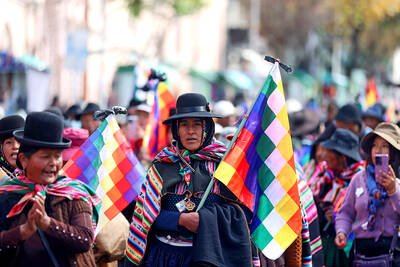
SEEKING ORDER: Rodrigo Paz said that ‘anyone who wants to destroy the nation will have to deal with this president and the full force of the constitution’ Bolivian President Rodrigo Paz on Wednesday said that the nation was at a “breaking point” after nearly a month of protests that have caused shortages of food, fuel and medicine. Paz, who took office six months ago amid the worst economic crisis there in four decades, is battling a groundswell of fury over his policies. The political capital, La Paz, has been besieged by low-income workers and members of the indigenous majority calling for his resignation. “The country needs order and is reaching breaking point,” the 58-year-old said at a public event in La Paz, renewing his appeal for dialogue. On Tuesday, the Bolivian

Forecasters in Europe yesterday warned of exceptional heat as record temperatures driven by a “heat dome” push temperatures well above seasonal norms across the continent. The surge follows a record-breaking Monday, with France logging its hottest day in the month of May on record, its weather agency said, and the UK also posting unprecedented highs. A so-called “heat dome” of warm air from northern Africa trapped under a high-pressure system over western Europe is behind the high temperatures not usually seen until high summer. Restrictions on outdoor work were imposed in parts of Italy, beaches in southwest France filled earlier than usual and

Australian researchers have trained lab-grown brain cells on a silicon computer chip to play the 1990s shooter game Doom and said they are just scratching the surface of what the neurons could be capable of doing. It is the science-fiction work of biotech boffins at Cortical Labs, who researched and developed the technology that harnesses the workings of the brain’s networking system. Each so-called “biological computer” contains about 200,000 living human brain cells, grown from stem cells that were harvested from blood donations. Having mastered the simple computer game Pong, where a paddle is moved up and down to send a ball


 RSS
RSS