


A man whose brothers contracted bird flu has tested positive for the deadly virus, state-controlled media reported yesterday, as the World Health Organization (WHO) said it was investigating the possibility that one of the siblings passed the disease to another.
Vietnamese officials, however, said there was no evidence of human-to-human transmission in the cases. Health officials fear that the bird-flu virus could mutate into a form that can easily spread among people, sparking a global pandemic that could kill millions. There is no evidence that has occurred, however.
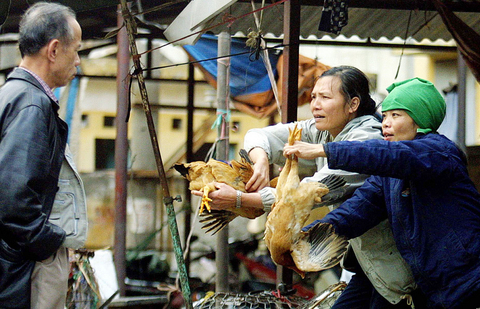
PHOTO: AP
A 36-year-old man from northern Thai Binh province tested positive for the H5N1 strain of bird flu, the Pioneer newspaper quoted Vice Minister of Health Tran Chi Liem as saying.
His 47-year-old brother died on Jan. 10 from bird flu, while another brother, 42, was recovering in a hospital in Hanoi after also testing positive for the virus.
Since Dec. 30, a total of nine people have died of bird flu in Vietnam.
Health officials have said the family had eaten raw duck blood pudding late last month, linking their infections to poultry.
"From the H5N1 virus infected cases in Thai Binh recently, there is no evidence of human-to-human transmission," Liem said.
However, the WHO has not ruled out the possibility, because the middle brother cared for the elder sibling before he died.
But that alone would not raise the threat of a flu pandemic, said Peter Cordingley, spokesman for WHO's Western Pacific Regional Office in Manila. The UN agency has not yet confirmed reports of the third brother's infection.
Similar isolated cases of possible human-to-human transmission occurred in Hong Kong in 1997 and in Vietnam and Thailand last year, he said.
"WHO would not be unduly concerned about the public health implications of limited transmission of the virus from one person to another," he said.
"What would worry us is evidence of the virus being able to pass effectively between humans, thus setting off a chain of transmission. We have not seen this with the present cases, nor with previous ones," he said.
So far most human cases have been linked to contact with sick poultry.
"There is no indication that something is spreading quickly," said Hans Troedsson, the WHO representative in Vietnam.
"It's not that it has passed the threshold and opened the flood gates," he said.
Also in Vietnam, a 22-year-old woman in critical condition was being tested for the disease in Ho Chi Minh City after her younger brother died of bird flu, said Phan Van Tu, chief virologist at the city's Pasteur Institute.
Bird-flu outbreaks among poultry have been reported nationwide in Vietnam so far this year, killing or forcing the cull of more than 500,000 birds. Vietnamese authorities have ordered quarantines, stricter border controls and a ban on poultry from neighboring countries in an effort to battle the disease, fearing a repeat of last year.
Last year the virus surfaced in 10 Asian countries, killing or forcing the slaughter of more than 100 million birds.
The virus jumped to humans in Vietnam and Thailand, killing 29 and 12, respectively.

‘CROSSING THE LINE’: China’s embassy in Seoul criticized US Forces Korea Commander General Xavier Brunson, asking if his ‘hostile’ remarks were authorized by Washington South Korea and the US are in talks over recent public remarks by the commander of US Forces Korea, Seoul’s presidential office said yesterday, after the comments drew sharp criticism from China. In a recent podcast interview, US Forces Korea Commander General Xavier Brunson described South Korea as “the dagger in the heart of Asia” from China’s east coast, prompting the Chinese embassy in Seoul to say that he had “truly crossed the line.” The interview came amid growing speculation that Washington might seek to expand the role of US Forces Korea in countering the growing regional influence of China, a key

SEEKING ORDER: Rodrigo Paz said that ‘anyone who wants to destroy the nation will have to deal with this president and the full force of the constitution’ Bolivian President Rodrigo Paz on Wednesday said that the nation was at a “breaking point” after nearly a month of protests that have caused shortages of food, fuel and medicine. Paz, who took office six months ago amid the worst economic crisis there in four decades, is battling a groundswell of fury over his policies. The political capital, La Paz, has been besieged by low-income workers and members of the indigenous majority calling for his resignation. “The country needs order and is reaching breaking point,” the 58-year-old said at a public event in La Paz, renewing his appeal for dialogue. On Tuesday, the Bolivian

Through the noise of rushing papers and whirring belts at a print factory in Kyoto, two creators watch their photo essay come to life in broadsheet form — part of an effort to win new audiences in the age of artificial intelligence (AI). Despite the decline of the publishing industry, self-publication and handmade “zine” magazines are growing in popularity in Japan, reflecting the nation’s enduring love of paper in the digital era. While speaking to Agence France-Presse at the plant, his hands black with ink, one of the creators, Kazuma Obara, said: “I think [paper] is a medium that engages all five

Australian researchers have trained lab-grown brain cells on a silicon computer chip to play the 1990s shooter game Doom and said they are just scratching the surface of what the neurons could be capable of doing. It is the science-fiction work of biotech boffins at Cortical Labs, who researched and developed the technology that harnesses the workings of the brain’s networking system. Each so-called “biological computer” contains about 200,000 living human brain cells, grown from stem cells that were harvested from blood donations. Having mastered the simple computer game Pong, where a paddle is moved up and down to send a ball


 RSS
RSS