


Iraq's most wanted man Abu Musab al-Zarqawi yesterday declared all-out war on next week's vote in his latest salvo to frighten Iraqis away from the poll and rob the milestone event of legitimacy.
The Jan. 30 election is a "wicked trap aimed at putting the Rafidha [Shiites] in the seat of power in Iraq," said the voice attributed to Zarqawi, in a message posted on an Islamic Web site.
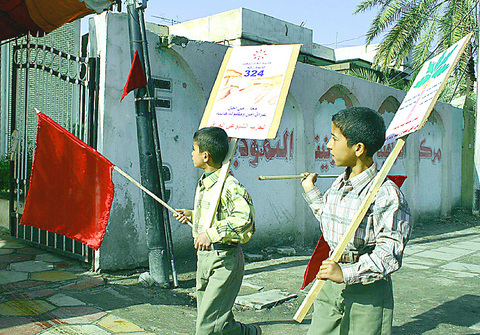
PHOTO: AFP
It was the second inflammatory message from the al-Qaeda frontman in Iraq since Thursday as he sought to instigate violence among the country's fractious mix of Shiites and Sunnis ahead of the first free elections in half a century.
Since Friday, rebels have responded to Zarqawi's rebel call as car bombs have torn apart a Shiite mosque and wedding party in the Baghdad region, killing nearly 30 people. A third car bomb wounded six Iraqi national guard outside the Shiite city of Hilla.
Leading Shiite politician Abdel Aziz Hakim -- whose list is expected to sweep the elections -- said the attacks were the latest effort by Zarqawi and other extremists trying to stoke civil war.
security measures
Seeking to stave off a bloodbath, Interior Minister Falah Naquib announced a tough package of security measures Saturday that will effectively seal Iraq off from the outside world for the elections.
Naquib warned that the government was prepared for the worst as the insurgency sought to deter Iraqis from casting a ballot in the election for a 275-seat parliament that will draft Iraq's permanent constitution.
"We do expect an escalation by these terrorist forces," the minister said. "There are many attempts to incite the violence. We will do our best to protect the civilians."
Naquib acknowledged that no plan could be airtight in the face of determined efforts by militant groups.
Security steps include an expansion of the curfews already in place in some Iraqi cities including the capital, the temporary closure of Baghdad's international airport and traffic restrictions.
As Naquib sought to instill confidence in the country's estimated 14.2 million voters, rebels carried on bombings and shootings.
A US soldier was killed in a firefight on Saturday in the restive northern city of Mosul, where elections are in doubt, and a woman was killed and two other civilians were wounded in a bomb blast in the southern Baghdad suburb of Dura.
Calmer Kurdish region
While Iraq's northern Kurdish and southern Shiite regions are relatively calm, central Iraq has been dogged by the lethal insurgency among its minority Sunni Muslim population who fear the political ascendency of the long oppressed Shiites.
In the latest hostage drama, the Chinese embassy confirmed that eight Chinese hostages captured four days ago and held by Iraqi insurgents had been released. But it said it had no word on their whereabouts.
Another armed group announced it was holding a Brazilian hostage after killing a Briton and an Iraqi in an attack on a security firm earlier in the week.
A statement from the group, calling itself the "Mujahedeen Squadrons," was received by Qatar-based news channel Al-Jazeera.
A third Sunni militant group, the Al-Qaeda-linked Ansar al-Sunna said it had shot dead 15 members of the Iraqi army, in a message posted on its Internet site.
Meanwhile, some 400 extra British troops were due to arrive at their base in Iraq at the weekend to bolster security in the runup to the elections, the defense ministry said on Saturday.

‘CROSSING THE LINE’: China’s embassy in Seoul criticized US Forces Korea Commander General Xavier Brunson, asking if his ‘hostile’ remarks were authorized by Washington South Korea and the US are in talks over recent public remarks by the commander of US Forces Korea, Seoul’s presidential office said yesterday, after the comments drew sharp criticism from China. In a recent podcast interview, US Forces Korea Commander General Xavier Brunson described South Korea as “the dagger in the heart of Asia” from China’s east coast, prompting the Chinese embassy in Seoul to say that he had “truly crossed the line.” The interview came amid growing speculation that Washington might seek to expand the role of US Forces Korea in countering the growing regional influence of China, a key

SEEKING ORDER: Rodrigo Paz said that ‘anyone who wants to destroy the nation will have to deal with this president and the full force of the constitution’ Bolivian President Rodrigo Paz on Wednesday said that the nation was at a “breaking point” after nearly a month of protests that have caused shortages of food, fuel and medicine. Paz, who took office six months ago amid the worst economic crisis there in four decades, is battling a groundswell of fury over his policies. The political capital, La Paz, has been besieged by low-income workers and members of the indigenous majority calling for his resignation. “The country needs order and is reaching breaking point,” the 58-year-old said at a public event in La Paz, renewing his appeal for dialogue. On Tuesday, the Bolivian

Through the noise of rushing papers and whirring belts at a print factory in Kyoto, two creators watch their photo essay come to life in broadsheet form — part of an effort to win new audiences in the age of artificial intelligence (AI). Despite the decline of the publishing industry, self-publication and handmade “zine” magazines are growing in popularity in Japan, reflecting the nation’s enduring love of paper in the digital era. While speaking to Agence France-Presse at the plant, his hands black with ink, one of the creators, Kazuma Obara, said: “I think [paper] is a medium that engages all five

Australian researchers have trained lab-grown brain cells on a silicon computer chip to play the 1990s shooter game Doom and said they are just scratching the surface of what the neurons could be capable of doing. It is the science-fiction work of biotech boffins at Cortical Labs, who researched and developed the technology that harnesses the workings of the brain’s networking system. Each so-called “biological computer” contains about 200,000 living human brain cells, grown from stem cells that were harvested from blood donations. Having mastered the simple computer game Pong, where a paddle is moved up and down to send a ball


 RSS
RSS