


Angry retirees demanding that their social benefits be restored staged a second day of protests in Russian President Vladimir Putin's home city, and along with protesters in other Russian cities demanded the president resign.
It has been the greatest public outburst of discontent since Putin took power five years ago. Top officials on Sunday tried to shift blame, accusing regional authorities of failing to implement the Kremlin-sponsored social reform properly.
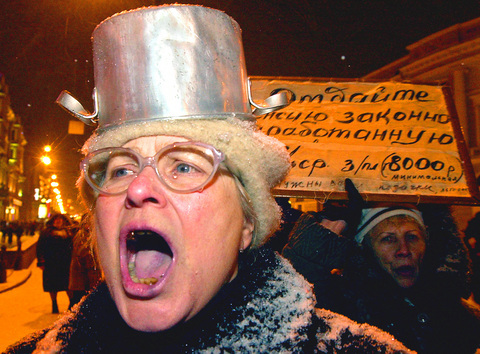
PHOTO: AP
Though St. Petersburg authorities promised to restore some benefits after 10,000 people flooded Russia's second-largest city on Saturday, about 1,000 demonstrators returned Sunday to rally on central Nevsky Prospect, paralyzing city traffic.
The protesters, most of them elderly, waved red flags, beat spoons against saucepans and chanted slogans calling for Putin to step down.
"We are here to demand the right to life," said Zhanna Filonova, 61.
The protests, which have spread to cities across Russia's 11 time zones, were triggered by a Jan. 1 law that gives retirees, the disabled and war veterans cash stipends instead of benefits such as free public medicine and transportation.
Many of the elderly, already feeling disenfranchised, considered the change a final insult after they were left struggling to survive on meager pensions in inflationary and capitalist Russia when the state welfare system collapsed with the Soviet Union in 1991.
"Prices keep rising, and now they have canceled our benefits," said Yevgeniya Sidorova, 70. "Putin and his government want us to lie down and wait for death to come."
Defending the social reform bill, First Deputy Prime Minister Alexander Zhukov and Parliament Speaker Boris Gryzlov blamed provincial authorities for the failure to deliver the promised cash stipends in full.
"It's quite natural that people are angry," Zhukov said on state-controlled Rossiya television late on Sunday.
Protesters say new monthly payments of about US$10 are worth much less than the benefits, leaving them to have to choose between food, transport and medicine.
Many pledged to keep protesting until benefits were returned and pensions were increased. An average monthly pension is now worth about US$80.
The rallies across Russian cities, many of which involved blockades of key highways, have put new pressure on Putin, who has seen little public protest in his tenure during which most citizens have either supported or simply accepted the Kremlin's initiatives.

‘CROSSING THE LINE’: China’s embassy in Seoul criticized US Forces Korea Commander General Xavier Brunson, asking if his ‘hostile’ remarks were authorized by Washington South Korea and the US are in talks over recent public remarks by the commander of US Forces Korea, Seoul’s presidential office said yesterday, after the comments drew sharp criticism from China. In a recent podcast interview, US Forces Korea Commander General Xavier Brunson described South Korea as “the dagger in the heart of Asia” from China’s east coast, prompting the Chinese embassy in Seoul to say that he had “truly crossed the line.” The interview came amid growing speculation that Washington might seek to expand the role of US Forces Korea in countering the growing regional influence of China, a key

SEEKING ORDER: Rodrigo Paz said that ‘anyone who wants to destroy the nation will have to deal with this president and the full force of the constitution’ Bolivian President Rodrigo Paz on Wednesday said that the nation was at a “breaking point” after nearly a month of protests that have caused shortages of food, fuel and medicine. Paz, who took office six months ago amid the worst economic crisis there in four decades, is battling a groundswell of fury over his policies. The political capital, La Paz, has been besieged by low-income workers and members of the indigenous majority calling for his resignation. “The country needs order and is reaching breaking point,” the 58-year-old said at a public event in La Paz, renewing his appeal for dialogue. On Tuesday, the Bolivian

Through the noise of rushing papers and whirring belts at a print factory in Kyoto, two creators watch their photo essay come to life in broadsheet form — part of an effort to win new audiences in the age of artificial intelligence (AI). Despite the decline of the publishing industry, self-publication and handmade “zine” magazines are growing in popularity in Japan, reflecting the nation’s enduring love of paper in the digital era. While speaking to Agence France-Presse at the plant, his hands black with ink, one of the creators, Kazuma Obara, said: “I think [paper] is a medium that engages all five

Australian researchers have trained lab-grown brain cells on a silicon computer chip to play the 1990s shooter game Doom and said they are just scratching the surface of what the neurons could be capable of doing. It is the science-fiction work of biotech boffins at Cortical Labs, who researched and developed the technology that harnesses the workings of the brain’s networking system. Each so-called “biological computer” contains about 200,000 living human brain cells, grown from stem cells that were harvested from blood donations. Having mastered the simple computer game Pong, where a paddle is moved up and down to send a ball


 RSS
RSS