


The US was eager to end its military tsunami relief operation as soon as other nations are ready to take over, Deputy Defense Secretary Paul Wolfowitz said yesterday. As relief and cleanup continued, the UN began paying survivors to clear rubble.
"As soon as our military folks can pass these responsibilities on to other folks ... and make sure the job gets done, we will be happy," Wolfowitz said after meetings in Bangkok to discuss aid efforts for the Dec. 26 disaster.

PHOTO: AP
Later in the day, Wolfowitz flew to Aceh, where he boarded a US Navy Seahawk helicopter for a tour of the province's tsunami-ravaged coastal areas.
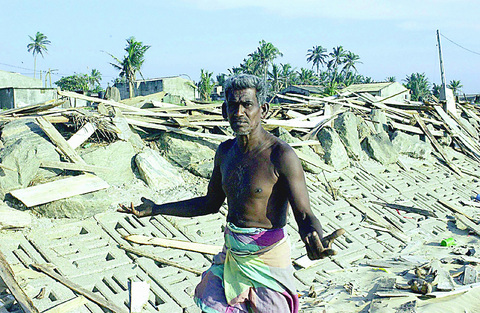
PHOTO: EPA
A huge earthquake and the tsunami it spawned killed more than 157,000 people across 11 countries, triggering an unprecedented global response. But Indonesia has expressed unease with the number of foreign troops on its territory as part of the relief effort and wants them out before the end of March.
Wolfowitz said the US military role would wind down by that deadline.
"I would hope that we would not be needed [in the region] as a military long before March," he said during the flight to Asia, according to a transcript of his remarks released at the Pentagon.
Wolfowitz, a former US ambassador to Indonesia, said cooperation with Jakarta has been very good.
"For any country it is sensitive to have foreign troops on your territory. It would be sensitive in the US and I can tell you that it is extremely sensitive in Indonesia," he said. "What's remarkable is that it has caused no problems to date."
In Aceh, thousands of tsunami survivors were being paid by the UN Development Program 30,000 rupiah (US$3.27) a day to clear rubble and debris.
"They are trying to hire local people to do this as part of stimulating the economy and getting some sort of livelihood back for survivors," said UNDP spokesman William Bergman. The number of Acehnese involved in the clean up operation was expected to rise quickly, he added.
The UN refugee organization, the UNHCR, was Saturday distributing 10,000 five-person tents to survivors in Banda Aceh, said spokesman Mans Nyberg. A further 10,000 tents will arrive soon, he added.
The tents are intended as a stopgap solution to provide shelter for hundreds of thousands of refugees in Aceh province while the UNHCR and Indonesian government plan for 24 more permanent camps with barracks-style shelters, Nyberg said.
With thousands made homeless by the disaster, efforts to keep epidemics at bay intensified. The UN sped up its measles vaccination drive after 20 cases of the disease were reported across Aceh. Health workers were spraying tents with insecticide to prevent malaria in areas that were swamped by the killer waves.
In Sri Lanka, UN World Food Program Director James Morris was traveling to the southern city of Galle. The tsunami killed more than 30,000 people in the island nation.
The WFP is leading a mammoth effort to feed up to 2 million survivors in the countries devastated.
A half a world away in Saudi Arabia, pilgrims streaming into Islam's holy city of Mecca for the annual hajj prayed for the tsunami's victims. Indonesia -- the world's most populous Muslim nation -- was hardest hit by the disaster. But 200,000 Indonesians, the country's quota, still were expected to make the journey.
"I have lost a friend in the tsunami, and I pray for him and the souls of all those that have perished," said Mohamed Saleh, a teacher from Jakarta, outside the Grand Mosque in Mecca.
Also See Story:
Muslim pilgrims pray for tsunami victims

‘CROSSING THE LINE’: China’s embassy in Seoul criticized US Forces Korea Commander General Xavier Brunson, asking if his ‘hostile’ remarks were authorized by Washington South Korea and the US are in talks over recent public remarks by the commander of US Forces Korea, Seoul’s presidential office said yesterday, after the comments drew sharp criticism from China. In a recent podcast interview, US Forces Korea Commander General Xavier Brunson described South Korea as “the dagger in the heart of Asia” from China’s east coast, prompting the Chinese embassy in Seoul to say that he had “truly crossed the line.” The interview came amid growing speculation that Washington might seek to expand the role of US Forces Korea in countering the growing regional influence of China, a key

SEEKING ORDER: Rodrigo Paz said that ‘anyone who wants to destroy the nation will have to deal with this president and the full force of the constitution’ Bolivian President Rodrigo Paz on Wednesday said that the nation was at a “breaking point” after nearly a month of protests that have caused shortages of food, fuel and medicine. Paz, who took office six months ago amid the worst economic crisis there in four decades, is battling a groundswell of fury over his policies. The political capital, La Paz, has been besieged by low-income workers and members of the indigenous majority calling for his resignation. “The country needs order and is reaching breaking point,” the 58-year-old said at a public event in La Paz, renewing his appeal for dialogue. On Tuesday, the Bolivian

Through the noise of rushing papers and whirring belts at a print factory in Kyoto, two creators watch their photo essay come to life in broadsheet form — part of an effort to win new audiences in the age of artificial intelligence (AI). Despite the decline of the publishing industry, self-publication and handmade “zine” magazines are growing in popularity in Japan, reflecting the nation’s enduring love of paper in the digital era. While speaking to Agence France-Presse at the plant, his hands black with ink, one of the creators, Kazuma Obara, said: “I think [paper] is a medium that engages all five

Australian researchers have trained lab-grown brain cells on a silicon computer chip to play the 1990s shooter game Doom and said they are just scratching the surface of what the neurons could be capable of doing. It is the science-fiction work of biotech boffins at Cortical Labs, who researched and developed the technology that harnesses the workings of the brain’s networking system. Each so-called “biological computer” contains about 200,000 living human brain cells, grown from stem cells that were harvested from blood donations. Having mastered the simple computer game Pong, where a paddle is moved up and down to send a ball


 RSS
RSS