


Palestinian presidential candidate Mahmoud Abbas canceled a campaign stop planned in Jerusalem, saying Israeli security arrangements would have embarrassed him, a campaign official said yesterday.
Abbas had been tentatively scheduled to travel to Jerusalem yesterday to pray at the Al-Aqsa Mosque, hold a rally and tour the Old City.
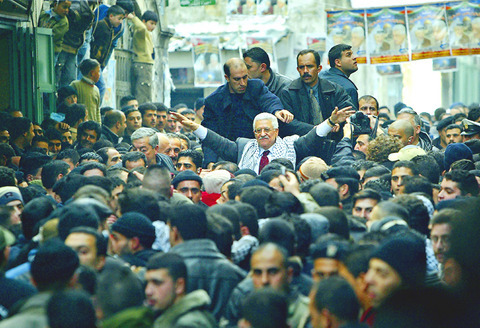
PHOTO: AP
The campaign official, speaking on condition of anonymity, said Israel wanted to provide Abbas a large security detail, concerned that Jewish extremists might attack him.
Abbas decided on Wednesday that being surrounded by Israeli security forces during a stop in front of his own people would have been embarrassing, the official said.
Instead, Abbas planned a campaign stop in Beir Naballah, a Palestinian town on the outskirts of Jerusalem.
Israeli police spokesman Gil Kleiman said no request had been received for Abbas to enter the city.
Abbas on Thursday declared that he hoped peace negotiations with Israel could resume soon after the winner of tomorrow's vote is declared on Monday.
Abbas said he viewed the Israeli prime minister, Ariel Sharon, as a potential partner in such peace talks. Earlier this week, Abbas irritated the Israeli government by referring to Israel as "the Zionist enemy."
The emolient words, which were welcomed by the Israeli government, came as Abbas and the other six candidates toured the West Bank and Gaza campaigning for tomorrow's election, the first for a Palestinian leader since Arafat was elected in 1996.
Speaking at a press conference in Nablus, a volatile city in the West Bank which suffered badly from an Israeli invasion ordered by Sharon two years ago, Abbas said: "After the elections, we will start negotiations. Ariel Sharon is an elected leader and we will negotiate with him. We will put the road map [the peace agreement drawn up by the UN, the US, the EU and Russia] on the table and say that we are ready to implement it completely."
Serious negotiations between Israel and the Palestinians are unlikely until Sharon completes his planned withdrawal of soldiers and Jewish settlers from Gaza in the summer.
Palestinians attending rallies on Thursday, though enjoying the novelty of the election, were pessimistic about the chances of lasting peace and were divided about whether Palestinian militants should cease operations against Israel.
Abbas has been trying to secure a ceasefire agreement from Hamas and Islamic Jihad, but the two militant groups -- both of which are boycotting the election -- have stepped up rocket and mortar attacks on Israel over the last week. They claim they are responding to Israeli attacks.
While polls indicate that Abbas will win 60-65 percent of the vote, he needs a big turnout to secure the kind of mandate that will help him face down Hamas and Islamic Jihad.
The same polls put Mustafa Barghouti, an academic and human rights campaigner, in second place, on about 20 percent.
Barghouti, addressing students at Birzeit University outside Ramallah on Thursday, said voting for Abbas would be voting for a continuation of the old system whereas he promised to clean up democratic institutions, the judicial system and the economy.
He described the call for Hamas and Islamic Jihad to stop their attacks as "a mistake" by Abbas. "To expect there to be a complete ceasefire while the other side [Israel] keeps shooting is unrealistic," he said.

‘CROSSING THE LINE’: China’s embassy in Seoul criticized US Forces Korea Commander General Xavier Brunson, asking if his ‘hostile’ remarks were authorized by Washington South Korea and the US are in talks over recent public remarks by the commander of US Forces Korea, Seoul’s presidential office said yesterday, after the comments drew sharp criticism from China. In a recent podcast interview, US Forces Korea Commander General Xavier Brunson described South Korea as “the dagger in the heart of Asia” from China’s east coast, prompting the Chinese embassy in Seoul to say that he had “truly crossed the line.” The interview came amid growing speculation that Washington might seek to expand the role of US Forces Korea in countering the growing regional influence of China, a key

SEEKING ORDER: Rodrigo Paz said that ‘anyone who wants to destroy the nation will have to deal with this president and the full force of the constitution’ Bolivian President Rodrigo Paz on Wednesday said that the nation was at a “breaking point” after nearly a month of protests that have caused shortages of food, fuel and medicine. Paz, who took office six months ago amid the worst economic crisis there in four decades, is battling a groundswell of fury over his policies. The political capital, La Paz, has been besieged by low-income workers and members of the indigenous majority calling for his resignation. “The country needs order and is reaching breaking point,” the 58-year-old said at a public event in La Paz, renewing his appeal for dialogue. On Tuesday, the Bolivian

Through the noise of rushing papers and whirring belts at a print factory in Kyoto, two creators watch their photo essay come to life in broadsheet form — part of an effort to win new audiences in the age of artificial intelligence (AI). Despite the decline of the publishing industry, self-publication and handmade “zine” magazines are growing in popularity in Japan, reflecting the nation’s enduring love of paper in the digital era. While speaking to Agence France-Presse at the plant, his hands black with ink, one of the creators, Kazuma Obara, said: “I think [paper] is a medium that engages all five

Australian researchers have trained lab-grown brain cells on a silicon computer chip to play the 1990s shooter game Doom and said they are just scratching the surface of what the neurons could be capable of doing. It is the science-fiction work of biotech boffins at Cortical Labs, who researched and developed the technology that harnesses the workings of the brain’s networking system. Each so-called “biological computer” contains about 200,000 living human brain cells, grown from stem cells that were harvested from blood donations. Having mastered the simple computer game Pong, where a paddle is moved up and down to send a ball


 RSS
RSS