


Gunmen assassinated the governor of Baghdad province -- the highest ranking government official to be slain since May -- and six of his bodyguards yesterday, and a suicide tanker-truck bomber killed 10 people at an Interior Ministry commando headquarters in western Baghdad, the latest in a steady drumbeat of insurgent violence ahead of Jan. 30 elections.
Governor Ali al-Haidari's three-vehicle convoy was passing through Baghdad's northern neighborhood of Hurriyah when unidentified gunmen opened fire, said the chief of his security detail, who asked only to be identified as Major Mazen.
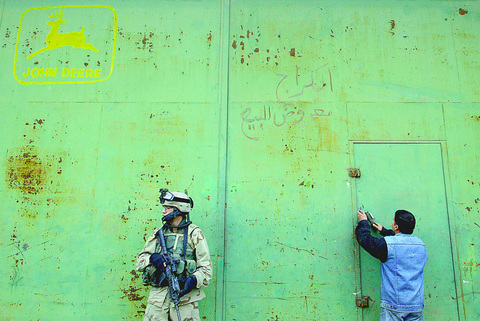
PHOTO: AFP
"Our convoy was moving in Hurriyah and they came from different directions and opened fire at us," Mazen said.
Al-Haidari, who was the target of another assassination attempt last year that killed two of his bodyguards, worked closely with the US-led multinational forces in Baghdad on rebuilding the capital.
He is the highest-ranking Iraqi official killed since the former president of the now defunct Governing Council, Abdel-Zahraa Othman, better known as Izzadine Saleem, was assassinated in May.
Al-Qaeda in Iraq, led by Iraq's most wanted terrorist Abu Musab al-Zarqawi, claimed responsibility for al-Haidari's assassination and the tanker-truck explosion, a statement posted on the Internet said.
"We tell every traitor and supporter of the Jews and Christians that this is your fate," said the statement on a Web site known for carrying militants' claims.
Also yesterday, a tanker truck packed with explosives detonated near an interior ministry commando headquarters in western Baghdad, killing 10 people and wounding about 60, the Interior Ministry said.
A suicide driver rammed the truck at an Iraqi police checkpoint near the headquarters, which is also near an entrance of the Green Zone, the heavily fortified area in the center of Baghdad that houses both the US embassy and Iraqi government offices. Eight Iraqi commandos and two civilians were killed, the interior ministry said in a statement.
Two US servicemen were also killed in Iraq yesterday. A roadside bomb attack killed one US 1st Infantry Division soldier and wounded another near Balad, 80km north of Baghdad. A US Marine assigned to the 1st Marine Expeditionary Force was also killed in action in western Iraq's restive Anbar province, which includes the former insurgent stronghold of Fallujah.
Later, a roadside bomb killed three Iraqi National Guardsmen and wounded two near Baqouba, 57km northeast of Baghdad, US military spokesman Neal O'Brien said.
In an interview published yesterday, al-Haidari said that infrastructure in Baghdad was improving as a result of cooperation between the governor's office and multinational forces.
However, he had not always sided with the Americans. In October, he demanded that the US leave the Green Zone.
Yesterday's attacks came a day after violence that saw three car bombs and a roadside attack, one near the prime minister's party headquarters in Baghdad and others targeting Iraqi troops and a US security-company convoy. At least 16 people were killed on Monday.
Britain's Foreign Office said yesterday that three Britons and an American were killed a day earlier in a bombing near the Green Zone.
Andrew Marshall, spokesman for US security firm Kroll Inc, said two British employees were killed in Baghdad on Monday when a suicide bomber attacked their vehicle. The blast also killed a third Briton and an American.

‘CROSSING THE LINE’: China’s embassy in Seoul criticized US Forces Korea Commander General Xavier Brunson, asking if his ‘hostile’ remarks were authorized by Washington South Korea and the US are in talks over recent public remarks by the commander of US Forces Korea, Seoul’s presidential office said yesterday, after the comments drew sharp criticism from China. In a recent podcast interview, US Forces Korea Commander General Xavier Brunson described South Korea as “the dagger in the heart of Asia” from China’s east coast, prompting the Chinese embassy in Seoul to say that he had “truly crossed the line.” The interview came amid growing speculation that Washington might seek to expand the role of US Forces Korea in countering the growing regional influence of China, a key

SEEKING ORDER: Rodrigo Paz said that ‘anyone who wants to destroy the nation will have to deal with this president and the full force of the constitution’ Bolivian President Rodrigo Paz on Wednesday said that the nation was at a “breaking point” after nearly a month of protests that have caused shortages of food, fuel and medicine. Paz, who took office six months ago amid the worst economic crisis there in four decades, is battling a groundswell of fury over his policies. The political capital, La Paz, has been besieged by low-income workers and members of the indigenous majority calling for his resignation. “The country needs order and is reaching breaking point,” the 58-year-old said at a public event in La Paz, renewing his appeal for dialogue. On Tuesday, the Bolivian

Through the noise of rushing papers and whirring belts at a print factory in Kyoto, two creators watch their photo essay come to life in broadsheet form — part of an effort to win new audiences in the age of artificial intelligence (AI). Despite the decline of the publishing industry, self-publication and handmade “zine” magazines are growing in popularity in Japan, reflecting the nation’s enduring love of paper in the digital era. While speaking to Agence France-Presse at the plant, his hands black with ink, one of the creators, Kazuma Obara, said: “I think [paper] is a medium that engages all five

Australian researchers have trained lab-grown brain cells on a silicon computer chip to play the 1990s shooter game Doom and said they are just scratching the surface of what the neurons could be capable of doing. It is the science-fiction work of biotech boffins at Cortical Labs, who researched and developed the technology that harnesses the workings of the brain’s networking system. Each so-called “biological computer” contains about 200,000 living human brain cells, grown from stem cells that were harvested from blood donations. Having mastered the simple computer game Pong, where a paddle is moved up and down to send a ball


 RSS
RSS