


A videotape found in a pile of documents in Baghdad following the collapse of Saddam Hussein's regime shows a former manager of the al-Jazeera satellite channel thanking one of Saddam's sons for his support, the Asharq al-Awsat newspaper reported Sunday, the latest allegation of impropriety between the feuding daily and the television network.
According to Asharq al-Awsat, the tape of the March 13 2000 meeting shows former al-Jazeera manager Mohammed Jassem al-Ali telling Odai Saddam Hussein, "al-Jazeera is your channel," and Odai says "some ideas" that he proposed in previous meetings led to "some changes" in political coverage, including new hosts on al-Jazeera programs.
Asharq al-Awsat is pitted in a rivalry with al-Jazeera and has recently published a series of reports about the Qatar-based network's alleged connections to insurgents in Iraq.
The paper is closely connected to Al-Arabiya, a television network that tries to take a moderate approach compared to al-Jazeera.
Alhurra, or The Free One, was launched by the US government to counter Arab satellite channels which were accused by the US defense secretary of turning Arabs against America. Harb said Alhurra allowed Asharq al-Awsat to have "a sneak preview" of the tape, obtained "through professional means."
During the conversation, the tape reportedly shows al-Ali telling Odai, "Thank God, the mission was fully successful as a result of our presence (in Iraq) ... Thank God, we had consecutive activities for the benefit of the two sides."
Al-Jazeera has occasionally run into problems with authorities in several Arab countries, including the former Iraqi regime. Unlike Arab state-run media, the station often airs views of local opposition figures and their criticisms of their countries' rulers.
On Sept. 4, the Iraqi government shut down al-Jazeera's Baghdad operations indefinitely, extending a one-month closure order imposed after the channel was accused of inciting violence.

SPEAKING OUT: After Siranudh Scott’s allegations surfaced, celebrities and public figures took to social media to share their own experiences of sexual misconduct and abuse A high-profile alleged sexual abuse case within a wealthy Thai beer brewing family has prompted a wave of painful accounts from survivors of unconnected abuse in the conservative nation. Siranudh Scott, a member of the billionaire Thai family that founded the ubiquitous Singha beer brand, posted an emotional video this month accusing his elder brother Sunit of repeatedly abusing him when he was a teenager. Sunit, who is in his 30s, later denied the allegations in a video posted online, but Singha parent Boonrawd dismissed him from his executive role with the company on Tuesday last week. “I felt I needed to speak

SEEKING ORDER: Rodrigo Paz said that ‘anyone who wants to destroy the nation will have to deal with this president and the full force of the constitution’ Bolivian President Rodrigo Paz on Wednesday said that the nation was at a “breaking point” after nearly a month of protests that have caused shortages of food, fuel and medicine. Paz, who took office six months ago amid the worst economic crisis there in four decades, is battling a groundswell of fury over his policies. The political capital, La Paz, has been besieged by low-income workers and members of the indigenous majority calling for his resignation. “The country needs order and is reaching breaking point,” the 58-year-old said at a public event in La Paz, renewing his appeal for dialogue. On Tuesday, the Bolivian

A Hong Kong astronaut is to join a Chinese space mission for the first time as part of a three-person crew launching today, as Beijing edges closer to its goal of landing people on the moon. The Tiangong space station — crewed by teams of three astronauts that are typically rotated every six months — is the crown jewel of China’s space program, boosted by billions in state investment in a bid to catch up with the US and Russia. The Shenzhou-23 mission is to blast off at 11:08pm from the Jiuquan Satellite Launch Center in northwestern China, carrying three astronauts to
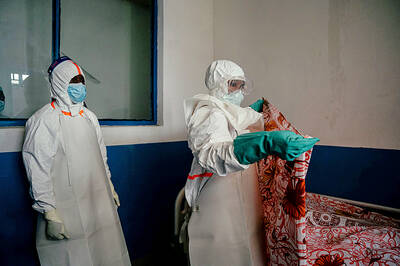
UPGRADED ALERT: The risk inside DR Congo is now considered ‘very high,’ while neighboring countries face a ‘high’ threat as the outbreak continues, the WHO said Ebola is spreading faster than responders can track it in eastern Congo, where health workers managed to follow up with barely one in five identified contacts in a single day. Authorities in the Democratic Republic of the Congo (DR Congo) reported 83 confirmed infections, 746 suspected cases and 1,603 identified contacts as of Thursday, but health workers were able to follow up on only 342 contacts that day — about 21 percent of the total under monitoring — data released by the DR Congo Ministry of Public Health on Friday showed. The figures suggest the response is falling behind the outbreak itself,


 RSS
RSS