


A Belgian theologian whose book about the contributions of other religions was attacked by the Vatican has died in Rome, his Jesuit order said Saturday.
The Reverend Jacques Dupuis, 81, collapsed Monday night after dinner and was taken to a hospital, where he died of a brain hemorrhage on Tuesday, said the Reverend Jose De Vera, director of the Jesuits' press office.
In 2001, Dupuis told reporters in Rome that he was forced to suffer in silence for two-and-a-half years while the Vatican attacked his book and made what he called "false accusations" about it.
Asked what his ideas were, Dupuis said, "For me Jesus Christ is the universal savior but at the same time I believe that in the divine plan the other religious traditions of the world have a positive contribution to make to humanity."
Dupuis' book, Toward a Christian Theology of Religious Pluralism, first published in 1997, was subjected to a long investigation by the Congregation for the Doctrine of the Faith, the Vatican's guardian of orthodoxy -- a sign that the Vatican was concerned that his book suggested one religion could be as good as another.
Dupuis first refused a compromise that incorporated the Vatican's criticisms in the book, but later agreed to a revised version, saying he wanted to be able to continue his theological work and remain loyal to the church.
But he expressed displeasure about the Vatican's description of the compromise. The Congregation had declared that Dupuis' book contained "notable ambiguities" that could lead a reader to "erroneous or harmful positions."
When the compromise was announced in February 2001, Jesuit Superior General Peter-Hans Kolvenbach said Dupuis book, "which has been justly recognized for the seriousness of its methodological research, the richness of its scientific documentation, and the originality of its exploration, dares to venture into a dogmatically fundamental area for the future of the interreligious dialogue."
He said the Congregation's notification about the book "clearly establishes the limits of this teaching to which the author has tried to adhere, even if he has not always succeeded."
Dupuis taught at Rome's Pontifical Gregorian University, a prestigious institution for seminarians.
When the Vatican in 2000 reaffirmed the primacy of the Roman Catholic Church over other religions, leaders of several denominations expressed concerns that the Vatican was changing course on efforts for dialogue with non-Catholics. Pope John Paul II has made better relations with non-Catholics a goal of his papacy.
Born in Huppaye, Belgium, in 1923, Dupuis studied literature and philosophy at Notre Dame of Peace in Namur, in the south of his homeland, and pursued his studies in philosophy at college in Eegenhoven, Belgium. After studying theology at St. Mary's College, in Kurseong, India, he studied Hinduism in Calcutta. He concluded his studies at the Gregorian, obtaining a doctorate in theology.
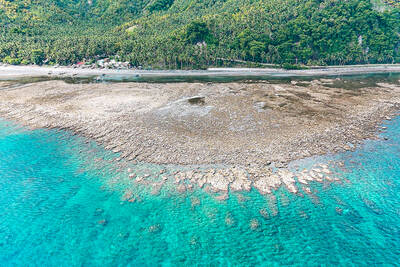
Arsenio Butil Jr fell to his knees and began to pray when last week’s deadly magnitude 7.8 earthquake began shaking his home on the coast of the southern Philippines. When he opened his eyes, he saw a once-familiar shoreline changing in real time, with swathes of previously submerged coral suddenly pushing above the waterline. The June 8 quake, driven by a shifting of the nearby Cotabato Trench, toppled buildings, triggered landslides and killed at least 76 people on the southern island of Mindanao. The tectonic forces at work also thrust chunks of the island’s coastline upward in a phenomenon known as “coastal uplift,”
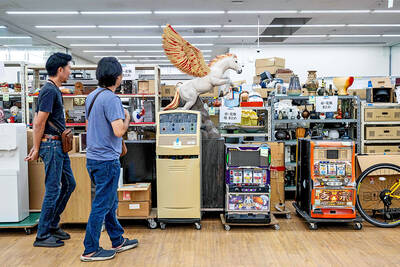
YUCK OR YUM? While it is difficult to sell second-hand goods that are more than seven years old in Japan, they are still popular in foreign markets, an executive said Under a scorching sun in a Bangkok suburb, a whistle blew, and shouts filled the air as dozens of shoppers rushed into a warehouse bearing the sign “Japanese Second-Hand Store.” From bags and bicycles to surfboards and suitcases, the Japanese second-hand market is booming, with quality-conscious buyers in other Asian countries increasingly tapping into the circular economy trend. “What is considered garbage for them can still be useful in Thailand,” said 36-year-old Lookpoo Sathitpanyapon, who runs an online store selling toy keychains. “That bag, that bag,” one shopper shouted while racing through the warehouse, filled with everything from colorful toys
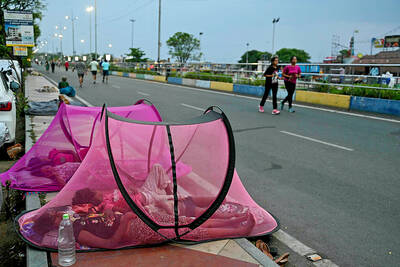
Growing up in Tahiti, Anna-Bella Failloux saw first-hand the threat posed by mosquitoes: Nearly one-third of adults on the picturesque island once had swollen limbs from elephantiasis caused by their bites. She has since dedicated her life to studying mosquitoes and the diseases they transmit — a concern that looms ever larger as climate change expands the area where the insects roam. “You have to accept being bitten by a mosquito from time to time,” the 63-year-old entomologist at France’s Pasteur Institute said. “But we have to avoid too many people getting sick and dying from the infections,” Failloux said, as she observed
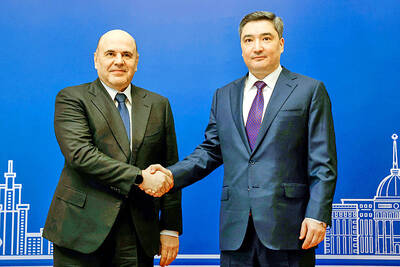
Kazakhstan signed accords with the start-up Firebird Inc on computing projects involving Nvidia Corp that could bring as much as US$10 billion in investment, as the Central Asian energy producer looks to position itself as an artificial intelligence (AI) hub. The pacts include a strategic cooperation agreement on developing AI infrastructure and terms for a planned large-scale project known as Data Center Valley in the country’s northeast, the Kazakh Ministry of Artificial Intelligence and Digital Development said in a statement. The plan envisages US$5 billion in investments in phase one — including US$1 billion provided by state-run Kazakhtelecom — with commercial operations


 RSS
RSS