


French troops killed more than 30 Ivory Coast nationals and wounded at least 100 others in the ongoing crisis in the west African country, Ivorian parliament speaker Mamadou Coulibaly said on French public radio France Inter Sunday.
"In [the main cities of] Abidjan and Yamassoukro the French army killed more than 30 people and wounded more than 100, people who were unarmed, to avenge the blood of nine dead French soldiers," Coulibaly said.
Nine French troops died in an air raid by Ivory Coast warplanes and 30 were wounded Saturday in the central Ivorian city of Bouake.
French reinforcements were expected in Ivory Coast after continuing unrest overnight.
Meanwhile, angry mobs of thousands laid siege to a French military base in Ivory Coast's largest city yesterday and went house-to-house in search of French families, answering hard-liners' call to take to the streets after deadly violence erupted between France's forces and those of its former colony.
French military helicopters dropped percussion grenades throughout the night on mobs massing at bridges, the international airport and the military base in the commercial capital, Abidjan, French military spokesman Henry Aussavy said.
France remained newly in control of the international airport after destroying what it said was the entire Ivorian Air Force -- two Sukhoi warplanes and five helicopter gunships -- Saturday.
Destruction came in retaliation for the Ivorian Air Force's surprise bombing of a French peacekeeping position in the north, held by Ivorian rebels since civil war broke out in the world's top cocoa producer in September 2002.
Saturday's airstrike killed nine French troops and one American civilian, believed by American diplomats to be a missionary.
France and the UN Security Council, meeting in emergency session, demanded President Laurent Gbagbo restore order.
Ivorian leaders sounded defiance yesterday.
National Assembly President Mamadou Coulibaly, No. 2 under Gbagbo, accused French President Jacques Chirac of arming Ivory Coast's rebels, telling France's Inter radio "we have the feeling and we have the proof" of it.
Accusing France of "connivance with the rebels," Coulibaly demanded French troops "liberate the territory and then go."
Hardliners urged loyalists on to more uprisings.
"We ask you all to take to the streets," Ble Goude, a so-called youth leader in control of thousands of loyalist militia members, declared on state TV.
"Show France we are a sovereign state," another loyalist hard-liner, Genevieve Bro Grebe, head of a women's militia, declared. Fearful of attempts to overthrow Gbagbo, Grebe on state TV urged crowds to form a ``human shield'' around his presidential palace.
Militia leaders also called on loyalists to march on the airport and the French military base.
Thousands of loyalists were demonstrating in front of the military base at daybreak yesterday, Aussavy said.
Enraged at the French retaliation for the airstrike, mobs went door-to-door looking for foreign families, and looted and burned French businesses and at least two French schools.
"We are all terrified, and try to reassure each other," one French resident said by telephone from his home, speaking on condition he not be identified.
"We have been told by the embassy to stay at home ... It is a difficult situation to live through," the Frenchman said.
Numerous French families called French authorities in Ivory Coast overnight, saying their homes were being attacked and looted, Aussavy said.
There was no word of casualties among French civilians, he said.
Ivory Coast television overnight showed the bodies of five loyalists they said had been killed in Abidjan's violence, journalists said.
A loyalist leader, Eugene Djue, claimed in a telephone interview at least six dead among loyalist demonstrators, allegedly killed by the French. He claimed two girls had disappeared after jumping off a bridge to escape the French helicopters.
France took control of Abidjan's airport by late Saturday, saying it was securing it for any evacuations, after French and Ivory Coast troops traded gunfire on the tarmac.
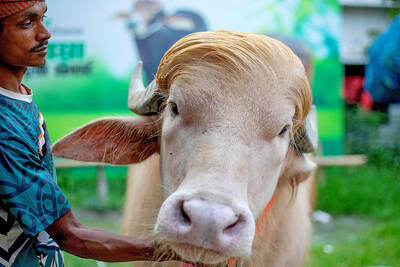
Crowds in Bangladesh are flocking to snap photographs with an unlikely social media star — an albino buffalo with flowing blond hair nicknamed “Donald Trump” that is due to be sacrificed within days. Owner Zia Uddin Mridha, 38, said his brother named the 700kg bull over its flowing helmet of hair resembling the signature look of the US president. “My younger brother picked this name because of the buffalo’s extraordinary hair,” he said at his farm in Narayanganj, just outside the capital, Dhaka. Mridha said that a constant stream of curious visitors — social media fans, onlookers and children — have come throughout

It began as a satirical online project. Now millions of young people in India are flocking to it as an outlet for their frustration. A parody political party called the Cockroach Janta Party, with the insect as its symbol, has exploded across India’s social media by turning absurdist humor into protest. Memes and short videos mocking corruption, joblessness and political dysfunction have flooded social media sites, where millions of users are embracing the cockroach — known for its ability to survive harsh conditions — as a tongue-in-cheek symbol of endurance. The online movement’s rise has been unusually rapid. The Cockroach Janta Party (CJP)
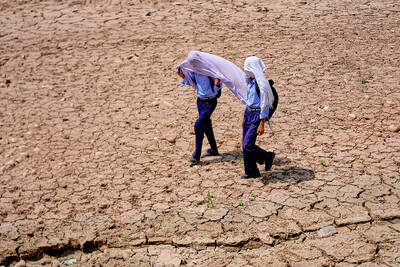
HOTTER: While Indians are accustomed to summer heat, climate change has caused northwestern India to warm faster than other parts of the country, an academic said Roads and markets have emptied during afternoons and some farmers have switched to nighttime work to avoid scorching temperatures as a heat wave grips large parts of India. The India Meteorological Department forecast maximum temperatures for yesterday of about 45°C in the capital, New Delhi, where authorities have opened temporary “cooling zones” to help people cope. The weather department warned that conditions would likely persist across several northern regions in the coming days, with temperatures staying well above seasonal averages. Authorities urged people to stay indoors during the hottest hours and take precautions against heat-related illnesses. India declares a heat wave whenever maximum temperatures
BIGGER ROLE: Beijing has said it maintains an impartial stance on the war in Ukraine, but by training Russian troops, China is far more involved than previously known China’s armed forces secretly trained about 200 Russian military personnel in China late last year, and some have since returned to fight in Ukraine, according to three European intelligence agencies and documents seen by Reuters. While China and Russia have held a number of joint military exercises since Moscow’s full-scale invasion of Ukraine in 2022, Beijing has repeatedly said that it is neutral in the conflict and presents itself as a peace mediator. The covert training sessions, which predominantly focused on the use of drones, were outlined in a dual-language Russian-Chinese agreement signed by senior Russian and Chinese officers in Beijing on


 RSS
RSS