


Chinese President Hu Jintao (胡錦濤) and Japanese Prime Minister Junichiro Koizumi both congratulated US President George W. Bush yesterday on his re-election and said they were looking forward to better relations with Washington.
"Both China and the United States are great countries and share a wide range of common interests and basis for cooperation," Hu was quoted as saying by the official Xinhua News Agency.
"I look forward to continuing to work together with you to further promote the development of the constructive cooperative relations between China and the United States" to benefit the people of the two countries and rest of the world, Hu said.
China and the US have made "significant progress in cooperation in various fields, bringing substantial benefits to both countries and playing a positive role in promoting peace and development in Asia Pacific and rest of the world," Hu was cited as saying by Xinhua.
Xinhua said Chinese Vice President Zeng Qinghong (
In Tokyo, Koizumi said he wants to build even closer ties with Washington in what he called Japan's "most important" diplomatic relationship.
Koizumi has staked his political future on strong support for Bush and the US-led invasion of Iraq.
"The president's re-election means that the American people trust his leadership," Koizumi said in a statement.
Koizumi said he hoped to strengthen ties with Bush.
"Building on the ties of trust and friendship, I want to promote stronger Japan-US relations," he said. "Japan's most important diplomatic relations are with the United States."
Earlier this year, Koizumi res-ponded to Washington's appeal for help in Iraq by deploying some 550 troops to Samawah on a humanitarian mission, despite public opposition at home.
Tokyo hasn't said whether the Japanese forces will stay in Iraq beyond the middle of next month. Without a formal extension, the aid mission would end.
But Bush's re-election alleviates pressure for Koizumi to consider pulling troops out of Iraq following the killing of a Japanese hostage by militants who had demanded that Japanese forces withdraw.
Japanese media called the results a plus for the two countries' warm trade relations.
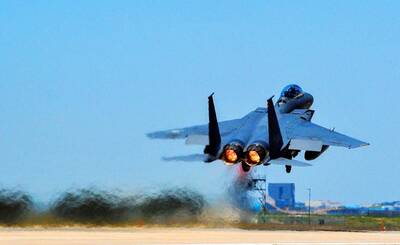
South Korea’s air force yesterday apologized for a 2021 midair collision involving two fighter jets, a day after auditors said the pilots were taking selfies and filming during the flight and held them responsible for the accident. “We sincerely apologize to the public for the concern caused by the accident that occurred in 2021,” an air force spokesman told a news conference, adding that one of the pilots involved had been suspended from flying duties, received severe disciplinary action and has since left the military. The apology followed a report released on Wednesday by the South Korean Board of Audit and Inspection,

Indonesian police have arrested 13 people after shocking images of alleged abuse against small children at a daycare center went viral, sparking outrage across the nation, officials said on Monday. Police on Friday last week raided Little Aresha, a daycare center in Yogyakarta on Java island, following a report from a former employee. CCTV footage circulating on social media showed children, most younger than two, lying on the floor wearing only diapers, their hands and feet bound with rags. The police have confirmed that the footage is authentic. Police said they also found 20 children crammed into a room just 3m by 3m. “So

About 240 Indians claiming descent from a Biblical tribe landed at Tel Aviv airport on Thursday as part of a government operation to relocate them to Israel. The newcomers passed under a balloon arch in blue and white, the colors of the Israeli flag, as dozens of well-wishers welcomed them with a traditional Jewish song. They were the first “bnei Menashe” (“sons of Manasseh”) to arrive in Israel since the government in November last year announced funding for the immigration of about 6,000 members of the community from the states of Manipur and Mizoram in northeast India. The community claims to descend from

‘TROUBLING’: The firing of Phelan, who was an adviser to a nonprofit that supported the defense of Taiwan, was another example of ‘dysfunction’ under Trump, a US senator said US Secretary of the Navy John Phelan has been fired, a US official and a person familiar with the matter said on Wednesday, in another wartime shakeup at the Pentagon coming just weeks after US Secretary of Defense Pete Hegseth ousted the Army’s top general. The Pentagon announced his departure in a brief statement, saying he was leaving the administration “effective immediately,” but it did not provide a reason or say whether it was his decision to go. The sources, who spoke on condition of anonymity, said Phelan was dismissed in part because he was moving too slowly to implement reforms to


 RSS
RSS