


Barack Hussein Obama grew up on the beaches of Hawaii and the streets of Indonesia. He was raised by his white mother and barely knew his African father. He experimented with drugs and seemed headed nowhere, yet ended up excelling at elite universities.
His life, in short, has been far different from that of the average American voter.
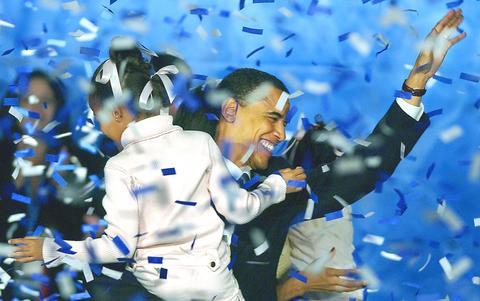
PHOTO: AP
But Obama had the political skills and charisma to turn those differences into an advantage in his US Senate race, which saw him handily defeating Republican Alan Keyes on Tuesday to become only the fifth black senator in US history.
He portrayed himself as a one-man American melting pot, straddling racial and cultural boundaries.
"We stand here as one people, as one nation proclaiming ourselves to be one America with the capacity to work together to create a better future for each other," Obama said in his victory speech.
Obama's father was a Kenyan student, also named Barack, who studied for several years in the US. His mother was a white Kansan who moved to Hawaii, where the couple met. The marriage didn't last long: They divorced while Obama was an infant, and he saw his father only once after that.
Obama, 43, lived in Indonesia for four years as a boy when his mother married again. His time there included schooling in the Bible and the Koran, sampling local dishes such as dog and snake, and wandering with other children, often encountering stark poverty and illness.
Today, he says that helped him understand the struggles facing so many around the world -- "the literal desperation of making sure you have enough to eat."
When he was about 10, Obama returned to his grandparents in Hawaii to attend a private school. Eventually, his mother divorced and left Indonesia to rejoin her son.
During his teenage years, Obama seemed headed straight for trouble.
His 1995 memoir, Dreams From My Father: A Story of Race and Inheritance, describes a period when he focused more on basketball than school. He drank, smoked pot, even experimented with cocaine.
"Junkie. Pothead. That's where I'd been headed," he wrote.
But Obama cleaned up his act, thanks to some concerned adults and the passage of time. "I think I just grew up," he said.
After his father died in a car accident, "Barry" Obama began using Barack. He became a community organizer, working with Chicago churches to help laid-off workers and remove asbestos from public housing.
"He just went from church to church, beating the pavement, trying to get every pastor in the community," recalled the Reverend Alvin Love of Lilydale First Baptist Church. "This skinny, scrawny guy trying to find out how we can make the community better."
Obama then decided to go to Harvard Law School, where he was elected the first black president of the Harvard Law Review. The position traditionally opens the door to clerking at the US Supreme Court and then a lucrative job, but Obama went to work for a small Chicago firm specializing in civil rights.
His first political campaign produced hard feelings.
He was recruited to replace a state senator who was running for Congress. But when the incumbent lost her congressional race, she decided to run for her old legislative seat and wanted Obama to step aside. Obama refused, and the well-regarded incumbent bowed out.
Four years later, he challenged US Representative Bobby Rush, but lost badly in the Democratic primary.
The incidents hint at a competitive nature that's usually cam-ouflaged by Obama's affability and intellect. "I have sharp elbows," he admitted, using a favor basketball metaphor.
Obama's success doesn't surprise Christine Spurell, who worked with him at the Harvard Law Review.
Even then, Spurell said, he was a "consummate politician" who could create a sense of intimacy in conversations even if he disagreed with someone.
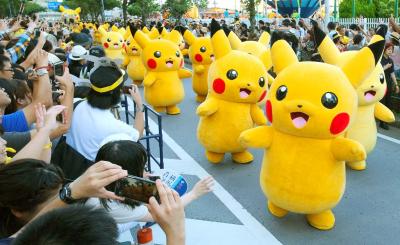
China’s military news agency yesterday warned that Japanese militarism is infiltrating society through series such as Pokemon and Detective Conan, after recent controversies involving events at sensitive sites. In recent days, anime conventions throughout China have reportedly banned participants from dressing as characters from Pokemon or Detective Conan and prohibited sales of related products. China Military Online yesterday posted an article titled “Their schemes — beware the infiltration of Japanese militarism in culture and sports.” The article referenced recent controversies around the popular anime series Pokemon, Detective Conan and My Hero Academia, saying that “the evil influence of Japanese militarism lives on in
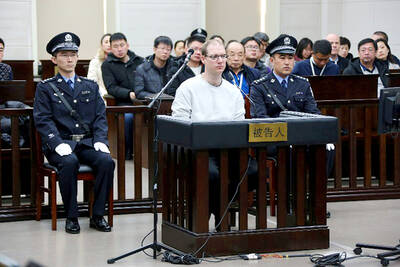
DIPLOMATIC THAW: The Canadian prime minister’s China visit and improved Beijing-Ottawa ties raised lawyer Zhang Dongshuo’s hopes for a positive outcome in the retrial China has overturned the death sentence of Canadian Robert Schellenberg, a Canadian official said on Friday, in a possible sign of a diplomatic thaw as Canadian Prime Minister Mark Carney seeks to boost trade ties with Beijing. Schellenberg’s lawyer, Zhang Dongshuo (張東碩), yesterday confirmed China’s Supreme People’s Court struck down the sentence. Schellenberg was detained on drug charges in 2014 before China-Canada ties nosedived following the 2018 arrest in Vancouver of Huawei chief financial officer Meng Wanzhou (孟晚舟). That arrest infuriated Beijing, which detained two Canadians — Michael Spavor and Michael Kovrig — on espionage charges that Ottawa condemned as retaliatory. In January
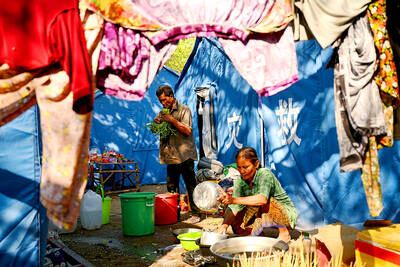
A sign hanging from a rusty ice-green shipping container installed by Thai forces on what they say is the border with Cambodia reads: “Cambodian citizens are strictly prohibited from entering this area.” On opposite sides of the makeshift barricade, fronted by coils of barbed wire, Cambodians lamented their lost homes and livelihoods as Thailand’s military showed off its gains. Thai forces took control of several patches of disputed land along the border during fighting last year, which could amount to several square kilometers in total. Cambodian Kim Ren said her house in Chouk Chey used to stand on what is now the Thai
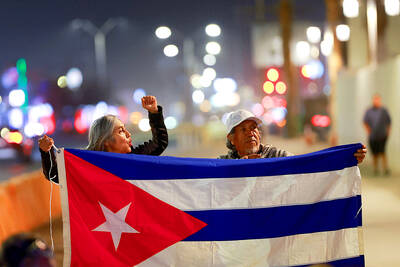
NEW RULES: There would be fewer school days, four-day workweeks, and a reduction in transportation services as the country battles a crisis exacerbated by US pressure The Cuban government on Friday announced emergency measures to address a crippling energy crisis worsened by US sanctions, including the adoption of a four-day work week for state-owned companies and fuel sale restrictions. Cuban Deputy Prime Minister Oscar Perez-Oliva Fraga blamed Washington for the crisis, telling Cuban television the government would “implement a series of decisions, first and foremost to guarantee the vitality of our country and essential services, without giving up on development.” “Fuel will be used to protect essential services for the population and indispensable economic activities,” he said. Among the new measures are the reduction of the working week in


 RSS
RSS