


The ruins of Genghis Khan's palace have been excavated in eastern Mongolia, a Japanese archaeologist said yesterday, estimating the conqueror's grave is near the site.
A joint Japanese and Mongolian research team has unearthed some 600,000m2 of the remains of the palace complex some 250km south-east of Ulan Bator.
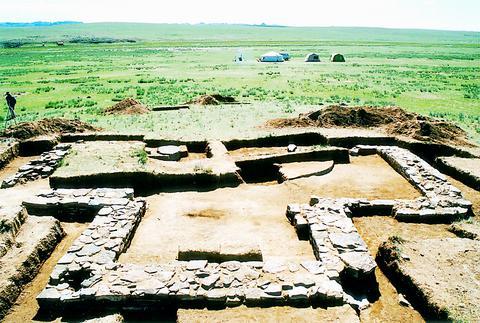
PHOTO: AP/THE JAPAN-MONGOLIA JOINT RESEARCH TEAM, HO
Cornerstones and holes for pillars were found in what is thought to be a mausoleum near the centre of the remains believed built in the 13th century, when the savage warrior unified local tribes and founded the Mongol Empire.
Other unearthed articles include earrings and bronze accessories as well as incense burners with dragon designs often considered the symbol of an emperor.
The research team, which began their project in 2001, has also found the ashes and bones of horses and cows believed to have been used for a memorial service for the Mongol leader.
"We concluded it was his mausoleum because historical documents are saying such a memorial service was held to mark his death," said Noriyuki Shiraishi, assistant professor at Niigata University and head of the Japanese side of the 30-member team.
"According to various documents related to Genghis Khan, his grave is supposed to be located within a radius of 12 kilometers from the mausoleum," he said.
"We believe that with this finding, we have taken a step closer to locating his grave," he added.
The burial site of Genghis Khan remains unknown. He was believed to have been buried in an unmarked spot in the Mongolian Plateau.
While the team will continue their dig in the second phase of the project that will end in 2007, it will wait for permission from the Mongolian government to expand the project to find the grave.
Most historians agree that Genghis Khan died in 1227 while fighting in the region of Xixia, on the edge of the autonomous Chinese regions of Ningxia and Inner Mongolia.
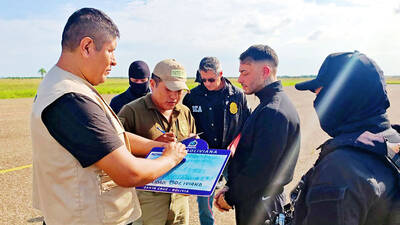
KINGPIN: Marset allegedly laundered the proceeds of his drug enterprise by purchasing and sponsoring professional soccer teams and even put himself in the starting lineups Notorious Latin American narco trafficker Sebastian Marset, who eluded police for years, was handed over to US authorities after his arrest on Friday in Bolivia. Marset, a Uruguayan national who was on the US most-wanted list, was passed to agents of the US Drug Enforcement Administration at Santa Cruz airport in Bolivia, then put on a US airplane, Bolivian state television showed. “The arrest and deportation were carried out pursuant to a court order issued by the US justice system,” Bolivian Minister of Government Marco Antonio Oviedo told reporters. The alleged kingpin was arrested in an upscale neighborhood of Santa
ACTIONABLE ADVICE: The majority of chatbots tested provided guidance on weapons, tactics and target selections, with Perplexity and Meta AI deemed to be the least safe From school shootings to synagogue bombings, leading artificial intelligence (AI) chatbots helped researchers plot violent attacks, according to a study published on Wednesday that highlighted the technology’s potential for real-world harm. Researchers from the nonprofit watchdog Center for Countering Digital Hate and CNN posed as 13-year-old boys in the US and Ireland to test 10 chatbots, including ChatGPT, Google Gemini, Perplexity, Deepseek and Meta AI. Eight of the chatbots assisted the make-believe attackers in more than half the responses, providing advice on “locations to target” and “weapons to use” in an attack, the study said. The chatbots had become a “powerful accelerant for
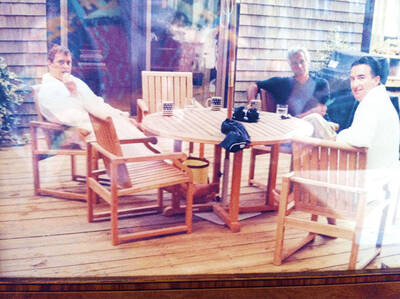
SCANDAL: Other images discovered earlier show Andrew bent over a female and lying across the laps of a number of women, while Mandelson is pictured in his underpants A photograph of former British prince Andrew and veteran politician Peter Mandelson sitting in bathrobes alongside late sex offender Jeffrey Epstein was unearthed on Friday in previously published documents. The image is believed to be the first known photograph of the two men with Epstein. They are currently engulfed in scandal in the UK over their ties to their mutual friend. The undated photograph, first reported by ITV News, shows King Charles III’s disgraced brother and former British ambassador to the US sitting barefoot outside on a wooden deck. They appear to have mugs with a US flag on them
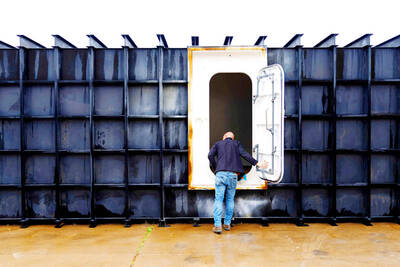
Since the war in the Middle East began nearly two weeks ago, the telephone at Ron Hubbard’s bomb shelter company in Texas has not stopped ringing. Foreign and US clients are rushing to buy his bunkers, seeking refuge in case of air raids, nuclear fallout or apocalypse. With the US and Israel pounding Iran, and Tehran retaliating with strikes across the region, Hubbard has seen demand for his product soar, mostly from Gulf nation customers in Bahrain, Qatar, Kuwait and the United Arab Emirates. “You can imagine how many people are thinking: ‘I wish I had a bomb shelter,’” Hubbard, 63, said in


 RSS
RSS