


Rebels in the Niger Delta, where unrest sent world oil prices soaring this week, promised on Friday to stop fighting government forces and hand in their weapons, the Nigerian president's office said.
"The groups affirm commitment to the peace offer by the president, promise to cease all hostilities against themselves and all economic and social interests of the Nigerian state," it said in a statement.
The rebels threatened earlier this week to go to war if their demands for a bigger slice of Nigeria's oil wealth, greater autonomy for the Ijaw people and a national debate on Nigeria's problems were not met.
Mujahid Dokubo Asari, leader of the People's Volunteer Force, began talks on Wednesday with officials from President Olusegun Obasanjo's government ahead of an Oct. 1 deadline set by his group for oil multinationals and foreigners to quit the Niger Delta.
Asari and Ateke Tom, leader of the rival Niger Delta Vigilante group, signed a ceasefire pact in which they promised "the disbandment of all militias and militant groups as well as total disarmament," according to the president's statement.
"It is a victory for my people," Asari said. "It is the first time that the president and the government of Nigeria recognized that nationalities in Nigeria have the right to ask for resources control and self-determination. It is a giant step forward."
He said after a seven-hour meeting on Friday that the agreement would take effect immediately.
"When there is a dialogue process, the most important thing is that your grievances are addressed and that we discussed it. You cannot get everything on the same day," he said, referring to the Oct. 1 deadline set by his group for oil multinationals and foreigners to leave the Niger Delta.
Fighting between the army and militias in the Niger Delta, which has lasted more than a year, had intensified in recent months. Violence escalated in August, when the army launched attacks on rebel camps.
Some 500 people have died in unrest in recent weeks, according to Amnesty International, but the government said only 13 were killed.
The unrest helped send oil prices on an upward spiral which saw them burst through the US$50-a-barrel barrier on Tuesday, but drop back when the peace talks began. They closed above US$50 a barrel for the first time in New York trading on Friday, as traders fretted about Nigerian oil production amid the threatened rebel uprising.
"It is a welcome development. The peace deal is a follow-up to a previous initiative of the Rivers State government asking armed gangs to stop killing themselves and confronting the federal government," Rivers State spokesman Emmanuel Okah said.
"The government is prepared to integrate them (Asari and Tom) into the larger society, but they have to faithfully implement the agreement by disarming and disbanding their groups. They have to also surrender their weapons," he said.
The government would grant the rebels "amnesty from prosecution" if they did not back down on the agreement, Okah said. Previous ceasefire pacts had been violated.
The Rivers State parliament recently passed a law ordering 10 years in prison for anyone found guilty of armed violence.
The Niger Delta accounts for the bulk of Nigeria's crude output of 2.3 million barrels per day. Nigeria, Africa's largest oil exporter and the world's seventh largest, derives more than 95 percent of its foreign exchange earnings from oil.
Most residents of the Niger Delta live in abject poverty and have benefitted little from the oil reserves in the region of creeks and mangrove swamps.
Officials say Nigeria has earned over US$360 billion since oil was discovered there by Anglo-Dutch giant Shell in 1957. But today the country's external debts stand at a staggering US$32 billion.
Despite the billions earned from oil, Nigeria, which on Friday celebrated the 44th anniversary of its independence from Britain, is listed among the world's 25 poorest countries and placed 146th out of 162 on the United Nations Development Program index of social indicators. On the World Health Organization index, the west African country occupies 186th position out of 192 member countries for the state of its health infrastructure.
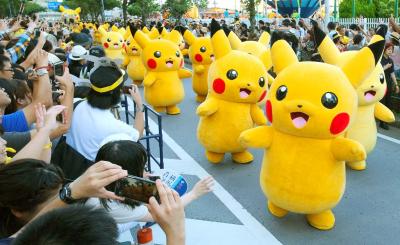
China’s military news agency yesterday warned that Japanese militarism is infiltrating society through series such as Pokemon and Detective Conan, after recent controversies involving events at sensitive sites. In recent days, anime conventions throughout China have reportedly banned participants from dressing as characters from Pokemon or Detective Conan and prohibited sales of related products. China Military Online yesterday posted an article titled “Their schemes — beware the infiltration of Japanese militarism in culture and sports.” The article referenced recent controversies around the popular anime series Pokemon, Detective Conan and My Hero Academia, saying that “the evil influence of Japanese militarism lives on in

DIPLOMATIC THAW: The Canadian prime minister’s China visit and improved Beijing-Ottawa ties raised lawyer Zhang Dongshuo’s hopes for a positive outcome in the retrial China has overturned the death sentence of Canadian Robert Schellenberg, a Canadian official said on Friday, in a possible sign of a diplomatic thaw as Canadian Prime Minister Mark Carney seeks to boost trade ties with Beijing. Schellenberg’s lawyer, Zhang Dongshuo (張東碩), yesterday confirmed China’s Supreme People’s Court struck down the sentence. Schellenberg was detained on drug charges in 2014 before China-Canada ties nosedived following the 2018 arrest in Vancouver of Huawei chief financial officer Meng Wanzhou (孟晚舟). That arrest infuriated Beijing, which detained two Canadians — Michael Spavor and Michael Kovrig — on espionage charges that Ottawa condemned as retaliatory. In January
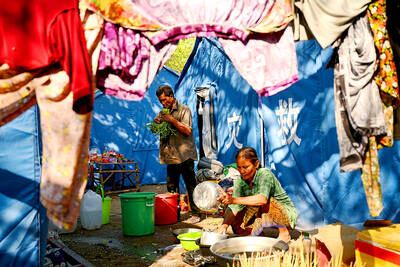
A sign hanging from a rusty ice-green shipping container installed by Thai forces on what they say is the border with Cambodia reads: “Cambodian citizens are strictly prohibited from entering this area.” On opposite sides of the makeshift barricade, fronted by coils of barbed wire, Cambodians lamented their lost homes and livelihoods as Thailand’s military showed off its gains. Thai forces took control of several patches of disputed land along the border during fighting last year, which could amount to several square kilometers in total. Cambodian Kim Ren said her house in Chouk Chey used to stand on what is now the Thai
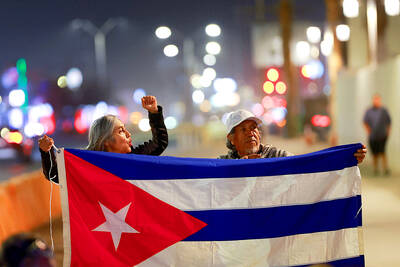
NEW RULES: There would be fewer school days, four-day workweeks, and a reduction in transportation services as the country battles a crisis exacerbated by US pressure The Cuban government on Friday announced emergency measures to address a crippling energy crisis worsened by US sanctions, including the adoption of a four-day work week for state-owned companies and fuel sale restrictions. Cuban Deputy Prime Minister Oscar Perez-Oliva Fraga blamed Washington for the crisis, telling Cuban television the government would “implement a series of decisions, first and foremost to guarantee the vitality of our country and essential services, without giving up on development.” “Fuel will be used to protect essential services for the population and indispensable economic activities,” he said. Among the new measures are the reduction of the working week in


 RSS
RSS